Freshly Printed - allow 8 days lead
Couldn't load pickup availability
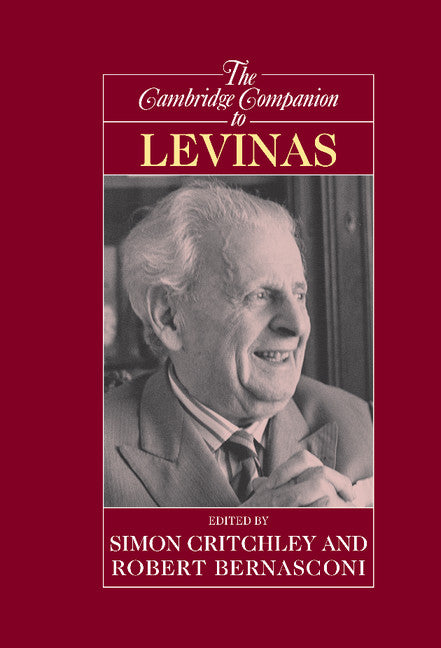
The Cambridge Companion to Levinas
A convenient and accessible guide to Levinas, first published in 2002, which emphasises the interdisciplinary significance of his work.
Simon Critchley (Edited by), Robert Bernasconi (Edited by)
9780521662062, Cambridge University Press
Hardback, published 25 July 2002
324 pages
22.9 x 15.2 x 2.2 cm, 0.65 kg
'Critchley's introduction wil now be the standard introductory essay to Levinas's thought, and is accessible to advanced undergraduates.' Religious Studies Review
Emmanuel Levinas is now widely recognised alongside Heidegger, Merleau-Ponty and Sartre as one of the most important Continental philosophers of the twentieth century. His abiding concern was the primacy of the ethical relation to the other person and his central thesis was that ethics is first philosophy. His work has also had a profound impact on a number of fields outside philosophy such as theology, Jewish studies, literature and cultural theory, psychotherapy, sociology, political theory, international relations theory and critical legal theory. This volume, first published in 2002, contains overviews of Levinas's contribution in a number of fields, and includes detailed discussions of his early and late work, his relation to Judaism and talmudic commentary, and his contributions to aesthetics and the philosophy of religion.
Emmanuel Levinas: a disparate inventory Simon Critchley
1. Introduction Simon Critchley
2. Levinas and Judaism Hilary Putnam
3. Levinas and the face of the other Bernhard Waldenfels
4. Levinas's critique of Husserl Rudolf Bernet
5. Levinas and the Talmud Catherine Chalier
6. Levinas and language John Llewelyn
7. Levinas, feminism and the feminine Stella Sandford
8. Sincerity and the end of theodicy: three remarks on Levinas and Kant Paul Davies
9. Language and alterity in the thought of Levinas Edith Wyschograd
10. The concepts of art and poetry in Emmanuel Levinas's writings Gerald Bruns
11. What is the question to which 'substitution' is the answer? Robert Bernasconi
12. Evil and the temptation of theodicy Richard J. Bernstein.
Subject Areas: Judaism [HRJ], History of religion [HRAX], Religion: general [HRA], Phenomenology & Existentialism [HPCF3], Anthologies [non-poetry DQ]