Freshly Printed - allow 4 days lead
Couldn't load pickup availability
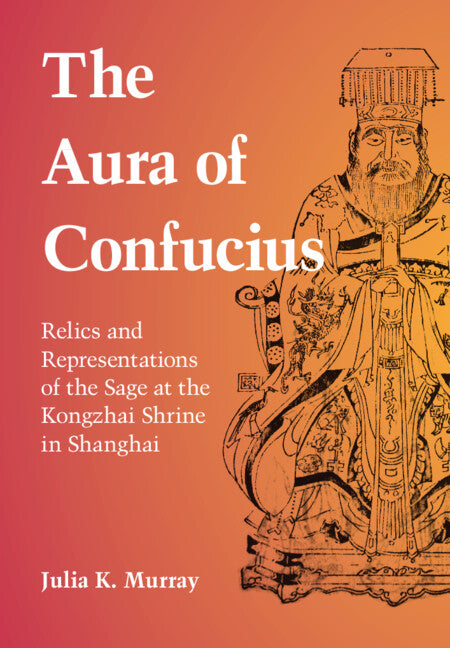
The Aura of Confucius
Relics and Representations of the Sage at the Kongzhai Shrine in Shanghai
This groundbreaking study highlights the importance of images within Confucianism and to a shrine-tomb for Confucius's buried robe and cap.
Julia K. Murray (Author)
9781316516324, Cambridge University Press
Hardback, published 25 November 2021
356 pages
26 x 18.5 x 2 cm, 0.91 kg
'… through scrupulous attention to detail, Murray addresses issues that should be of interest to us all, including the old question of whether Confucianism should be considered a religion or a philosophy; how social, cultural, and material resources can be manipulated to produce something so compelling as Kongzhai; and how easily the numinous site can fade away when those resources disappear.' James Flath, Journal Of Religious History
The Aura of Confucius is a ground-breaking study that reconstructs the remarkable history of Kongzhai, a shrine founded on the belief that Confucius' descendants buried the sage's robe and cap a millennium after his death and far from his home in Qufu, Shandong. Improbably located on the outskirts of modern Shanghai, Kongzhai featured architecture, visual images, and physical artifacts that created a 'Little Queli,' a surrogate for the temple, cemetery, and Kong descendants' mansion in Qufu. Centered on the Tomb of the Robe and Cap, with a Sage Hall noteworthy for displaying sculptural icons and not just inscribed tablets, Kongzhai attracted scholarly pilgrims who came to experience Confucius's beneficent aura. Although Kongzhai gained recognition from the Kangxi emperor, its fortunes declined with modernization, and it was finally destroyed during the Cultural Revolution. Unlike other sites, Kongzhai has not been rebuilt and its history is officially forgotten, despite the Confucian revival in contemporary China.
Introduction: Veneration of Confucius and Local Prestige
Part I. Confucius in Qufu and Kongzhai: 1. Confucius and His Cults
2. Proposing a History of Kongzhai
3. Visual Representations of Confucius at Kongzhai
Part II. The Rhetorical Construction of Kongzhai: 4. Early Formulations of Kongzhai's History
5. The Emergence and Impact of the Gazetteer of Kongzhai
6. Kongzhai in 19th- and 20th- Century Local Gazetteers and Poetry Collections
7. The Physical Layout of Kongzhai and its Visual Depictions
8. Conclusion.
Subject Areas: Buddhism [HRE], Religion & beliefs [HR], Asian history [HBJF], Regional & national history [HBJ], Humanities [H], Oriental art [ACBP], History of art / art & design styles [AC], The arts [A]