Freshly Printed - allow 10 days lead
Couldn't load pickup availability
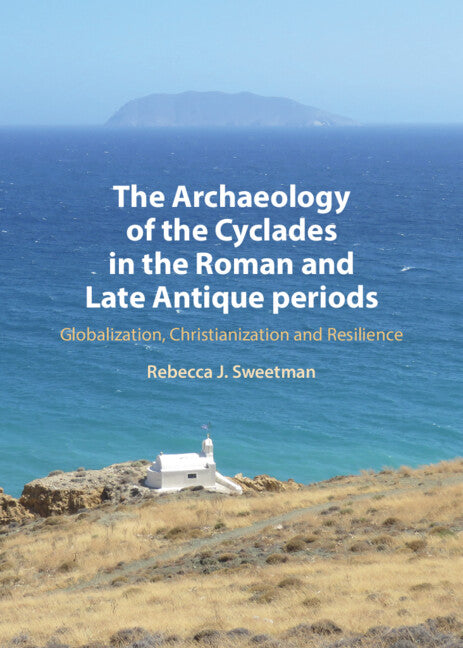
The Archaeology of the Cyclades in the Roman and Late Antique Periods
Globalization, Christianization and Resilience
Through the analysis of material culture, this book offers a fresh interpretation of Cycladic societies.
Rebecca Sweetman (Author)
9781009563475, Cambridge University Press
Hardback, published 6 November 2025
292 pages
25.4 x 17.8 x 1.8 cm, 0.756 kg
The Cycladic islands have traditionally been considered as backwaters during the Roman and Late Antique periods. Through analysis of the material culture produced from the late first century BCE through to the seventh century CE, however, Rebecca Sweetman offers a fresh interpretation of Cycladic societies across this diachronic period. She demonstrates that the Cyclades remained vibrant, and that the islands embraced the potential of being part of wider political, economic and religious networks that were enabled as part of the Roman Empire. Sweetman also argues that the Cyclades were at the forefront of key social developments, notably, female social and physical mobility, as well as in the islands' early adoption of Christianity. Drawing on concepts related to Globalization, Christianization, and Resilience, Sweetman's analysis highlights the complex relationships between the islands and their Imperial contexts over time. The gazetteer of archaeological sites will be fundamental for all working on archaeology of the Roman and Late Antique periods as well as those interested in the Mediterranean.
1. Cyclades: islands, scholarship and methodology
2. Cyclades: life, death and settlement patterns
3. Cyclades economy
4. Sanctuaries and churches
5. Island populations and visitors
6. Conclusion: connectivity and resilience
Appendix 1. Gazetteer of Roman and late antique sites on the Cyclades
Appendix 2. Mosaics
Bibliography.
Subject Areas: Classical Greek & Roman archaeology [HDDK]