In Stock - dispatch within 48 hours
Couldn't load pickup availability
The Archaeology of Power and Politics in Eurasia
Regimes and Revolutions
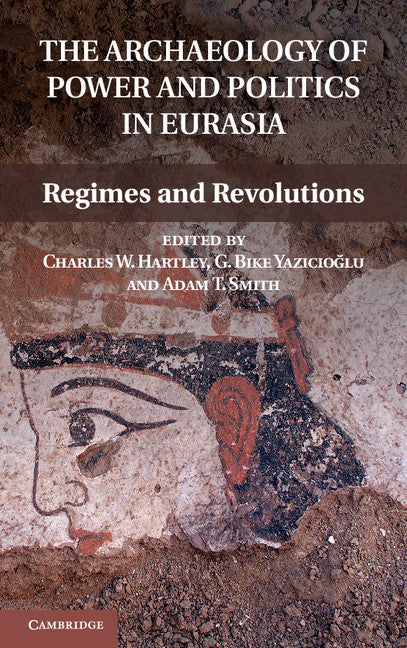
This book brings together archaeological investigations of Eurasian regimes and revolutions ranging from the Bronze Age to the modern day.
Charles W. Hartley (Edited by), G. Bike Yazicio?lu (Edited by), Adam T. Smith (Edited by)
9781107016521, Cambridge University Press
Hardback, published 19 November 2012
486 pages, 65 b/w illus. 7 maps 11 tables
23.5 x 15.8 x 3 cm, 0.74 kg
For thousands of years, the geography of Eurasia has facilitated travel, conquest and colonization by various groups, from the Huns in ancient times to the Union of Soviet Socialist Republics in the past century. This book brings together archaeological investigations of Eurasian regimes and revolutions ranging from the Bronze Age to the modern day, from Eastern Europe and the Caucasus in the west to the Mongolian steppe and the Korean Peninsula in the east. The authors examine a wide-ranging series of archaeological studies in order to better understand the role of politics in the history and prehistory of the region. This book re-evaluates the significance of power, authority and ideology in the emergence and transformation of ancient and modern societies in this vast continent.
Introduction: regimes, revolutions, and the materiality of power in Eurasian archaeology Charles W. Hartley, G. Bike Yaz?c?o?lu and Adam T. Smith
Part I. The Rhetoric of Regime and Ideology of Revolution: 1. Archaeology and the national idea in Eurasia Victor A. Shnirelman
2. National history and identity narratives in China and cultural heritage interpretation in Xinjiang Gwen P. Bennett
3. 'Yerevan, my ancient Erebuni': archaeological repertoires, public assemblages, and the manufacture of a (post-)Soviet nation Adam T. Smith
4. Violence and power visualized: representations of military engagements between Central Asia and the Achaemenid Persian Empire Wu Xin
5. Public vs. private: perspectives on the communication of power in ancient Chroasmia Fiona Kidd, Michelle Negus Cleary and Elizabeth Baker Brite
6. Lines of power: equality or hierarchy among the Iron Age agro-pastoralists of southeastern Kazakhstan Claudia Chang
Part II. Materialities of Homeland, Practices of Expansion: 7. Homelands in the present and in the past: political implications of a dangerous concept Philip Kohl
8. Processes and practices of death: toward a bioarchaeology of dynamic societies Maureen Marshall
9. Ritualization of weapons in a contact zone: between the past and the present Kathryn M. Linduff and Yang Jianhua
10. Ethos, materiality, and paradigms of political action in early medieval communities of the northwestern Caspian region Irina Lita Shingiray
11. Legitimacy and control: the making of the imperial Liao heartland Hu Ling
12. A bioarchaeological study of Xiongnu expansion in Iron Age Tuva, South Siberia Eileen M. Murphy
Part III. Regimes of the Body, Revolutions of Value: 13. Kazakhstan, post-socialist transition, and the problem of multiple materialities Victor Buchli
14. Forging social networks: metallurgy and the politics of value in Bronze Age Eurasia David L. Peterson
15. Where pottery and politics meet: mundane objects and complex political life in the Late Bronze Age South Caucasus Alan Greene
16. Forming techniques and Kura-Araxes period pottery in the Eastern Caucasus MaryFran Heinsch
17. Beastly goods: pastoral production in the Late Bronze Age Tsaghkahovit Plain Belinda H. Monahan
18. From regimes to revolutions: technology and technique at the Bronze Age tell at Százhalombatta, Hungary Joanna Sofaer
Conclusion: on archaeology and politics across Eurasia Geoff Emberling.
Subject Areas: Comparative politics [JPB], Prehistoric archaeology [HDDA], General & world history [HBG]