Freshly Printed - allow 7 days lead
Couldn't load pickup availability
The Analysis of Means – A Graphical Method for Comparing Means, Rates, and Proportions
A Graphical Method for Comparing Means, Rates, and Proportions
First comprehensive modern treatment of ANOM will be welcomed by practitioners and statisticians as a primer and reference.
Peter R. Nelson (Author), Peter S. Wludyka (Author), Karen A.f. Copeland (Author)
9780898715927
Paperback / softback, published 31 August 2005
260 pages
25.3 x 17.8 x 1.2 cm, 0.464 kg
'This book provides an excellent introduction to ANOM, and it should be part of every statistician's library. It is well written and covers a wide range of methods … In addition to the lucid presentation of the different types of analyses, the authors also provide excellent explanations of statistical concepts, as they are needed.' Gudmund R. Iverson, MAA Reviews
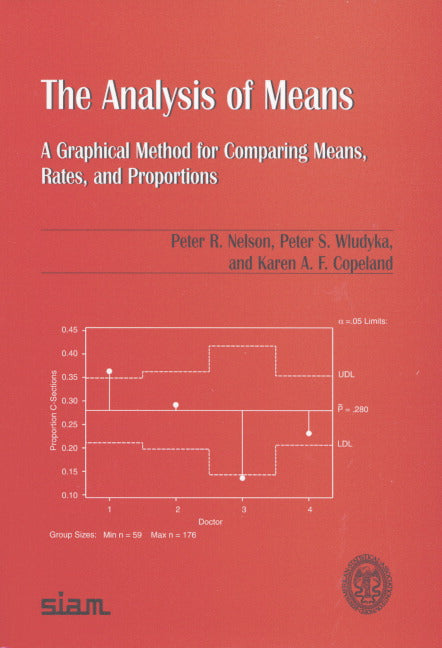
The analysis of means (ANOM) is a graphical procedure used to quantify differences among treatment groups in a variety of experimental design and observational study situations. Key advances in ANOM procedures that have appeared only in technical journals during the last 20 years are included in this first comprehensive modern treatment of the ANOM containing all of the needed information for practitioners to understand and apply ANOM. This book contains examples from a wide variety of fields adapted from real-world applications and data with easy-to-follow, step-by-step instructions. It is front loaded, so potential ANOM users can find solutions to standard problems in the first five chapters. An appendix contains several SAS® examples showing the system's ANOM capabilities and how SAS was used to produce selected ANOM decision charts in the book. It will be welcomed by practitioners and statisticians, for whom it will serve both as a primer and reference.
Preface
Introduction
1. One-Factor Balanced Studies
2. One-Factor Unbalanced Studies
3. Testing for Equal Variances
4. Complete Multi-Factor Studies
5. Incomplete Multi-Factor Studies
6. Axial Mixture Designs
7. Heteroscedastic Data
8. Distribution-Free Techniques
Appendix A: Figures
Appendix B: Tables
Appendix C: SAS Examples
References
Index.
Subject Areas: Miscellaneous items [WZ]