Freshly Printed - allow 10 days lead
Couldn't load pickup availability
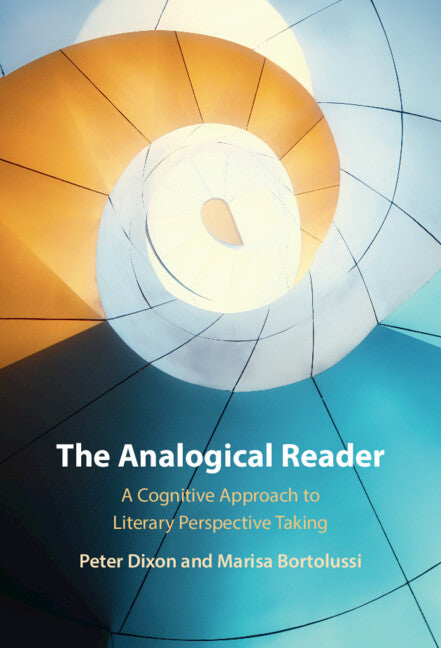
The Analogical Reader
A Cognitive Approach to Literary Perspective Taking
Uses the concept of analogy to analyze how perspective taking functions in real life and in narrative.
Peter Dixon (Author), Marisa Bortolussi (Author)
9781009344180, Cambridge University Press
Hardback, published 23 November 2023
268 pages
23.5 x 15.5 x 1.8 cm, 0.56 kg
'An incredibly thoughtful treatise by the leading experts on the cognition of reading. This book presents a balanced and wide-ranging review of relevant research underpinned by concrete and accessible examples, in combination with entirely new data to substantiate their well-considered arguments. Mandatory reading for literary scholars, avid readers, and cognitive scientists alike!' Raymond Mar, York University, Canada
Perspective taking is a critical component of approaches to literature and narrative, but there is no coherent, broadly applicable, and process-based account of what it is and how it occurs. This book provides a multidisciplinary coverage of the topic, weaving together key insights from different disciplines into a comprehensive theory of perspective taking in literature and in life. The essential insight is that taking a perspective requires constructing an analogy between one's own personal knowledge and experience and that of the perspective taking target. This analysis is used to reassess a broad swath of research in mind reading and literary studies. It develops the dynamics of how analogy is used in perspective taking and the challenges that must be overcome under some circumstances. New empirical evidence is provided in support of the theory, and numerous examples from popular and literary fiction are used to illustrate the concepts. This title is part of the Flip it Open programme and may also be available Open Access. Check our website Cambridge Core for details.
1. Introduction
2. An analysis of perspective and perspective taking
3. Perspective taking in life
4. Perspective taking and literature
5. Processing components of perspective taking
6. Challenges to perspective taking
7. Evidence for analogy in perspective taking
8. Conclusions.
Subject Areas: Cognition & cognitive psychology [JMR]