Freshly Printed - allow 10 days lead
Couldn't load pickup availability
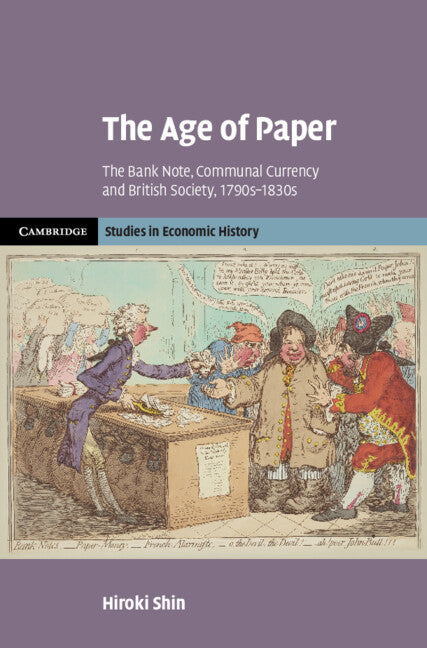
The Age of Paper
The Bank Note, Communal Currency and British Society, 1790s–1830s
The first detailed examination of Britain's transition to paper money, highlighting the social and cultural dimensions of communal currency.
Hiroki Shin (Author)
9781009503273, Cambridge University Press
Hardback, published 2 January 2025
332 pages
23.5 x 16 x 2.2 cm, 0.62 kg
Nuno Palma, University of Manchester
In the first detailed examination of Britain's transition to paper currency, Hiroki Shin explores how state, nation and community each played their respective role in its introduction. By examining archival materials and personal accounts, Shin's work sheds fresh light on societal, institutional, communal and individual responses to the transformation. The dominance of communal currency during the Bank Restriction period (1797–1821) demonstrates how paper currency derived its value from the community of users rather than the state or the intrinsic value of precious metal. Shin traces the expanded use of the Bank of England note – both geographically and socially – in this period, revealing the economic and social factors that accelerated this shift and the cultural manifestations of the paper-based monetary regime, from everyday politics to bank-note forgeries. This book serves as an essential resource for those interested in understanding the modern monetary system's historical origins.
Introduction
1. The beginning of the bank restriction period
2. The users of the Bank of England note
3. The registers of paper-currency use
4. Gold, gold, gold: the legal tender question and the bullionist controversy
5. The forgery crisis and the radicalisation of communal currency
6. Resumption and its aftermath
Conclusion
Bibliography
Index.
Subject Areas: Economic history [KCZ]