Freshly Printed - allow 10 days lead
Couldn't load pickup availability
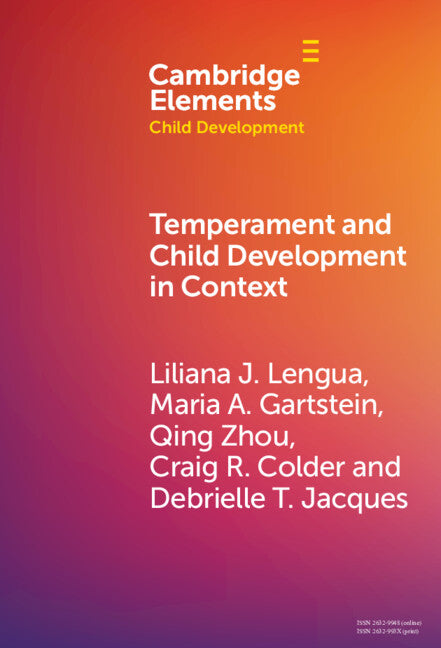
Temperament and Child Development in Context
This Element mentions that temperament alters the direction, exposure, and strength of social and family contexts and relationships.
Liliana J. Lengua (Author), Maria A. Gartstein (Author), Qing Zhou (Author), Craig R. Colder (Author), Debrielle T. Jacques (Author)
9781009521871, Cambridge University Press
Hardback, published 28 November 2024
98 pages
23.5 x 16.1 x 1.2 cm, 0.29 kg
Children's temperament is a central individual characteristic that has significant implications, directly and indirectly, for their social, emotional, behavioral, cognitive, and health outcomes, through its evocative and moderating effects on other social and contextual influences. Accounting for these contextual influences is critical to articulating the role of temperament in children's development. This Element defines temperament and describes its roots in neurobiological systems as well as its relevance to children's developmental outcomes, with a focus on understanding the influence of temperament in children's social and environmental contexts. It covers key developmental periods, situating the contribution of temperament to children's development in complex and changing processes and contexts from infancy through adolescence. The Element concludes by underscoring the value of integrating contextual, relational, and dynamic systems approaches and pointing to future directions in temperament research and application.
1. Introduction
2. Definition and biological basis of temperament
3. Temperament, developmental processes, and outcomes
4. Social, cultural, and contextual influences on temperament development
5. Developmental periods, contexts, and outcomes
6. Contextual, relational, and dynamic systems theories
7. Clinical and translational implications for child temperament
8. Future directions in research and practice
9. Conclusions
References.
Subject Areas: Child & developmental psychology [JMC]