Freshly Printed - allow 7 days lead
Couldn't load pickup availability
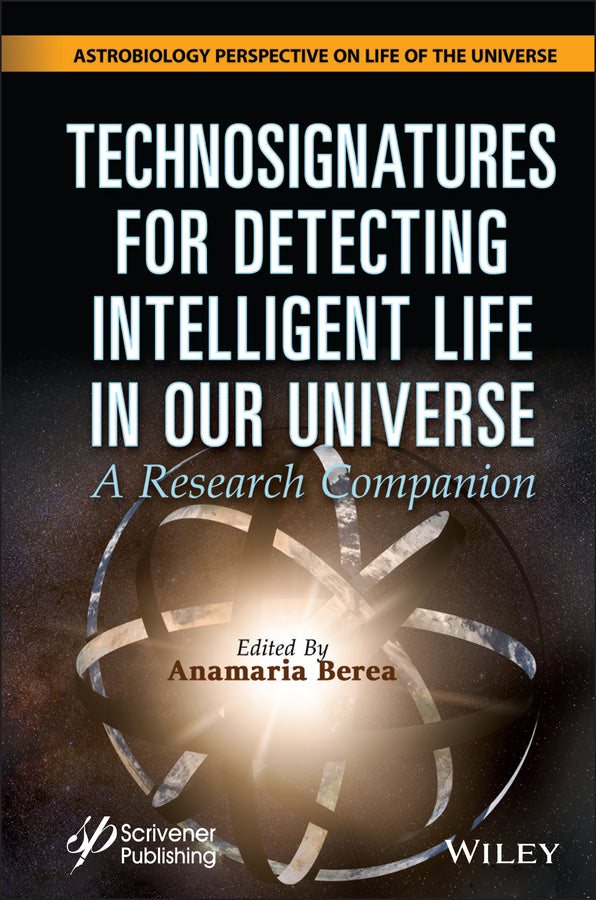
Technosignatures for Detecting Intelligent Life in Our Universe
A Research Companion
Anamaria Berea (Edited by)
9781119640400, Wiley
Hardback, published 28 August 2022
192 pages
1 x 1 x 1 cm, 0.454 kg
TECHNOSIGNATURES FOR DETECTING INTELLIGENT LIFE IN OUR UNIVERSE This book shows the current state of the research in the field of technosignatures, presenting novel ideas from economics, forecasting, and data sciences, making it an ideal research compendium for scientists. The book summarizes the multiple interdisciplinary efforts that have contributed to the field of technosignatures. The technosignatures represent any signals that can be collected from the Universe, such as radio wavelengths, optical signals, and many more, that can be potential candidates as signals emitted intentionally from another part of the Universe that is not Earth. It shows how current advances in science, technology, and social sciences can support this effort and can be used as both a resource for the scientists in the field and as a reference for the public at large interested in the topic. It includes novel research work from economics, forecasting, and data sciences fields, as well as a deeper understanding of the role mass media and popular fiction has played in the evolution of this field. Audience
The book will interest both natural scientists (astronomers and astrophysicists) and social scientists (economists), as well as the new emerging data scientists. Amateur astronomers will be attracted to the book as well.
Preface 1 Historical Perspectives: How the Search for Technosignatures Grew Out of the Cold War 1 1.1 Introduction 1 1.2 The Extraterrestrial Life Debate Gets Technical 3 1.3 Finding the 21-cm Hydrogen Line 7 1.4 The Role of the Space Race in Early CETI 10 1.5 Same Planet, Different Civilizations 13 1.6 Making Intelligent Life in the Universe 19 1.7 Conclusion: Returning to l 23 References 25 2 Reading the Cosmos: What Our Science Tells Us About the Science of Another World 33 2.1 Introduction 33 2.2 The Why and How of Interstellar Communication 34 2.3 An Early Language 36 2.4 A Language Based on Science 36 2.5 Our Senses, Our Perceptions and Our Science 38 2.5.1 Motion 38 2.5.2 Space “in the small” 39 2.5.3 Time 39 2.5.4 Space “in the large” 40 2.5.5 Mathematics 42 2.6 Conclusion 44 References 45 3 The Impact of Discovering the First Technosignature 47 3.1 Introduction 48 3.2 Cultural Impact Based on Analogous Historical Events 48 3.3 Modeling the Impact Based on the Discovery’s Diffusion into Society 49 3.4 Multimodal Diffusion into Knowledge Systems of Complex Publics 52 References 55 4 Searching for Extraterrestrial Intelligence by Locating Potential ET Communication Networks in Space 57 4.1 Introduction 58 4.2 Concepts 60 4.3 Case Study 63 4.4 Conclusions 64 Acknowledgements 65 References 66 5 Habitable Mini-Earths with Black Hole Cores 69 5.1 Introduction 70 5.2 Surface Comfort 71 5.3 Concept and Design 72 5.4 Surface Conditions and Size 72 5.5 Black Hole Core 75 5.6 Mass Boosting and Terraformation 76 5.7 Technosignatures 76 5.8 Conclusion 77 Acknowledgement 78 References 78 6 Technosignatures in Time-Series Photometry 85 6.1 Introduction 85 6.2 Types of Technosignatures 87 6.2.1 Dyson Spheres 87 6.2.2 Transit Beacons 88 6.2.3 Orbital Mirrors 88 6.2.4 Lagrange-Point Starshades 89 6.2.5 Geostationary Artifacts 90 6.2.6 Laser Broadcasting and Planetary Cloaking 93 6.2.7 Non-Keplerian Orbits 93 6.3 Axis of Merit Discussion for These Technosignatures 93 6.4 Methods 97 6.4.1 Detectability of Time-Series Technosignatures 98 References 99 7 Post-Detection Message Analysis and Comprehension 103 7.1 Categorizing an ET Signal 103 7.1.1 Megastructures 103 7.1.2 Beamed Power and Propulsion Signals 104 7.1.3 Intercepted Communication 104 7.1.4 Intentional Communication 104 7.2 The Interstellar Communication Relay 106 7.3 The Processing Pipeline and Participants 106 7.4 Demodulation 107 7.4.1 Pulse Width Modulation 107 7.4.2 Pulse Interval Modulation 107 7.5 Combining Pulse Width and Pulse Interval Modulation 108 7.5.1 Wavelength Multiplexing 108 7.5.2 Information Carrying Capacity 108 7.6 Data Extraction 109 7.6.1 Transcription 109 7.6.2 Structural Analysis 110 7.6.3 Segmentation and Extraction 110 7.6.4 Data Types 110 7.6.5 Communicating Observables vs. Qualia 111 7.6.6 Images 111 7.6.7 Time Domain Signals 112 7.6.8 Algorithms (Computer Programs) 114 7.6.9 Solve For X Patterns 114 7.6.10 Memory 115 7.6.11 Modularity and Reuse 115 7.6.12 Symbolic Communication Systems and Artificial Languages 117 7.6.13 Genomic Information 118 7.6.14 Other Data Types 118 7.7 Classifying ETI Communication 119 7.7.1 Static/One Way Communication 119 7.7.2 Algorithmic Systems 121 7.7.3 Statically Defined Programs 121 7.7.4 Data-Driven Programs 121 7.7.5 Machine Learning/Narrow AI 122 7.7.6 Adaptive/Self-Learning Systems 122 7.8 Risks of Contact 123 7.8.1 Internal (Human Originated) Risks 123 7.8.1.1 Interstate Competition and Interference 123 7.8.2 Misinformation 123 7.8.3 Societal Reaction 123 7.8.4 External Risks 124 7.8.5 Algorithms 124 7.8.5.1 Malware 124 7.8.6 Artificial Intelligence 124 7.8.7 Genetic Information 124 7.8.8 Unknown Unknowns 125 References and Recommended Reading 125 8 Statistical Issues in the Search for Technosignatures 127 8.1 Introduction 127 8.2 General Issues 130 8.3 Emission Processes 134 8.3.1 drake’s N d 135 8.3.2 Average Number of Emission Processes at Earth 136 8.4 Bayesian Inference from Non-Detection and Detection 139 References 143 9 Economics and Technosignatures: New Connections 149 9.1 The Different Faces of Economics 149 9.2 Economics in the Context of NASA Astrobiology Roadmap and the Drake Equation 152 9.3 Economics in the Context of Biosignatures vs. Technosignatures Research 153 9.4 Economic Methodology and Epistemology into Astrobiology 155 References 156 Index 161
Rebecca Charbonneau
Carl L. DeVito
Ross Davis, Kevin Schillo and Lucianne Walkowicz
Ross Davis
Branislav Vukotić and Richard Gordon
Hector Socas-Navarro, Shauna Sallmen, Eric Korpela and Daniel Angerhausen
Brian S. McConnell
Amedeo Balbi and Claudio Grimaldi
Anamaria Berea
Subject Areas: Physics [PH]