Freshly Printed - allow 7 days lead
Couldn't load pickup availability
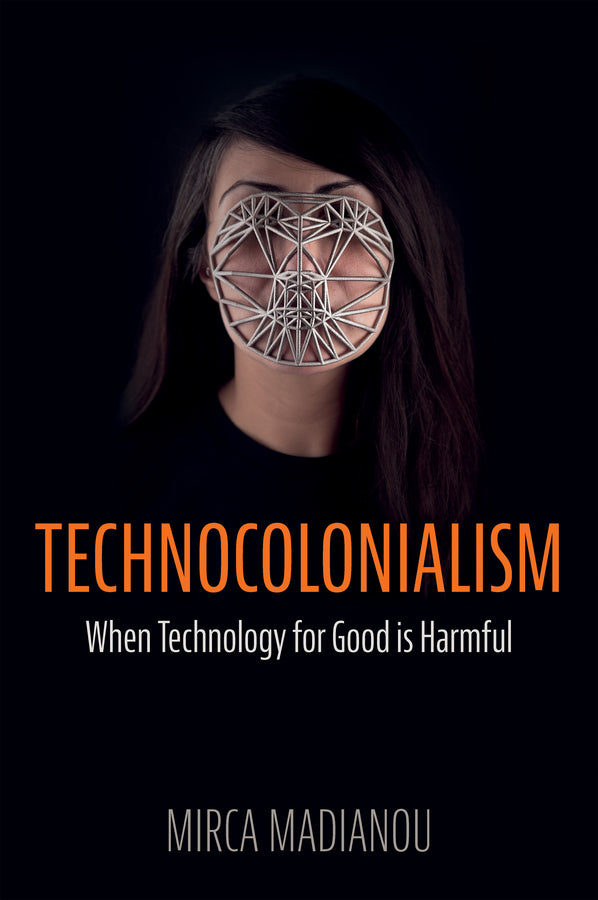
Technocolonialism
When Technology for Good is Harmful
Mirca Madianou (Author)
9781509559039, Polity Press
Paperback / softback, published 1 November 2024
256 pages
22.9 x 15.2 x 1.3 cm, 0.363 kg
"Technocolonialism offers a rich and radical rethinking of digital humanitarianism from the perspective of postcolonial theory. Drawing on decade-long research, it compellingly demonstrates how the promise of freedom inherent in AI applications and big data turns into a practice of control, surveillance and extraction that reveals the colonial power relations at the heart of 'technologies for good'. Superbly evidenced and argued, this is a must-read that will define critical scholarship on humanitarianism as well as media and communications for years to come."
Lilie Chouliaraki, London School of Economics and Political Science, and author of The Ironic Spectator
"Technocolonialism gets at the very core of how humanitarianism is being redefined in the global context when AI technologies and datafication prevail. With analytical mastery, Madianou reveals the multiple hierarchies embedded in this subject. The book is a must-read, a timely intervention with interdisciplinary appeal."
Radha Sarma Hegde, New York University
"Technocolonialism dives into the heart of the increasing digitisation and datafication of humanitarian aid. Drawing from years of ethnographic research on humanitarian infrastructures, Madianou's groundbreaking work not only attends to humanitarian and critical AI studies but also illuminates the profound impact of digital technologies on modern colonial legacies. This accessible yet theoretical work sheds light on the tangible repercussions of technocolonialism on the most vulnerable of populations, making it indispensable reading for understanding the contemporary landscape of global aid."
Cheryll Soriano, De La Salle University, Manila
"Madianou's book is an impressive feat, capturing the ever-evolving face of technology in the sector, while identifying the core evergreen undercurrents that push it forward... It is a critical read and a resonant capstone on her pioneering work over the last decade. We would do well to heed her message."
Quito Tsui, The MERL Tech Initiative
"Madianou has closely followed the technologization of humanitarian operations over the past decade in a way that very few scholars have, and her familiarity with the field leads to the thinking in this book. Technocolonialism offers us a framework to interpret this field."
Susan Sreemala, Bot populi
"A powerful and well-documented examination of how digital technologies are transforming humanitarianism in ways that reinforce colonial structures."
Josué García Veiga, LSE Review of Books
"In the humanitarian sector, Madianou has found an urgent analogue for the social, political, and cultural institutions that structure everyday life, and how those institutions engage digital technology to 'make life better' without contemplating the power dynamics that undergird the application of technology".
Robert Lundberg, Anthropological Forum
"Madianou's arguments are timely and extensively researched... Technocolonialism serves as a valuable resource for current and future scholars of cultural studies, media studies, and development studies, amongst others, as it offers critique on how colonial power structures are embedded in humanitarian technology."
Eirene Nsudoon Binabiba, Cultural Studies
"Technocolonialism is a landmark contribution to the critical study of technology, media, and humanitarianism. It deepens the conversation on digital inequality by situating it within centuries-long structures of coloniality and offers a vital corrective to the celebratory discourses that pervade humanitarian innovation. For scholars of media and communication, the book revitalizes debates around imperialism and dependency in the digital age; for practitioners and policymakers, it demands a reckoning with the ethical contradictions of 'innovation for good.' Madianou's lucid prose, rigorous fieldwork, and theoretical acuity make this an essential text for anyone concerned with the politics of digital infrastructures and the futures they enable—or foreclose."
Jilian York, International Journal of Communication
"Technocolonialism accomplishes a rare feat. It names what had remained fragmented, sensed, or unsaid in critical scholarship on digital aid. It offers a framework for analyzing the entanglements of care, computation, and coloniality. In doing so, Madianou does not call for better technology. She calls for a rethinking of aid itself, its histories, its hierarchies, and its claims to moral authority… Her critique is not merely diagnostic. It is generative. It asks us to rethink how infrastructures make worlds, and what kinds of worlds we are willing to sanction in the name of helping... A field-shaping contribution."
Abdellatif El Aidi, Dialogues on Digital Society
"Technocolonialism offers a thorough and fascinating account that rewards reading and is likely to become a vital reference in debates on digital humanitarianism, datafication and coloniality."
Miren Gutierrez, Dialogues on Digital Society
"At a time when colonial violence is visibly ongoing, from aggressive resource extraction such as cobalt mining in the Congo to settler-colonial violence and genocide in Gaza, the book reveals how colonial logics continue to shape contemporary systems of power, including those built in the name of humanitarian care."
Amir Payberah, Dialogues on Digital Society
"Technocolonialism offers a theoretically rigorous and empirically grounded critique of digital humanitarianism... Drawing on a decade of fieldwork, Madianou transforms abstract debates into tangible insights that illuminate how technologies of care become infrastructures of control."
Yijun Yao and Yifei Zhao, Journal of Information Technology and Politics
Winner of the 2026 International Communication Association Outstanding Book Award
Winner of the 2026 Philosophy, Theory and Critique (PTC-ICA) Book Award
With over 300 million people in need of humanitarian assistance, and with emergencies and climate disasters becoming more common, AI and big data are being championed as forces for good and as solutions to the complex challenges of the aid sector.
This book argues, however, that digital innovation engenders new forms of violence and entrenches power asymmetries between the global South and North. Madianou develops a new concept, technocolonialism, to capture how the convergence of digital developments with humanitarian structures, state power and market forces reinvigorates and reshapes colonial legacies. The concept of technocolonialism shifts the attention to the constitutive role that digital infrastructures, data and AI play in accentuating inequities between aid providers and people in need.
Drawing on ten years of research on the uses of digital technologies in humanitarian operations, the book examines a range of practices: from the normalization of biometric technologies and the datafication of humanitarian operations to experimentation in refugee camps, which are treated as laboratories for technological pilots. In so doing, the book opens new ground in the fields of humanitarianism and critical AI studies, and in the debates in postcolonial studies, by highlighting the fundamental role of digital technologies in reworking colonial genealogies.
Abbreviations
Introduction
1. The Logics of Digital Humanitarianism
2. Biometric Infrastructures
3. Extracting Data and the Illusion of Accountability
4. Surreptitious Experimentation: Enchantment, Coloniality and Control
5. The Humanitarian Machine: Automating Harm
6. Mundane Resistance: Contesting Technocolonialism in Everyday Life
Conclusion: Technocolonialism as Infrastructural Violence
A Note on Research Methods
Acknowledgements
Notes
References
Index
Subject Areas: Society & culture: general [JF]