Freshly Printed - allow 7 days lead
Couldn't load pickup availability
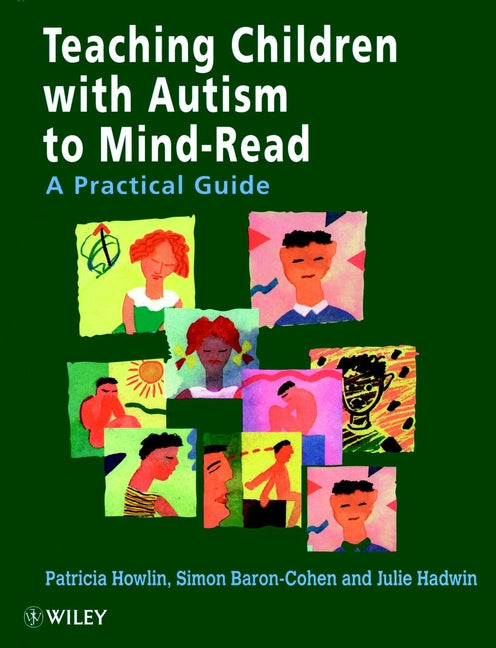
Teaching Children with Autism to Mind-Read
A Practical Guide for Teachers and Parents
'This is a much-awaited revision of Howlin, Baron-Cohen, and Hadwin's 1998 volume Teaching Children with Autism to Mind-Read that includes expanded lessons and concepts to teach high-functioning children with autism about mental states. The approach is importantly developmental - based on prior research and progressive sequences of concepts and stages of instruction. It includes multiple foci, including teaching about differences in perspectives, about beliefs, about knowing, about emotions, and more. No one thinks that teaching mental-state understandings will address all the social-cognitive challenges faced by children with autism, but understanding the mental states of self and other is an acknowledged and crucial challenge for these children (and adults) and one that this workbook carefully and effectively addresses. It is a lively and practical book that will be a tremendous resource for parents as well as educators.'
Henry Wellman, Harold W. Stevenson Collegiate Professor of Psychology, University of Michigan
Patricia Howlin (Author), Simon Baron-Cohen (Author), Julie A. Hadwin (Author)
9780471976233, Wiley
Paperback / softback, published 18 November 1998
304 pages
24.6 x 19.1 x 1.8 cm, 0.59 kg
"... is highly recommended for teachers, speech and language clinicians, psychologists and others who work with more able children with autism." (Child Psychology Psychiatry, Vol 41/8, 2000) "... a valuable book for anyone working with children and even adults on the autistic spectrum." (RCSLT Bulletin, 2000)
Das erste praxisorientierte Buch über die Anwendung der "Gedankentheorie" bei Kindern mit Autismus. Der Schwerpunkt liegt auf der wirkungsvollen Behandlung sozialer und kommunikativer Abnormitäten bei Kindern mit Autismus mit Hilfe der Gedankentheorie (auch als "Gedankenlesen" bezeichnet). Hier geht es um die Fähigkeit, den Gemütszustand (Gedanken, Einstellungen, Wünsche, Absichten etc.) anderer zu erfassen und die Fähigkeit, mit dieser Information zu ergründen, was sie sagen wollen, ihr Verhalten sinnvoll zu deuten und vorauszusagen, was sie als nächstes tun werden. Ein unverzichtbares Buch für alle, die in diesem Bereich arbeiten. (01/98)
Teaching About Emotions.
Teaching About Informational States.
Developing Pretend Play.
Future Directions.
Subject Areas: Psychology [JM]