Special Order - allow 2+ weeks lead
Couldn't load pickup availability
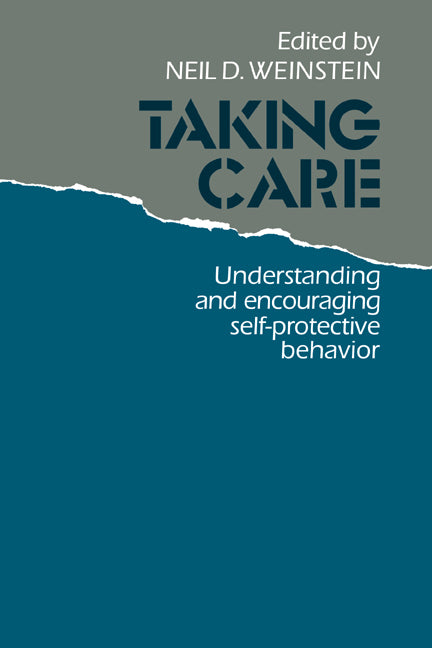
Taking Care
Understanding and Encouraging Self-Protective Behavior
Taking Care examines the reasons why people take precautions - and the reasons why they do not.
Neil D. Weinstein (Edited by)
9780521324359, Cambridge University Press
Hardback, published 13 August 1987
364 pages
23.6 x 16.2 x 3 cm, 0.67 kg
Taking Care examines the reasons why people take precautions - and the reasons why they do not. Some authors offer theoretical perspectives on issues ranging from the cognitive processes of the individual to the values and historical trends in the larger society to illuminate the puzzle of self-protective behaviour. Others look at prevention programmes themselves: the forms they take, the assumptions they make, and the success or failure they meet. A unique feature of the book is its attention to different types of hazards and its integration of the knowledge that has been gained from research and practical experience in health promotion, natural hazards preparedness, occupational safety and health, consumer safety and community crime prevention. The underlying questions addressed in these different fields of study are much the same, but in the past there has been little communication.
List of contributors
Acknowledgements
Introduction: studying self-protective behaviour Neil D. Weinstein
Part I. Theoretical Perspectives: 1. Behavioural decision theory perspectives on protective behaviour Paul Slovic, Baruch Fischhoff and Sarah Lichtenstein
2. Social learning theory and preventive behaviour Alfred McAlister
3. The role of emotion and psychological defense in self-protective behaviour James R. Averill
4. The diffusion of innovations perspective Everett M. Rogers
5. Cultural influences on prevention and the emergence of a new health consciousness Robert Crawford
Part II. Research and Prevention Programs for Specific Hazards
Section 1. Health: 6. Why people take precautions against health risks Paul D. Cleary
7. Community studies of smoking cessation Surgeon General's Report
8. Preventing adolescent smoking Kevin D. McCaul and Russell E. Glasgow
Section 2. Natural Hazards: 9. Natural hazards and precautionary behaviour Dennis S. Mileti and John H. Sorensen
10. Programs that encourage the adoption of precautions against natural hazards: review and evaluation John H. Sorensen and Dennis S. Mileti
Section 3. Crime: 11. Why people take precautions against crime: a review of the literature on individual and collective responses to crime Stephanie W. Greenberg
12. Promoting citizen involvement in crime prevention and control Fred Heinzelmann
Section 4. Inquiry, Safety, and Occupational Settings: 13. Injury prevention: limits to self-protective behaviour Leon S. Robertson
14. Perspectives on protective behaviours and work place hazards Alexander Cohen
Part III. Conclusion: 15. Cross-hazard consistencies: conclusions about self-protective behaviour Neil D. Weinstein
Index.
Subject Areas: Social, group or collective psychology [JMH]