Freshly Printed - allow 10 days lead
Couldn't load pickup availability
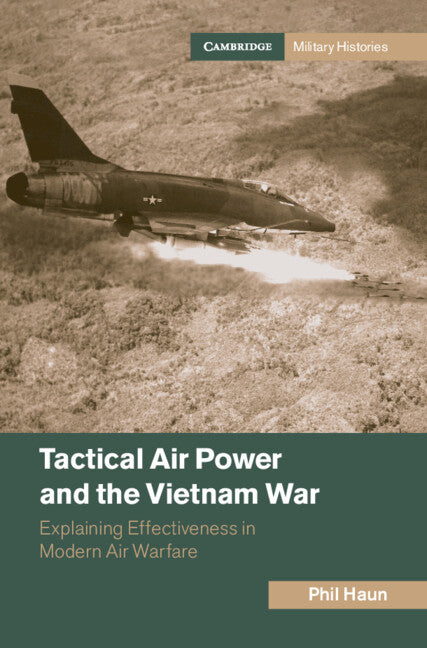
Tactical Air Power and the Vietnam War
Explaining Effectiveness in Modern Air Warfare
A theory of tactical air power explaining US air power effectiveness in Vietnam and the modern air wars that followed.
Phil Haun (Author)
9781009364171, Cambridge University Press
Hardback, published 18 January 2024
312 pages
23.5 x 15.5 x 2 cm, 0.637 kg
'… this book is a welcome addition to the airpower literature, which is dominated all too often by strategic bombing arguments.' Daniel Gipper, H-Net Reviews
This book introduces a much-needed theory of tactical air power to explain air power effectiveness in modern warfare with a particular focus on the Vietnam War as the first and largest modern air war. Phil Haun shows how in the Rolling Thunder, Commando Hunt, and Linebacker air campaigns, independently air power repeatedly failed to achieve US military and political objectives. In contrast, air forces in combined arms operations succeeded more often than not. In addition to predicting how armies will react to a lethal air threat, he identifies operational factors of air superiority, air-to-ground capabilities, and friendly ground force capabilities, along with environmental factors of weather, lighting, geography and terrain, and cover and concealment in order to explain air power effectiveness. The book concludes with analysis of modern air warfare since Vietnam along with an assessment of tactical air power relevance now and for the future.
1. Introduction
2. Tactical air power theory
3. Vietnam and rolling thunder: 1965–1966
4. Khe sanh and tet: 1967–1968
5. Commando hunt I-III and cambodia: 1969–1970
6. Commando hunt V-VII and lam son 719: 1971–1972
7. Easter offensive and linebacker I & II: 1972–1973
8. Analysis and conclusion
9. Epilogue.
Subject Areas: Military history [HBW]