Freshly Printed - allow 10 days lead
Couldn't load pickup availability
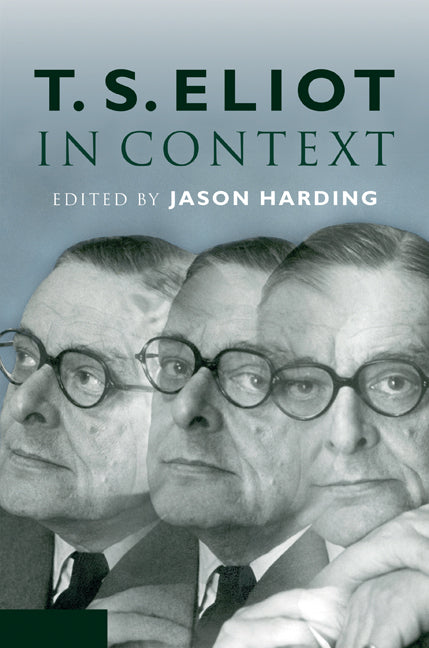
T. S. Eliot in Context
Explains the background to Eliot's works, from his life and career to art, politics and publishing.
Jason Harding (Edited by)
9780521511537, Cambridge University Press
Hardback, published 31 March 2011
432 pages, 5 b/w illus.
23.5 x 16 x 2.1 cm, 0.82 kg
'[T. S. Eliot in Context] is a highly useful volume. Many of the essays illuminate with a personal perspective well-informed, solid accounts of essential topics in Eliot studies. Others synthesize recent developments in Eliot scholarship the authors themselves have pioneered, or else flesh out interestingly idiosyncratic critical approaches to their subjects. Finally, there are a few essays that, fulfilling Harding's hopes, provide thick description of adjacent historical materials and open up genuinely fresh scholarly approaches to Eliot's work.' Modernism/Modernity
T. S. Eliot's work demands much from his readers. The more the reader knows about his allusions and range of cultural reference, the more rewarding are his poems, essays and plays. This book is carefully designed to provide an authoritative and coherent examination of those contexts essential to the fullest understanding of his challenging and controversial body of work. It explores a broad range of subjects relating to Eliot's life and career; key literary, intellectual, social and historical contexts; as well as the critical reception of his oeuvre. Taken together, these chapters sharpen critical appreciation of Eliot's writings and present a comprehensive, composite portrait of one of the twentieth century's pre-eminent men of letters. Drawing on original research, T. S. Eliot in Context is a timely contribution to an exciting reassessment of Eliot's life and works, and will provide a valuable resource for scholars, teachers, students and general readers.
Introduction Jason Harding
Part I. Life: 1. St Louis Earl K. Holt III
2. New England Eric Sigg
3. Paris William Marx
4. London C. D. Blanton
5. Englishness Simon Grimble
6. The idea of Europe Jeroen Vanheste
Part II. Forms: 7. The role of the intellectual Michael Levenson
8. Publishing Jason Harding
9. Censorship Rachel Potter
10. Literary journalism Peter White
11. Visual art Charles Altieri
12. Dance Terri Mester
13. Drama Richard Badenhausen
14. Music David Fuller
15. Radio Michael Coyle
Part III. Literary Cross-Currents: 16. Allusion Hugh Haughton
17. Classics Hannah Sullivan
18. Dante Massimo Bacigalupo
19. Seventeenth-century literature Jennifer Formichelli
20. Romantic and Victorian poetry Michael O'Neill
21. French poetry Stephen Romer
22. Georgian poetry Peter Howarth
23. Bloomsbury Mark Hussey
24. Ezra Pound Anne Stillman
25. The avant-garde Marjorie Perloff
Part IV. Politics, Society and Culture: 26. Politics David Bradshaw
27. Economics Adam Trexler
28. Anti-Semitism John Xiros Cooper
29. Gender Rachel Blau DuPlessis
30. Religion Barry Spurr
31. Philosophy Manju Jain
32. Social science Jewel Spears Brooker
33. Natural science Michael H. Whitworth
Part V. Reception: 34. Contemporary reviews Martin Dodsworth
35. Contemporary and postwar poetry Stephen Regan
36. Eliot studies Benjamin G. Lockerd
37. Legacies: from literary criticism to literary theory Patricia Waugh
Guide to further reading
Index.
Subject Areas: Literary studies: from c 1900 - [DSBH]