Freshly Printed - allow 7 days lead
Couldn't load pickup availability
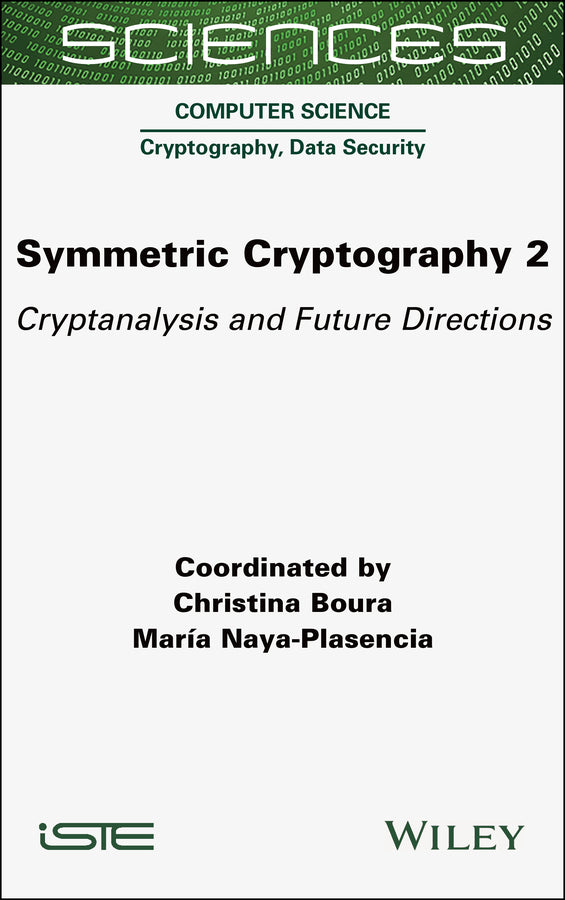
Symmetric Cryptography, Volume 2
Cryptanalysis and Future Directions
Christina Boura (Edited by), Maria Naya-Plasencia (Edited by)
9781789451474, Wiley
Hardback, published 13 December 2023
272 pages
23.5 x 15.6 x 1.8 cm, 0.653 kg
Symmetric cryptology is one of the two main branches of cryptology. Its applications are essential and vital in the Information Age, due to the efficiency of its constructions.
The scope of this book in two volumes is two-fold. First, it presents the most important ideas that have been used in the design of symmetric primitives, their inner components and their most relevant constructions. Second, it describes and provides insights on the most popular cryptanalysis and proof techniques for analyzing the security of the above algorithms. A selected number of future directions, such as post-quantum security or design of ciphers for modern needs and particular applications, are also discussed.
We believe that the two volumes of this work will be of interest to researchers, to master’s and PhD students studying or working in the field of cryptography, as well as to all professionals working in the field of cybersecurity.
Preface xiii Part 1 Cryptanalysis of Symmetric-key Algorithms 1 Chapter 1 Differential Cryptanalysis 3 1.1. Statistical attacks on block ciphers: preliminaries 4 1.2. Principle of differential cryptanalysis and application to DES 7 1.2.1. Differential transitions and differential characteristics 7 1.2.2. Derivation of non-trivial differential characteristics 10 1.2.3. Leveraging characteristics to mount a key-recovery attack 14 1.3. Some refinements and generalizations 18 1.3.1. Differential effect 18 1.3.2. Truncated differentials 19 1.4. Design strategies and evaluation 20 1.4.1 Case of the AES 21 1.4.2. Automated analysis 23 1.5. Further notes and references 23 1.6. References 26 Chapter 2 Linear Cryptanalysis 29 2.1. History 29 2.2. Correlation and linear hull 30 2.3. Multidimensional linear approximation 31 2.4. Walsh-Hadamard transform 32 2.5. Linear approximation of an iterative block cipher 32 2.6. Matsui’s Algorithm 1 type of key recovery 33 2.7. Matsui’s Algorithm 2 type of key recovery 34 2.8. Searching for linear approximations and estimating correlations 35 2.9. Speeding up key recovery 36 2.10. Key-recovery distinguisher 38 2.11. Classical model of Algorithm 2 39 2.12. Algorithm 2 with distinct known plaintext and randomized key 40 2.13. Multiple linear approximations 40 2.14. Multidimensional linear cryptanalysis 42 2.15. References 43 Chapter 3 Impossible Differential Cryptanalysis 47 3.1. Finding impossible differentials 48 3.2. Key recovery 49 3.2.1. Data, time and memory complexities 50 3.3. Some improvements 52 3.3.1. Early abort technique 52 3.3.2. Multiple impossible differentials or multiple extension paths 53 3.4. Applications 54 3.5. References 54 Chapter 4 Zero-Correlation Cryptanalysis 57 4.1. Correlation and linear cryptanalysis 57 4.1.1. Correlation matrix 57 4.1.2. Linear trails and linear hulls 58 4.1.3. Approximations of linear functions 59 4.1.4. Computing the correlations over a permutation 60 4.2. Attacks using a linear hull with correlation zero 60 4.2.1. Correlation zero in random permutations 61 4.2.2. Distinguisher 61 4.2.3. Reducing the data complexity 62 4.3. Linear hulls with correlation zero 62 4.3.1. Feistel ciphers 63 4.3.2. AES 64 4.3.3 Extended result on AES 64 4.4. References 64 Chapter 5 Differential-Linear Cryptanalysis 67 5.1. Brief introduction of differential-linear attacks 67 5.2. How to estimate correlations of a differential-linear distinguisher 69 5.3. On the key recovery 71 5.4. State of the art for differential-linear attacks 72 5.4.1. Differential-linear connecting table 72 5.4.2. Three techniques to improve differential-linear attacks 73 5.5. References 76 Chapter 6 Boomerang Cryptanalysis 77 6.1. Basic boomerang attack 77 6.2. Variants and refinements 79 6.3. Tricks and failures 80 6.4. Formalize the dependency 83 6.5. References 86 Chapter 7 Meet-in-the-Middle Cryptanalysis 89 7.1. Introduction 89 7.2. Basic meet-in-the-middle framework 90 7.2.1. The 2DES attack 90 7.2.2. Algorithmic framework 91 7.2.3. Complexity analysis and memory usage 92 7.3. Meet-in-the-middle techniques 94 7.3.1. Filtering 94 7.3.2. Splice-and-cut 96 7.3.3. Bicliques 97 7.4. Automatic tools 98 7.5. References 98 Chapter 8 Meet-in-the-Middle Demirci-Selçuk Cryptanalysis 101 8.1. Original Demirci-Selçuk attack 101 8.2. Improvements 103 8.2.1. Data/time/memory trade-off 104 8.2.2. Difference instead of value 104 8.2.3. Multiset 105 8.2.4. Linear combinations 105 8.2.5. Differential enumeration technique 106 8.3. Finding the best attacks 108 8.3.1. Tools 108 8.3.2. Results 109 8.4. References 109 Chapter 9 Invariant Cryptanalysis 111 9.1. Introduction 111 9.2. Invariants for permutations and block ciphers 112 9.2.1. Invariant subspaces 113 9.2.2. Quadratic invariants 117 9.3. On design criteria to prevent attacks based on invariants 117 9.4. A link to linear approximations 119 9.5. References 121 Chapter 10 Higher Order Differentials, Integral Attacks and Variants 123 10.1. Integrals and higher order derivatives 123 10.2. Algebraic degree of an iterated function 126 10.3. Division property 128 10.4. Attacks based on integrals 130 10.4.1. Distinguishers 130 10.4.2. Attacks 130 10.5. References 131 Chapter 11 Cube Attacks and Distinguishers 133 11.1. Cube attacks and cube testers 133 11.1.1. Terminology 134 11.1.2. Main observation 135 11.1.3. The basic cube attack 136 11.1.4. The preprocessing phase on cube attacks 137 11.1.5. Cube testers 138 11.1.6. Applications 139 11.2. Conditional differential attacks and dynamic cube attacks 140 11.2.1. Conditional differential attacks 140 11.2.2. Dynamic cube attacks 140 11.2.3. A toy example 140 11.3. References 141 Chapter 12 Correlation Attacks on Stream Ciphers 143 12.1. Correlation attacks on the nonlinear combination generator 144 12.2. Correlation attacks and decoding linear codes 145 12.3. Fast correlation attacks 146 12.3.1. Fast correlation attacks and low weight feedback polynomials 147 12.3.2. Finding low weight multiples of the feedback polynomial 148 12.3.3. Fast correlation attacks by reducing the code dimension 150 12.4. Generalizing fast correlation attacks 151 12.4.1. The E0 stream cipher 151 12.4.2. The A5/1 stream cipher 152 12.5. References 153 Chapter 13 Addition, Rotation, XOR 155 13.1. What is ARX? 155 13.1.1. Structure of an ARX-based primitive 156 13.1.2. Development of ARX 156 13.2. Understanding modular addition 157 13.2.1. Expressing modular addition in Fn2 158 13.2.2. Cryptographic properties of modular addition 158 13.3. Analyzing ARX-based primitives 160 13.3.1. Searching for differential and linear trails 160 13.3.2. Proving security against differential and linear attacks 161 13.3.3. Other cryptanalysis techniques 162 13.4. References 163 Chapter 14 SHA-3 Contest Related Cryptanalysis 167 14.1. Chapter overview 167 14.2. Differences between attacks against keyed and keyless primitives 168 14.3. Rebound attack 169 14.3.1. Basic strategy of the rebound attack 169 14.3.2. Rebound attack against AES-like structures 171 14.4. Improving rebound attacks with Super-Sbox 173 14.5. References for further reading about rebound attacks 175 14.6. Brief introduction of other cryptanalysis 176 14.6.1. Internal differential cryptanalysis 176 14.6.2. Rotational cryptanalysis 177 14.7. References 177 Chapter 15 Cryptanalysis of SHA-1 181 15.1. Design of SHA-1 181 15.2. SHA-1 compression function 182 15.3. Differential analysis 184 15.4. Near-collision attacks 184 15.5. Near-collision search 185 15.6. Message expansion differences 186 15.7. Differential trail 187 15.8. Local collisions 187 15.9. Disturbance vector 188 15.10. Disturbance vector selection 189 15.11. Differential trail construction 190 15.12. Message modification techniques 190 15.13. Overview of published collision attacks 191 15.14. References 192 Part 2 Future Directions 195 Chapter 16 Lightweight Cryptography 197 16.1. Lightweight cryptography standardization efforts 197 16.2. Desired features 198 16.3. Design approaches in lightweight cryptography 200 16.4. References 202 Chapter 17 Post-Quantum Symmetric Cryptography 203 17.1. Different considered models 204 17.1.1. With respect to the queries 204 17.1.2. With respect to memory 205 17.2. On Simon’s and Q2 attacks 206 17.2.1. Off-line Simon’s attack 207 17.3. Quantizing classical attacks in Q 1 207 17.3.1. About collisions 207 17.4. On the design of quantum-safe primitives 208 17.5. Perspectives and conclusion 209 17.5.1. About losing the quantum and classical surname 209 17.5.2. No panic 209 17.6. References 209 Chapter 18 New Fields in Symmetric Cryptography 215 18.1. Arithmetization-oriented symmetric primitives (ZK proof systems) 216 18.1.1. The current understanding of this new language 217 18.1.2. The first attempts 218 18.1.3. Cryptanalysis 219 18.2. Symmetric ciphers for hybrid homomorphic encryption 220 18.2.1. The current understanding of this new language 221 18.2.2. First design strategies 221 18.3. Parting thoughts 223 18.4. References 223 Chapter 19 Deck-function-based Cryptography 227 19.1. Block-cipher centric cryptography 227 19.2. Permutation-based cryptography 227 19.3. The problem of the random permutation security model 228 19.4. Deck functions 228 19.5. Modes of deck functions and instances 229 19.6. References 230 List of Authors 231 Index 233 Summary of Volume 1 239
Christina Boura and María Naya-Plasencia
Henri Gilbert and Jérémy Jean
Kaisa Nyberg and Antonio Flórez-Gutiérrez
Christina Boura and María Naya-Plasencia
Vincent Rijmen
Yosuke Todo
Ling Song
Brice Minaud
Patrick Derbez
Christof Beierle
Anne Canteaut
Itai Dinur
Thomas Johansson
Léo Perrin
Yu S Asaki
Marc Stevens
Meltem Sönmez Turan
María Naya-Plasencia
Léo Perrin
Joan Daemen
Subject Areas: Computer science [UY]