Freshly Printed - allow 7 days lead
Couldn't load pickup availability
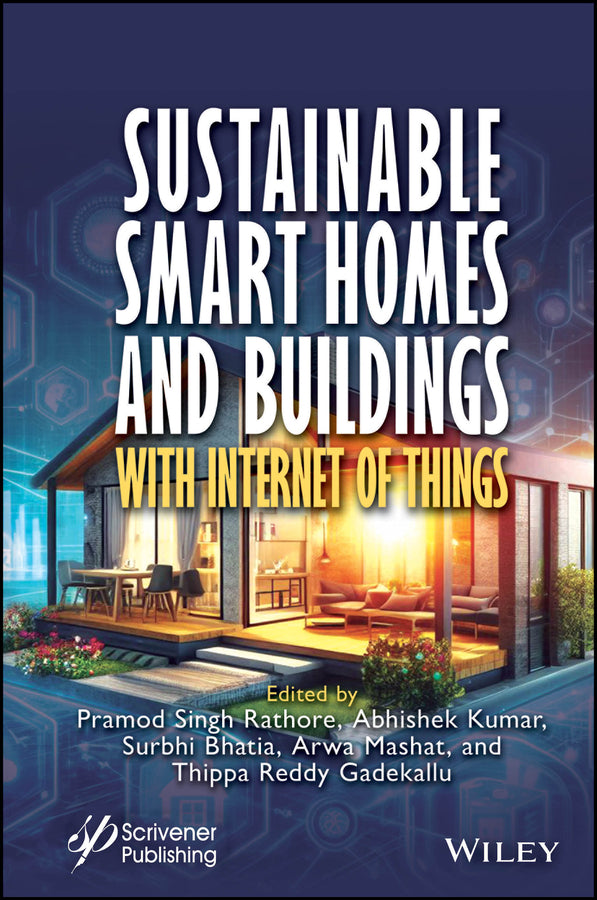
Sustainable Smart Homes and Buildings with Internet of Things
Pramod Singh Rathore (Edited by), Abhishek Kumar (Edited by), Surbhi Bhatia (Edited by), Arwa Mashat (Edited by), Thippa Reddy Gadekal (Edited by)
9781394231485, Wiley
Hardback, published 29 November 2024
368 pages
22.9 x 15.2 x 2.3 cm, 0.744 kg
Written and edited by a team of experts in the field, this exciting new volume explores the real-world applications and methods for using Internet of Things (IoT) to make homes and buildings smart and sustainable and to continue working toward a “greener” world. Sustainable Smart Homes and Buildings with Internet of Things (IoT) is a book that explores the integration of renewable energy sources and IoT technology in the design and management of smart homes and buildings. The book covers various topics related to the subject, including energy efficiency, real-time monitoring, control and optimization of renewable energy sources, smart grid integration, energy storage systems, and microgrids. The book explains how IoT technology can be used to collect data from various sensors and devices installed in smart homes and buildings to create a real-time monitoring and control system for renewable energy sources, which can help optimize energy usage and reduce waste. It also discusses the challenges and opportunities associated with the integration of renewable energy sources in smart homes and buildings, and how these challenges can be addressed through the use of IoT technology. The book is intended for architects, engineers, building managers, energy professionals, and researchers interested in the design and management of sustainable smart homes and buildings. It provides practical insights, case studies, and examples that illustrate the benefits of using renewable energy sources and IoT technology to create energy-efficient, environmentally friendly, and comfortable living spaces.
Preface xv 1 Development of a Framework to Integrate Smart Home and Energy Operation Systems to Manage Energy Efficiency Through AI 1 1.1 Introduction 2 1.2 Research Idea Definitions 3 1.2.1 A Service for Intelligence Awareness 3 1.2.2 IAT Sensor 4 1.2.3 IAT Smartphone 5 1.2.4 IAT Smart Appliance 6 1.2.5 Service-Based Intelligence Energy Efficiency 7 1.2.6 Service Idea for Intelligence Target 8 1.3 Algorithms for Intelligent Models 9 1.3.1 Algorithm for IAT 9 1.3.2 Algorithm of IE2S 11 1.3.3 Algorithm for IST 11 1.4 Analyzing and Implementing 12 1.4.1 Sensory Things 12 1.4.2 Server 13 1.5 Conclusion 15 Bibliography 16 2 Development of a Hybrid System to Make the Decision and Optimization of Renewable Energy Sources 19 2.1 Introduction 20 2.2 Related Work 20 2.3 Methods of Modelling 22 2.3.1 Designing a Hybrid Energy Infrastructure 22 2.3.2 Modelling Web-Based SCADA Systems 22 2.4 Methodology 24 2.4.1 A Simulated Model 24 2.4.1.1 Model Experiment 26 2.5 Discussion and Result 27 2.6 Conclusion 31 Bibliography 32 3 IoT-Based Renewable Energy Management Systems in Apartment 35 3.1 Introduction 36 3.2 Smart House Design Using Internet of Things 38 3.3 Problem Statement 41 3.4 The Proposed Methodology 42 3.5 A Mathematical Framework 42 3.5.1 Grid Model for Electricity 43 3.5.2 Energy-Use Model 44 3.5.3 Pricing Energy 45 3.5.4 Demand-Reply Paradigm 45 3.6 Optimize Design 46 3.6.1 Objectives and Restrictions 46 3.7 Discussion and Results 47 3.7.1 The Provided Data 47 3.8 Conclusion 48 References 50 4 Framework of IoT-Based Meta Firewall System to Plan the Renewable Energy Consumption in Smart Homes or Buildings 53 4.1 Introduction 54 4.1.1 Green Home 57 4.1.2 Green Dorms 58 4.2 Problem Formulation and System Model 58 4.2.1 System Design 58 4.2.2 The Research Goal 58 4.2.2.1 Comfort Error 59 4.2.2.2 Consumption of Energy 59 4.2.2.3 Co 2 Emissions 59 4.2.3 Baseline Methods 59 4.3 Meta-Control Firewall Plus (IMCF+) 60 4.3.1 Operation Summary 60 4.3.2 Procedure for Amortization 61 4.3.3 Algorithm for Green Plan (GP) 61 4.3.4 Analysis of Performance 63 4.4 Architecture of the IMCF+ System 63 4.4.1 A System Architecture 63 4.4.2 Graphical User Interface 65 4.5 Trial Methods and Assessment 66 4.5.1 Methods 66 4.5.1.1 Datasets 66 4.5.2 Evaluations of IMCF+ 67 4.5.2.1 Evaluation of Households 67 4.5.2.2 Evaluation of University Campus 69 4.5.2.3 Hotel Apartment Evaluation 70 4.5.3 Series of Micro-Benchmarks 70 4.5.3.1 Series-1: Evaluation of Performance 70 4.5.3.2 Series-2: K-Opt Assess 71 4.5.3.3 Series-3: Evaluation of Initialization 72 4.5.3.4 Series-4: Studying Energy Conservation 72 4.6 Conclusion 73 Bibliography 74 5 Manage and Optimization of Renewable Energy Consumption Efficiency for Smart Homes 77 5.1 Introduction 78 5.2 Proposed Method 82 5.2.1 Preprocessing 82 5.2.2 Forecasting 84 5.2.3 Optimization 86 5.3 Results 88 5.3.1 Testing Environment 88 5.3.2 Dataset 88 5.3.3 Assessment 89 5.3.3.1 Preprocessing 89 5.3.3.2 Forecast 90 5.3.3.3 Optimization 90 5.4 Discussion 92 5.5 Conclusion 93 References 93 6 Cost and Renewable Energy Management by IoT-Oriented Smart Home Based on Smart Grid Demand Response 97 6.1 Introduction 98 6.2 Methodology 99 6.2.1 Edge MCU 100 6.2.2 Pro Mini Arduino 101 6.2.3 Measurement of Current and Voltage 102 6.2.4 Blynk, A Creator of Interfaces for iOS and Android Platforms 104 6.3 System Design 104 6.4 Results 107 6.5 Conclusion 110 Bibliography 112 7 IoT-Based Smart Green Building Energy Management System 115 7.1 Introduction 116 7.2 Methodology 118 7.3 Results of Construction 121 7.3.1 Hypotheses 121 7.3.2 DPM Data Creation 121 7.3.3 Room Power Management (Face Recognition), Power-Cut Feature 122 7.4 Working Model 123 7.4.1 Short-Term Load Forecasting (RT-STLF): Five Primary Blocks Make Up the RT-STLF 123 7.4.2 Manage Room Power 125 7.4.3 IoT Data Update 126 7.5 Results of Testing 126 7.5.1 Face Recognition (Classification) Accuracy 126 7.5.2 Forecasting Methodologies Comparison 128 7.6 Conclusion 130 References 130 8 The Framework of IoT-Based Paradigms to Renewable Power Utilization and Distribution by Microgrid 133 8.1 Introduction 134 8.2 Related Work 135 8.3 Intelligent Power System Design 137 8.3.1 Connected Devices Network 138 8.3.1.1 Methods of Processing and Computing 139 8.3.1.2 Capacity for Storage 139 8.3.1.3 Optimizing Energy Use in Microgrids 140 8.4 Daily External Energy Requirements 145 8.4.1 Factory Robots 145 8.4.2 The Topic of Discussion Pertains to Domestic or Home Robots 146 8.4.3 Robotic Doctors 146 8.5 Conclusion 146 Bibliography 147 9 Machine Learning-Based Swarm Optimization for Residential Demand-Based Electricity 149 9.1 Introduction 150 9.2 Relevant Works 150 9.3 The Motivation 152 9.4 Energy Optimization Proposal 153 9.4.1 Appliance Scheduling Problem Formulation 156 9.4.2 Problem of Optimization 156 9.5 Discussions and Results 158 9.6 Conclusion 163 References 163 10 Integration of Intelligent System and Big Data Environment to Find the Energy Utilization in Smart Public Buildings 167 10.1 Introduction 168 10.2 Methods and Materials 169 10.2.1 Data 169 10.2.2 Methods 170 10.2.2.1 Data Collection/Preprocessing Methods 170 10.2.2.2 Predictive Modelling Techniques 171 10.3 Results 174 10.3.1 Energy Consumption Results Using ML Systems 174 10.3.2 Design of an Intelligent Energy Management System Architecture 177 10.4 Discussions 180 10.4.1 Theory Contributions 182 10.4.2 Practice Implications 183 10.4.3 Research Limitations and Direction 183 10.5 Conclusion 184 Bibliography 185 11 Multi-Objective Optimization Process to Analyze the Renewable Energy Storage and Distribution System from the Grid 187 11.1 Introduction 188 11.2 Review of Literature 189 11.3 Work Proposal 192 11.4 Results and Discussion 195 11.5 Conclusion 200 References 200 12 Deep Learning and Multi-Horizontal Solar Energy Forecasting of Different Weather Conditions in Smart Cities 203 12.1 Introduction 204 12.2 Description of Data 206 12.2.1 Information About Photovoltaic Production 207 12.2.2 Weather Information from the CWB 207 12.2.3 AccuWeather Reports 208 12.2.4 Local Weather Position/Pyrheliometer 208 12.3 Information Preparation 209 12.3.1 Classifying Data 209 12.3.2 Encryption of Data 210 12.4 Procedures and Assessment 212 12.4.1 Artificial Neural Network 212 12.4.2 Long Short-Term Memory 212 12.4.3 Gated Recurrent Unit 213 12.5 Results 213 12.5.1 Findings from Hyperparameter Tuning 213 12.5.2 Different Weather Data Groups’ Forecast Performance 214 12.6 Conclusion 216 Bibliography 217 13 Machine Learning Models are Used to Analyze the Effectiveness of Daily Residential Area Energy Consumption 221 13.1 Introduction 222 13.2 Intelligent Energy Systems for the House 223 13.2.1 Tracking 223 13.2.2 Management 223 13.2.3 Leadership 224 13.2.4 Recording 224 13.3 Advanced Plan for Demand Response 224 13.4 Results 228 13.5 Conclusion 231 Bibliography 232 14 Integration of AI and IoT Used to Manage and Secure the Renewable Energy Management in the Environment 235 14.1 Introduction 236 14.1.1 Efforts 237 14.2 Smart IoT Device Setting Out and Energy-Saving Equipment 238 14.2.1 Smart IoT Deployment 238 14.2.2 Relevant Work 240 14.3 Key AI-Based Energy-Efficient Network Issues 240 14.3.1 Energy from Renewable Sources 241 14.3.2 AI Technology 242 14.3.2.1 Algorithm Regression 243 14.3.2.2 Neural Networks 244 14.3.2.3 SVM Algorithm 244 14.3.2.4 Analysis Clusters 245 14.3.2.5 Suggest Algorithm 245 14.4 AI-Based Managing Framework for Multidimensional Smart IoT Devices 245 14.4.1 Logistic Regression/Clustering Analysis Interlayer 246 14.4.1.1 Logistic Regression Interlayer 246 14.4.1.2 Clustering-Analysis Interlayer 247 14.4.2 Regression-Based Intra-Layer Control 248 14.4.3 Pushing and Caching with Recommendation Procedure 249 14.5 Research Futures 249 14.6 Conclusion 250 References 251 15 Hybrid Genetic Optimization and Particle Swarm Optimization for Enhanced Electricity Demand Forecasting Using Artificial Neural Networks 253 15.1 Introduction 254 15.2 Electricity Sector 255 15.3 Methodology 257 15.3.1 ANN Method 257 15.3.2 Particle Swarm Optimization (PSO) 257 15.4 ANN-GA-PSO Methods 260 15.4.1 Estimating Two Forms Method 260 15.4.2 Algorithm for Hybrid Optimization using GA-PSO 261 15.4.3 Data Management and Computation 261 15.4.4 Forecast Performance Evaluation 261 15.5 Results 262 15.5.1 Future Estimation 264 15.5.2 The Correlation Between Gross Domestic Product (GDP) and the Electricity Demand 266 15.6 Conclusion 266 References 267 16 Harmonizing Renewable Energy, IoT, and Economic Prosperity: A Multifaceted Analysis 271 16.1 Introduction 272 16.1.1 Designing of Smart Home Models 273 16.1.2 Prediction of Electricity from Smart Home Models 276 16.2 Literature Survey 278 16.3 Proposed Methodology 284 16.4 Conclusion 287 References 288 17 An Optimized Demand for Cost and Environment Benefits Towards Smart Residentials Using IOT and Machine Learning 291 17.1 Introduction 292 17.1.1 Overview of Smart-Based Systems 292 17.1.2 Benefits of Machine-Based Learning Algorithms in Smart-Based Systems 293 17.1.3 Challenges and Limitations of Machine-Based Learning Algorithms in Smart-Based Systems 293 17.1.4 Real-World Applications of Machine-Based Learning Algorithms in Smart-Based Systems 294 17.2 Literature Review 294 17.3 Key Considerations for Implementing Machine-Based Learning Algorithms in Smart-Based Systems 302 Conclusion 304 References 305 18 IoT-Enabled RBFNN MPPT Algorithm for High Gain SEPIC Converter in Grid-Tied Rooftop PV Applications 309 18.1 Introduction 310 18.2 Related Works 311 18.3 Proposed System 312 18.4 Results and Discussion 318 18.5 Conclusion 321 References 324 Index 327
Sasikala P., S. Sivakumar, Murali Kalipindi and Makhan Kumbhkar
M. Jayakrishna, S. Sivakumar, Nalam Chandra Sekhar and Yabesh Abraham Durairaj Isravel
Thulasi Bikku, S. Sivakumar, Sudha Arogya Mary Chinthamani and Pramoda Patro
Mandeep Kaur Ghumman, A. Vinay Bhushan, Chetan Khemraj Lanjewar and Abhishek Choubey
Thulasi Bikku, V.O. Kavitha, Chetan Khemraj Lanjewar and Abhishek Choubey
Omprakash B., Jatinkumar Patel, Dhanaselvam J. and Shruti Bhargava Choubey
Rahama Salman, Ghada Elkady, Mukta Sandhu and Sandeep Gupta
Kannan Kaliappan, Basi Reddy A., D. Muthukumaran, Gopinath S., T. Aditya Sai Srinivas and R. Senthamil Selvan
Yalamanchili Salini, Kiran Sree Pokkuluri, D. Deepa and Mary Joseph
Sushil Bhardwaj, Bharath Sampath, Latifjon Kosimov and Shakhlokhon Kosimova
Dinesh G., Manisha G., Dina Allam and Ghada Elkady
Pradosh Kumar Sharma, M. V. Kesava Kumar, Mohd Wazih Ahmad and Radhika M.
Kapil Aggarwal, D. M. Kalai Selvi, Vijay Kumar Rayabharapu and K. S. Chakradhar
R. Swathi, M. Prabha, Ravichandran Sekar, Basi Reddy A., T. Aditya Sai Srinivas and R. Senthamil Selvan
V. Sharmila, Gaikar Vilas B., Rajiv Nayan and Pavithra G.
Sri Silpa Padmanabhuni, Pradeep K. G. M., Sai Pallavi Akkisetti and G. Jayalaxmi
Hemlata and Manish Rai
Thomas Thangam, P. Kavitha, P. Nammalvar, D. Karthikeyan and V. Pujari
Subject Areas: Civil engineering, surveying & building [TN]