Freshly Printed - allow 7 days lead
Couldn't load pickup availability
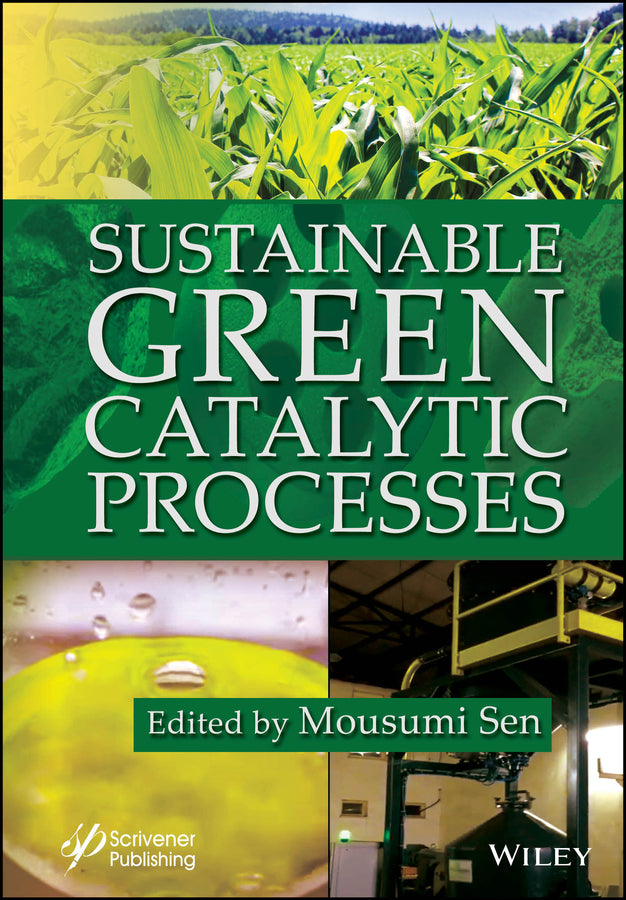
Sustainable Green Catalytic Processes
Mousumi Sen (Edited by)
9781394212552, Wiley
Hardback, published 4 September 2024
560 pages
25.4 x 17.8 x 3.3 cm, 1.315 kg
This groundbreaking book offers an in-depth description of sustainable green catalytic processes that have emerged as the means to empower the existing protocols with greener, sustainable, and environmentally benign versions that hold enormous potential in industry and society. Growing worldwide concerns about environmental pollution and global warming have directed the attention of scientists towards approaches for developing sustainable protocols, and the need for employing greener and more sustainable catalytic approaches that are environmentally greener and more eco-friendly than current ones. Green and sustainable catalysts are the one class of catalysts that possess higher selectivity and activity, efficient recovery from the reaction medium, recyclability, cost-effectiveness and are prepared using environmentally benign preparation techniques. The most potent instrument in organic synthesis, and the cornerstone of green chemistry, is catalysis which has broadened the possibilities for organic transformations in the direction of a sustainable future. The catalyst has been playing a vital role, from the improvement of reaction conditions to enhanced selectivity towards the intended product and a decrease in the creation of byproducts. The purpose of this book is to highlight the developments made towards designing new catalysts (homogeneous, heterogeneous, organocatalyst, nanocatalyst, photocatalyst, nanophotocatalyst, biocatalyst, nanobiocatalyst, metal catalyst etc,.) and present the advancements in the field of chemical synthesis using greener catalytic routes with far-reaching applications. The other environmentally friendly method is the enzymatic synthesis of organic molecules, which substitutes safe reagents for those that imitate the biosynthetic route to synthesize the desired organic molecules. With its ability to produce transformations that occasionally enable the reduction of steps in a synthetic route, biophotocatalysis has long been recognized as a green technology and key to creating environmentally friendly and sustainable chemistry. The employment of sustainable green processes on the most crucial reaction steps of the synthetic protocol satisfies contemporary needs for environmentally friendly operations during the creation of valuable chemicals. Readers will find the book: Audience The core audiences for this book include scientists and engineers working in green chemistry, materials science, photocatalysts, biotechnology, nanotechnology, waste minimization, and sustainability. This book is an excellent resource for graduate students, R&D experts, and researchers in academic and industrial fields of chemical synthesis.
Preface xv 1 Green and Sustainable Catalytic Reaction Processes Including New Reaction Medium-Enriched Atom Utilization 1 1.1 Introduction 2 1.2 Background 3 1.3 Literature Review 7 1.4 Environmental Impact of Catalytic Reactions 9 1.5 Experimental Section 13 1.6 Results and Discussion 16 1.7 Summary and Outlook 21 References 22 2 Green Catalysis for Chemical Transformation: Need for the Sustainable Development 29 2.1 Introduction 30 2.2 Conclusion 46 References 46 3 Green Avenues in Controlled Radical Polymerization for Precision Synthesis of Macromolecules 59 3.1 Introduction 59 3.2 Green Advances in Atom Transfer Radical Polymerization Technique 61 3.3 Green Advances in Reversible Addition Fragmentation Chain Transfer Polymerization Technique 65 3.4 Green Advances in Nitroxide-Mediated Polymerization Technique 67 3.5 Conclusions and Future Perspective 69 References 70 4 Catalytic Synthesis and Application of Heterocyclic and Heteroatom Compounds: Recent Advances 79 4.1 Introduction 80 4.2 Conclusion 92 References 93 5 The Novel Trends in Asymmetric Catalysis: Green and Sustainable Catalysts 97 5.1 Introduction 98 5.2 Role of Green Synthesis and Catalyst 100 5.3 Asymmetric Hydrogenation Catalyzed by Transition Metals 101 5.4 Asymmetric Cross-Couplings Catalyzed by TM 104 5.5 Approaches to Profens Through Organocatalysis 113 5.6 Conclusions 116 Acknowledgments 116 References 116 6 Application of Nanocatalysts in Greener Synthesis of Chemical Compounds 121 6.1 Introduction 122 6.2 Green Strategies 123 6.3 Nanocatalysts for Green Synthesis of Organic Compounds 125 6.4 Conclusion 135 References 135 7 Heterogeneous Photocatalysis: Recent Advances and Applications 141 7.1 Introduction 142 7.2 Fundamental Principles of Photocatalysis 144 7.3 Photocatalytic Mechanisms 145 7.4 Factors Affecting Photocatalytic Efficiency 146 7.5 Recent Advances in Heterogeneous Photocatalysts 148 7.6 Applications of Heterogeneous Photocatalysis 149 7.7 Recent Advances in Enhancing Photocatalytic Performance 153 7.8 Prospects and Pioneering Challenges in Heterogeneous Photocatalysis 156 7.9 Conclusion 158 References 158 8 Role of Biocatalysis-Biotransformations in Sustainable Chemistry 165 8.1 Introduction 166 8.2 Principle of Biocatalysis 168 8.3 Recent Development in Biocatalysis 169 8.4 Future in Biocatalysis 177 8.5 Conclusion 179 Acknowledgments 179 References 180 9 Synthesis and Functionalization of Natural Products with Light-Driven Reactions 183 9.1 Introduction 184 9.2 Visible Light-Driven Total Synthesis of Natural Products 186 9.3 Visible Light-Driven Functionalization of Natural Products 213 9.4 Conclusion 217 Acknowledgements 218 References 218 10 Metrics of Green Chemistry and Sustainability 225 10.1 Green Metrics 226 10.2 Tools and Applications of Green Metrics 244 10.3 Life Cycle Assessment 255 10.4 Conclusions 256 References 257 11 Biocatalysis and Biobased Economy 259 11.1 Introduction of Biocatalysis and Biobased Economy 259 11.2 Carbon-Based Biocomposites 261 11.3 Waste Biomass 262 11.4 Enzymes as Catalytically Active 264 11.5 Immobilization of Enzymes in Biocatalysts 265 11.6 Biopolymer 266 11.7 Catalytic Applications in Biocatalysts 268 11.8 Computational Approaches in Biocatalyst 269 11.9 Conclusion and Future Prospects 270 References 271 12 Chemistry and Technology Innovation to Advance Green and Sustainable Chemistry 273 12.1 Introduction 274 12.2 Computational Chemistry Methods in Green and Sustainable Drug Design and Development 276 12.3 Green Chemistry Principles in Computational Drug Design 280 12.4 Case Studies in Green and Sustainable Drug Design Using Computational Approaches 286 12.5 Technology Innovations in Computational Green and Sustainable Drug Design 289 12.6 Challenges and Limitations in Computational Green and Sustainable Drug Design 292 12.7 Future Directions and Conclusion 294 References 295 13 Green Chemistry: The Emergence of a Transformative Framework 301 13.1 Introduction 302 13.2 Synthetic Routes with Catalysts in Stoichiometric Amounts with the Higher Selectivity of the Chemistry Showcasing Its Advancement 303 13.3 Solvent-Free Syntheses or Alternative Environmental Benign Solvents 305 13.4 Overcoming the Conventional Methods by Switching to Microwave, Ball Milling, and Photochemical Synthesis 308 13.5 Preventing the Usage of Toxic Chemicals, Use of Alternative Chemicals 317 Conclusion 319 References 320 14 Sustainable Therapeutic Approaches with Nanophotocatalyst 329 14.1 Introduction 330 14.2 Cancer Therapeutics 330 14.3 Photocatalysis and Drug Delivery 334 14.4 Challenges and Perspectives 336 14.5 Conclusion 338 References 338 15 Chemistry for Catalytic Conversion of Biomass/Waste Into Green Fuels 343 15.1 Introduction 344 15.2 Lignocellulosic Biomass 345 15.3 Conventional Approach for the Generation of Liquid Fuels From Lignocellulosic Biomass 347 15.4 Selective Transformations of Platform Chemicals 362 15.5 Conclusions and Future Perspectives 368 References 369 16 Detoxification of Industrial Wastewater by Catalytic (Photo/Bio/Nano) Techniques 377 Abbreviations 378 16.1 Introduction 378 16.2 Detoxification of Wastewater 380 16.3 Miscellaneous Types of Adsorbent 387 16.4 Adsorption Isotherm and Its Kinetics 390 16.5 Significance of Adsorption Technique for Remediation of Hazardous Effluents 390 16.6 Future Prospects of Detoxification of Wastewater Through Catalysis 391 16.7 Conclusion 391 References 392 17 New Trends in Asymmetric Catalysis: Chiral Hypervalent Iodine Compounds as Green and Sustainable Catalysts 397 17.1 Introduction 398 17.2 Role of Hypervalent Iodines in Asymmetric Synthetic Approach 399 17.3 Synthesis and Reactivity 407 17.4 Conclusion 438 References 438 18 High-Turnover Palladium Catalysts: Accelerating C-H Activation for Sustainable Green Catalysis 447 18.1 Introduction 448 18.2 High-TON Pd Catalysis for C-H Arylation of Arenes 452 18.3 Palladium-Catalyzed Activation of Csp3 -H Bonds 457 18.4 Palladium-Catalyzed Cross-Dehydrogenative Coupling 457 18.5 Oxidative Alkynylation Reactions 460 18.6 Tandem C–H and N–H Activation 465 18.7 Conclusions 467 References 467 19 Thin-Film Fabrication Techniques in Dye‐Sensitized Solar Cells for Energy Harvesting 473 19.1 Introduction 474 19.1.1 Energy Crisis and the World Scenario 474 19.2 Structure and Operation Principle of DSSCs 476 19.3 Various Methods for Fabricating Thin Films for DSSCs 477 19.4 Concluding Remarks 508 References 508 Index 521
Amit and Mousumi Sen
Dripta De Joarder, Rajarshi Sarkar and Dilip K. Maiti
Pratibha Sharma and Amit Kumar
Nayeem Ahmed, Zeba N. Siddiqui, Waqas A. Khan and Hinna Hamid
Surya Prakash Verma, Devashish Singh and Poonam Rajesh Prasad
Karan Chaudhary and Dhanraj T. Masram
Sher Mohd and Amjad Mumtaz Khan
Devashish Singh, Surya Prakash Verma and Poonam Rajesh Prasad
Kanchanbala Sahoo, Gitanjali Mishra and Barla Thirupathi
Ramuel John I. Tamargo, Hannah Shamina O. Cosiñero, Don Nelson C. Potato and Apraile Hope P. Dumrigue
Gyanendra Kumar, Nitanshu Dhama, Rohit Yadav and Dhanraj T. Masram
Prabitha Prabhakaran, Sakshi Bhardwaj, Bhawna Chopra, Ashwani K. Dhingra and Madhur Kant
Priyanka Chaudhary, Rapelly Venkatesh and Reena Singh
Rajarshi Sarkar, Dripta De Joarder and Dilip K. Maiti
Poulami Hota and Dilip K. Maiti
Mohd Ehtesham, Naushad Ansari, Gyanendra Kumar, Satendra Kumar, Panmei Gaijon, Sudipta Ghosh, M. Ramananda Singh and Arun Kant
Vikas Yadav, Rohit Kumar, Amrit Gond, Ashvani Yadav, Mitushree Ghosh, Ram Singh Kuri and Virendra Prasad
Biswajit Panda
Aman Kumar, Anamika Chaudhari, Sudhanshu Kumar, Suman Kushwaha and Sudip Mandal
Subject Areas: Chemistry [PN]