Freshly Printed - allow 7 days lead
Couldn't load pickup availability
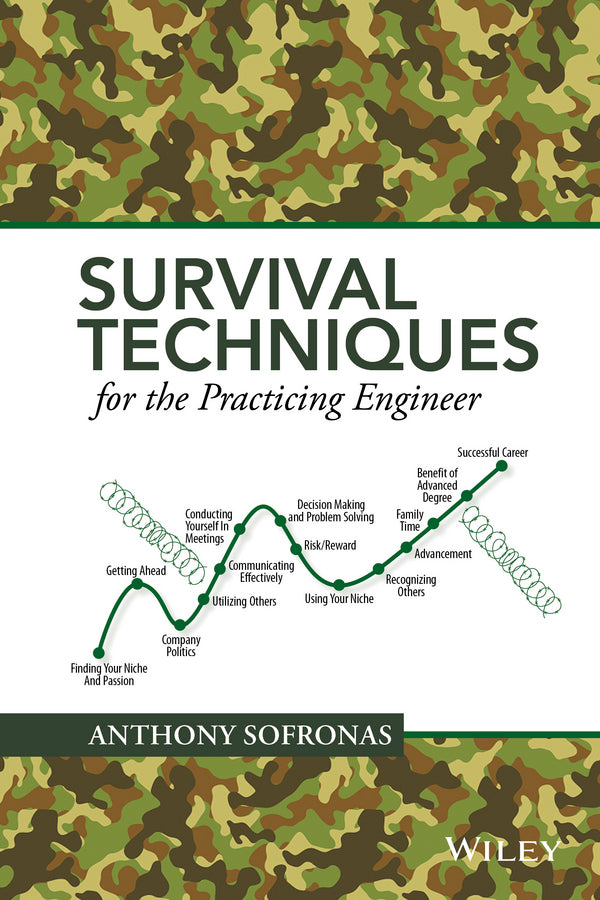
Survival Techniques for the Practicing Engineer
Anthony Sofronas (Author)
9781119250456, Wiley
Hardback, published 7 October 2016
208 pages
23.6 x 16 x 1.5 cm, 0.408 kg
Providing engineers with the tools and skills to survive and become successful in the work place
About the Author xi Preface xiii Acknowledgments xv 1 Getting Ahead 1 1.1 Finding your Niche 1 1.2 Twenty Rules to Remember 5 1.3 Calculated Risk Versus Reward 8 1.4 Advancement 9 1.5 Learn from Observing Failures 10 1.6 Keep Good Records of what you have done 12 1.7 Flexibility in your Career 17 1.8 You’re Known for Your Work 17 1.9 Ethical Behavior in Engineering 19 1.10 Humor in the Workplace 20 1.11 Self-Preservation when Documenting your Analysis 21 1.12 Don’t be Overwhelmed 22 1.13 Providing Guidance to Others 23 1.14 The Technical and Managerial Ladder to Advancement 24 References 26 2 The Politics of Engineering 27 2.1 What to do 27 2.2 What not to do 28 2.3 Disenchantment with your Job 30 2.4 Conducting yourself in a Meeting 33 2.5 Organize and Prioritize 35 2.6 Do as much as you can for your Colleagues 36 2.7 The Catch 22 of Engineering Project Work 37 2.8 Arrogance, Humility, Favors, and Courtesies 38 2.9 Be Curious and Inquisitive 40 2.10 Striving for Perfection 43 References 44 3 Utilizing the Input from Others 45 3.1 Just out of College 45 3.2 Mentors and Colleagues 46 3.3 Interaction Between Disciplines 47 3.4 It’s Nice to be Appreciated 48 3.5 The Funny Look Test 49 3.6 Uncluttered Thinking 49 3.7 The Art of Visualization 51 3.8 The Importance of Alliances and Networking 52 References 53 4 Communicating Effectively 55 4.1 Speaking Effectively at Meetings 55 4.2 Effective Writing Skills 57 4.3 Learn to Listen 58 5 Problem Solving and Decision Making 61 5.1 Why is this Section Important? 61 5.2 The Simplest Solution First 62 5.3 The 80–20 Relationship 63 5.4 The Five WHY’s used in Problem Solving 65 5.5 Being the Devil’s Advocate 66 5.6 An Engineering Approach: Use the Scientific Method for Problem Solving 66 5.7 You Need to know the Whole Story 70 5.8 Failure Analysis and Accident Investigations Differ 72 5.9 Why Decision Making is Important in Engineering 73 5.10 Decision on Several Choices 74 5.11 The Importance of Personal Checklists 76 5.12 Confirmational Bias or Self-fulfilling Prophecies 78 References 79 6 How an Engineering Consultant can help your Company 81 6.1 Why Use a Consultant? 81 6.2 What a Consultant can do 82 6.3 The Cost of a Consultant 83 7 Consulting Engineering as a Career 85 7.1 Consulting as a Career 86 7.2 Compensation will Probably be less than you Expected 87 7.3 How much should my Billing Rate be? 88 7.4 The Job Contract 88 7.5 You must Understand the Companies’ Politics 88 7.6 Documenting the Consulting Effort 90 7.7 Useful Equipment for a Mechanical Engineering Consultant 90 7.8 Verifying an Analysis 91 8 Precautions on Purchasing First of its Kind Equipment 93 8.1 Initial Design Specifications 94 8.2 Question Everything and Understand the Design 94 8.3 Document all Changes and Trust no one 95 8.4 Assign Responsibilities 95 8.5 When things don’t Work as Expected 96 References 97 9 Useful Information to Consider 99 9.1 Various Types of Equipment and their Failure Loads 100 9.2 Cracking of Welds due to Cyclic Stresses 101 9.3 Remember to Consider all Forces and Moments 104 9.4 Phantom Failures: Some Failures are very Elusive 107 9.5 The Art of Hammer Tapping 108 9.6 Development of Some Simple Energy Equations 109 9.7 Maintaining Proficiency in your Analytical Abilities 111 9.8 Safety Concerns to be Aware of 115 9.9 Should I Pursue a Patent? 118 References 119 10 Case Histories using Analytical Models 121 10.1 Building an Analytical Model of a Material Processor 123 10.2 Determining the Loads on the Processor Structure 129 10.3 Determining the Life of the Processor 131 10.4 Discussion of Failure and Potential Fix of Processor 132 10.5 Understanding the Sloshing Equation 135 10.6 Failure of Agitator Coupling Bolts 138 10.7 Causes of Auger Feeder Screw Failures 140 10.8 Temperature of a Blocked in Centrifugal Pump on Bypass 141 10.9 Heat up Rate and Rubs on a Steam Turbine 143 10.10 Pneumatic Testing Dangers and Beware of Safe Distances 144 10.11 Containment of a Wrecked Internal Part 147 10.12 A Catastrophic Disaster 152 10.13 Why are Parts out of Tolerance on the Production Line? 155 10.14 Failures Caused by an Impact Force 157 10.15 Design of an Aircraft Tow 159 10.16 Shaft Failures and Crack Growth 162 References 166 11 Benefits of Continuing your Education 167 11.1 Benefits of an Advanced Degree 167 11.2 Importance on Selecting your Academic Advisor 168 11.3 Difference between an Engineer and a Scientist 170 11.4 Benefits of Continued Education 170 Reference 171 12 Closing Guidance 173 12.1 Determine what you want to Achieve 173 12.2 Most of my Success was due to others 174 12.3 It’s not so much what you do as what you Haven’t Done 174 12.4 Become a Mentor to Someone 174 12.5 Remembering those before us 176 12.6 Thoughts on the Future of Engineering 178 References 180 Index 181
Subject Areas: Chemistry [PN]