Freshly Printed - allow 10 days lead
Couldn't load pickup availability
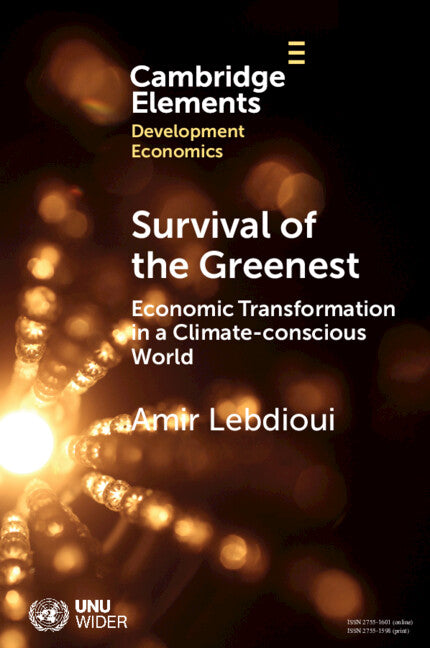
Survival of the Greenest
Economic Transformation in a Climate-conscious World
Shows how nations adjust to -and take advantage of- the new dynamics of structural transformation induced by climate change.
Amir Lebdioui (Author)
9781009339384, Cambridge University Press
Paperback / softback, published 16 May 2024
102 pages
23 x 15 x 0.7 cm, 0.164 kg
'Recognising that the economy will not grow into a sustainable and just direction on its own, Amir Lebdioui presents urgently needed insights on how to govern the intricate dynamics of sustainable development. Through careful analysis spanning from the uneven economic impact of climate change to the rise of green industrial strategy, he provides invaluable insights into the challenges and opportunities of a green transition. This book is a must-read for policymakers, economists, and anyone invested in shaping a world where the false dichotomy between economic prosperity and environmental sustainability no longer persists.' Mariana Mazzucato, Professor at University College London and author of Mission Economy: a moonshot guide to changing capitalism
The pathways to economic development are changing. Environmental sustainability is no longer a choice but a necessity to maintain a competitive edge in the global economy. Just like in nature, where survival hinges on adaptation, this Element shows how nations adjust to -and take advantage of- the new dynamics of structural transformation induced by climate change. First, by analysing the uneven industrial geography of decarbonisation, the inadequate state of climate financing and rise of green protectionism, it demonstrates that the low-carbon economy stands to increase economic disparities between nations, unless action is taken. Then, by examining green industrial policies and their varied success, it explains how governments can still join the green industrialisation race. Finally, it examines how to adapt green industrial policy to different starting points, market sizes, productive structures, state-business relations dynamics, institutional layouts, and ecological contexts. This title is also available as Open Access on Cambridge Core.
1. A Changing Climate for Economic Development
2. Rethinking Resilience to Climate and Transition Risks Beyond the Adaptation/Mitigation Dichotomy
3. Industrial Opportunities Arising Out of Low Carbon Transitions: Who Benefits?
4. Governments as Referees and Head Coaches: The Political Economy of Green Industrial Policy
5. No Green Silver Bullets: Various Contexts and Pathways for Green Economic Transformation
6. Kicking Away the Green Ladder: Green Protectionism, Broken Pledges and Double Trade Standards
7. Conclusion and Reflections on the Future Relevance of Development Economics.
Subject Areas: Development economics & emerging economies [KCM]