Freshly Printed - allow 7 days lead
Couldn't load pickup availability
Superatoms – Principles, Synthesis and Applications
Principles, Synthesis and Applications
P Jena (Author)
9781119619529, Wiley
Hardback, published 23 December 2021
400 pages
24.6 x 17.5 x 2.9 cm, 0.884 kg
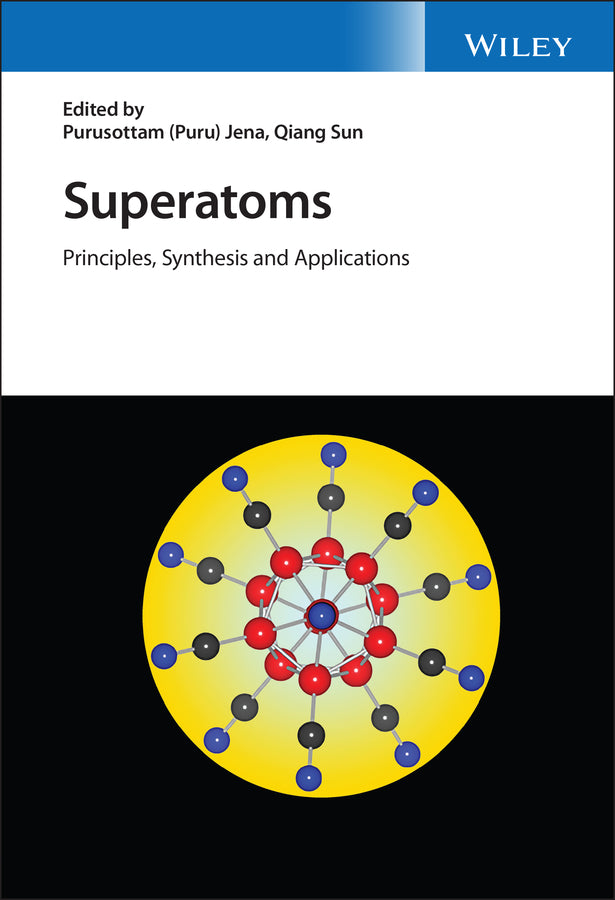
Explore the theory and applications of superatomic clusters and cluster assembled materials Superatoms: Principles, Synthesis and Applications delivers an insightful and exciting exploration of an emerging subfield in cluster science, superatomic clusters and cluster assembled materials. The book presents discussions of the fundamentals of superatom chemistry and their application in catalysis, energy, materials science, and biomedical sciences. Readers will discover the foundational significance of superatoms in science and technology and learn how they can serve as the building blocks of tailored materials, promising to usher in a new era in materials science. The book covers topics as varied as the thermal and thermoelectric properties of cluster-based materials and clusters for CO2 activation and conversion, before concluding with an incisive discussion of trends and directions likely to dominate the subject of superatoms in the coming years. Readers will also benefit from the inclusion of: Perfect for academic researchers and industrial scientists working in cluster science, energy materials, thermoelectrics, 2D materials, and CO2 conversion, Superatoms: Principles, Synthesis and Applications will also earn a place in the libraries of interested professionals in chemistry, physics, materials science, and nanoscience.
Preface xi List of Contributors xiii 1 Introduction 1 References 7 2 Rational Design of Superatoms Using Electron-Counting Rules 15 2.1 Introduction 15 2.2 Electron-Counting Rules 17 2.3 Stabilizing Negative Ions Using Multiple Electron-Counting Rules 37 2.4 Conclusions 46 References 46 3 Superhalogens – Enormously Strong Electron Acceptors 53 3.1 Superhalogen Concept 53 3.2 Alternative Superhalogens 61 3.3 Polynuclear Systems and the Search for EA and VDE Limits 70 3.4 Superhalogens’ Applications at a Glance 77 3.5 Final Remarks 78 Acknowledgements 79 References 79 4 Endohedrally Doped Superatoms and Assemblies 85 4.1 Introduction 85 4.2 Magic Clusters and Their Electronic Stability 88 4.3 Discovery of Silicon Fullerenes and Other Polyhedral Forms 89 4.4 Endohedral Superatoms of Ge, Sn, and Pb 97 4.5 Magnetic Superatoms 101 4.6 Endohedral Clusters of Group 11 Elements 101 4.7 Endohedral Clusters of B, Al, and Ga 104 4.8 Hydrogenated Silicon Fullerenes 107 4.9 Compound Superatoms and Other Systems 108 4.10 Assemblies of Superatoms 110 4.11 Concluding Remarks 117 Acknowledgements 117 References 118 5 Magnetic Superatoms 129 5.1 Introduction 129 5.2 The Arrival of the Magnetic Superatom 130 5.3 Tunable Superatoms 133 5.4 The Delocalisation of d-electrons 134 5.5 Prospects for Nanostructured Magnetic Material Design 137 References 138 6 Atomically Precise Synthesis of Chemically Modified Superatoms 141 6.1 Introduction 141 6.2 Electronic Structures of Chemically Modified Superatoms 147 6.3 Atomically Precise Synthesis of Chemically Modified Superatoms 160 6.4 Summary 176 References 177 7 Atomically Precise Noble Metals in the Nanoscale, Stabilized by Ligands 183 7.1 Introduction 183 7.2 Fundamentals 184 7.3 Applications 194 7.4 Summary and Outlook 205 References 206 8 Superatoms as Building Blocks of 2D Materials 209 8.1 Introduction 209 8.2 Fullerene-Assembled 2D Materials 211 8.3 Si-Based Cluster Assembled 2D Materials 223 8.4 Binary Semiconductor Cluster Assembled 2D Materials 231 8.5 Simple and Noble Metal Cluster-assembled 2D Materials 236 8.6 Zintl-ion Cluster-assembled 2D Materials 240 8.7 Chevrel Cluster-Assembled 2D Materials 243 8.8 Summary and Future Perspectives 247 References 249 9 Superatom-Based Ferroelectrics 257 9.1 Introduction 257 9.2 Organic Ferroelectrics 258 9.3 Hybrid Organic-Inorganic Perovskites 262 9.4 Supersalts 266 9.5 Conclusion 270 References 270 10 Cluster-based Materials for Energy Harvesting and Storage 277 10.1 Introduction 277 10.2 Cluster-Based Materials for Moisture-resistant Hybrid Perovskite Solar Cells 283 10.3 Cluster-Based Materials for Optoelectronic Devices 287 10.4 Cluster-Based Materials for Solid-state Electrolytes in Li-and Na-ion Batteries 287 10.5 Cluster-Based Materials for Hydrogen Storage 300 10.6 Clusters Promoting Unusual Reactions 305 10.7 Conclusions 310 References 311 11 Thermal and Thermoelectric Properties of Cluster-based Materials 317 11.1 Introduction 317 11.2 Basic Theory 318 11.3 Low Lattice Thermal Conductivity of Cluster-based Materials 323 11.4 Thermoelectric Properties of some Selected Cluster-based Materials 330 11.5 Conclusion 341 References 342 12 Clusters for CO2 Activation and Conversion 349 Haoming Shen, Qiang Sun, and Puru Jena 12.1 Introduction 349 12.2 Superalkali Catalysts 351 12.3 Al-Based Clusters for CO2 Capture 359 12.4 Ligand-Protected Au25 Clusters for CO2 Conversion 361 12.5 M@Ag24 Clusters for CO2 Conversion 364 12.6 Cu-Based Clusters for CO2 Conversion 367 12.7 Metal Encapsulated Silicon Nanocages for CO2 Conversion 370 12.8 Summary and Perspectives 370 References 372 13 Conclusions and Future Outlook 375 Index 379
Puru Jena and Qiang Sun
Puru Jena, Hong Fang, and Qiang Sun
Piotr Skurski
Vijay Kumar
Nicola Gaston
Shinjiro Takano and Tatsuya Tsukuda
Hannu Häkkinen
Zhifeng Liu
Menghao Wu and Puru Jena
Puru Jena, Hong Fang, and Qiang Sun
Tingwei Li, Qiang Sun, and Puru Jena
Puru Jena and Qiang Sun
Subject Areas: History [HB]