Freshly Printed - allow 10 days lead
Couldn't load pickup availability
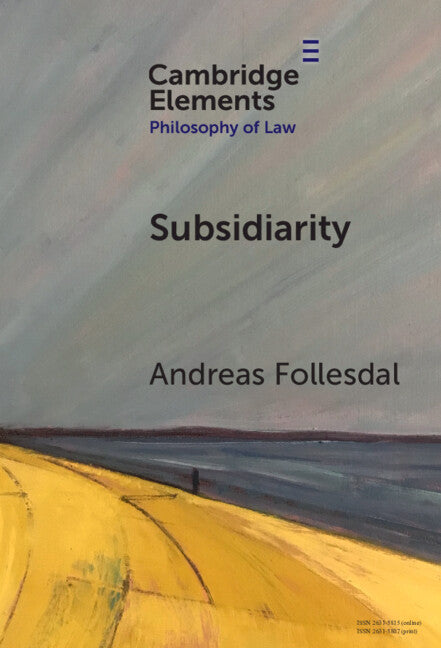
Subsidiarity
Subsidiarity concerns how to establish, allocate, or use authority with a rebuttable presumption for the local.
Andreas Follesdal (Author)
9781009571654, Cambridge University Press
Hardback, published 20 February 2025
100 pages
23.5 x 16 x 1.1 cm, 0.285 kg
'Subsidiarity' is vague and contested, yet popular in scholarship about international law due to its role in the European Union (EU). Which conceptions of subsidiarity are more justifiable, and how might they contribute to international law? A principle of subsidiarity concerns how to establish, allocate, or use authority within a social or legal order, stating a rebuttable presumption for the local. Various historical patterns, practices, principles, and justifications offer different recommendations. Seven normative theories vary in how immunity protecting or person promoting they are. The latter appear more justifiable and withstand criticism often raised against subsidiarity. Some conceptions of person promoting subsidiarity serve as a structuring principle for international law and fullfills several criteria of a general principle of law. It can harmonize domestic and international law but is not sufficient to reduce fragmentation among sectors with different objectives.
1. Introduction
Part I. Historical and Systematic Accounts of Subsidiarity: 2. Traditions of subsidiarity: patterns, practices, principles
3. Elements of subsidiarity
4. Theories of subsidiarity
5. Modest conclusions
Part II. Subsidiarity in International Law: 6. Subsidiarity – a general principle of law?
7. Inter-systemic coherence: human rights and state sovereignty
8. Inter-systemic coherence: subsidiarity in the European union
9. Intra-systemic coherence and subsidiarity: human rights in Europe
10. Conclusions
References.
Subject Areas: Jurisprudence & philosophy of law [LAB]