Freshly Printed - allow 7 days lead
Couldn't load pickup availability
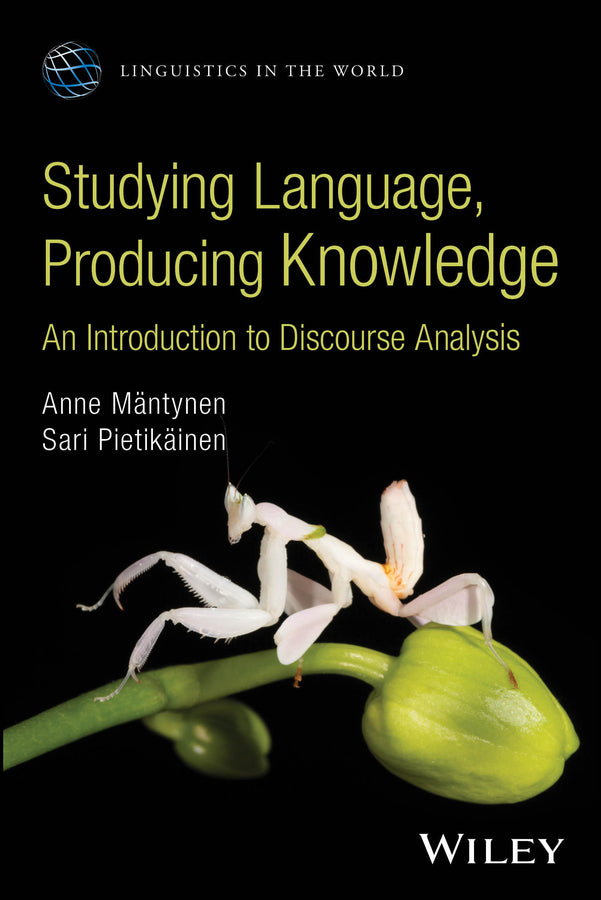
Studying Language, Producing Knowledge
An Introduction to Discourse Analysis
Anne Mäntynen (Author), Sari Pietikäinen (Author)
9781119860310, Wiley
Paperback / softback, published 30 April 2026
192 pages
22.6 x 15.2 x 1.5 cm, 0.34 kg
Language is more than a tool for communication—it is a powerful force that shapes how knowledge is produced and understood. Studying Language, Producing Knowledge offers a clear and comprehensive introduction to discourse studies, demonstrating how language operates as social action. Anne Mäntynen and Sari Pietikäinen trace the evolution of the field, combining classic theories with contemporary approaches to show how discourse constructs meaning, identities, and social realities. Through an engaging blend of conceptual explanation and practical guidance, this textbook guides readers step by step through the process of analyzing discourse in real-world contexts. Each chapter provides key concepts, discussion points, and examples that help students move confidently from theory to research practice. Throughout the text, the authors highlight how discourse interacts with power, ideology, and change, and how the study of language can reveal the dynamics of knowledge production in today’s complex social world. Studying Language, Producing Knowledge is written for undergraduate and postgraduate students across language, communication, and cultural studies, as well as sociology and anthropology. It is ideal for courses on discourse analysis, language and society, or qualitative research methods, and serves as an essential guide for anyone seeking to understand how language shapes the ways we know and act.
Acknowledgements ix Part I What is Discourse Studies? 1 1 Language as Social Action 3 1.1 Language and Society 4 1.2 Language as a Resource 7 Takeaways 10 Discussion Points 11 References 11 2 The Dynamic Concept of Discourse 12 2.1 What Is Discourse? 12 2.2 Discourse: Entanglements Between Language and Society 15 Takeaways 17 Discussion Points 18 References 18 3 Discourse in Contexts 19 3.1 Context Matters 20 3.2 Connecting Contexts 21 3.3 Situational Context 22 3.4 Discourse Practices 25 3.5 Multiplicity of Contexts 26 Takeaways 28 Discussion Points 28 References 29 4 Frameworks for Examining Discourse 30 4.1 Frameworks for Analysing Discourse Dimensions, Processes and Connections 31 4.2 Three- Dimensional Discourse: Norman Fairclough 32 4.3 Nexus Analysis 33 4.4 Critical Assemblage Analysis 34 4.5 Concepts as Thinking Tools 36 Takeaways 37 Discussion Points 37 References 37 Part II Key Concepts for Analysing Discourse 39 5 Discourse, Power and Knowledge 41 5.1 Discourse and Knowledge Production 42 5.2 Discursive Struggles: A Moment of Competing Discourses 43 5.3 Intertwined Knowledges 44 5.4 Categorisation as a Revaluing Resource 46 Takeaways 48 Discussion Points 49 References 49 6 Genre 51 6.1 Genre Matters 52 6.2 Functional Genre 53 6.3 The Power of the Genre 54 6.4 Genre Frameworks 56 6.5 Genre Norms 58 6.6 Genre as an Organising Power 59 Takeaways 61 Discussion Points 62 References 62 7 Regulating Discourse 64 7.1 Centripetal and Centrifugal Forces 65 7.2 Discourse Norms 65 7.3 Discourse Regulation 67 7.4 Discourse Regimes 69 7.5 AI as a Regulating Writing Machine 71 Takeaways 72 Discussion Points 73 References 73 8 Discourse Dynamics 74 8.1 Intertextuality 74 8.2 Genre Hybridity 78 8.3 Re/Deterritorialisation 81 Takeaways 82 Discussion Points 83 References 84 9 The Power of Language Ideologies 85 9.1 Language Ideological Debates: A Discourse Studies Approach 86 9.2 Language Ideology at the Service of Nation- Building 89 9.3 Multilingualism and Language Ideologies 90 9.4 Indexicality and Language Ideological Processes 92 Takeaways 96 Discussion Points 96 Note 96 References 97 Part III A Practical Guide to Discourse Analysis 101 10 Research Process in Discourse Studies 103 10.1 Qualitative Researching 103 10.2 Designing Your Discourse Research 105 10.3 Get Started with Your Discourse Research: The Plan 108 10.4 Doing Discourse Analysis: 20 Practical Steps 108 10.5 A Final Note 110 11 Getting Started with Your Research Project 111 11.1 Choosing a Topic 112 Checklist: Understanding and Analysing Context in Discourse Research 113 11.2 Research Questions as Research Strategy 114 11.3 Thinking Tools: Theories and Concepts 116 11.4 Concepts at Work 117 11.5 Finding Your Data 118 11.6 Collecting Your Data 119 11.7 Managing Your Data 120 References 121 12 Methods for Meaning: Doing Discourse Analysis 122 12.1 Methods in Discourse Studies 123 12.2 Analytical Process: Step by Step 124 12.2.1 Description 124 12.2.2 Interpretation 125 12.2.3 Explanation 127 12.3 Making Your Argument 127 References 128 13 Doing Discourse Analysis 129 Key Principle: Knowledge Is Discursively Constructed 131 Stage I: Getting Started 132 Step 1: Analysis Is a Process 132 Step 2: Analysis Requires Theoretical Understanding 138 Step 3: Analysis Requires a Selective Gaze 142 Step 4: Researcher Constructs the Data 144 Stage II: Doing Analysis and Making Connections 146 Step 5: Analysis Means Making Choices 146 Step 6: Analysis Is the Systematic Classification and Organisation of Observations 148 Step 7: Analysis Requires Conceptualisation and Abstraction 150 Step 8: Analysis Is Making Connections 152 Stage III: Producing New Knowledge 154 Step 9: Analysis Is Argumentation and Writing 154 Step 10: Analysis Is Participating in a Discussion 157 References 160 Bibliography 162 Index 168
Subject Areas: Linguistics [CF]