Freshly Printed - allow 10 days lead
Couldn't load pickup availability
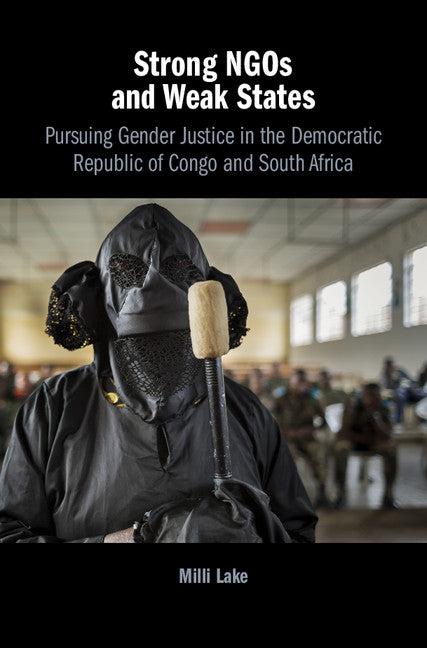
Strong NGOs and Weak States
Pursuing Gender Justice in the Democratic Republic of Congo and South Africa
Offers evidence that opportunity structures created by state weakness can allow NGOs to exert unparalleled influence over local human rights law and practice.
Milli Lake (Author)
9781108419376, Cambridge University Press
Hardback, published 31 May 2018
320 pages, 5 b/w illus. 2 maps 1 table
23.5 x 15.8 x 2.1 cm, 0.59 kg
'This is a book that should be read by many: area experts and ethnographers, feminist and queer scholars, global sociologists, political scientists with a comparative politics and IR focus, policy makers and development aid practitioners, legal scholars, and criminologists with international and human rights interests.' Randi Solhjell, Forum for Development Studies
Over the past decade, the Democratic Republic of the Congo (DR Congo) and South Africa have attracted global attention for high rates of sexual and gender-based violence. Why is it that courts in eastern DR Congo prioritize gender crimes despite considerable logistical challenges, while courts in South Africa, home to a far stronger legal infrastructure and human rights record, have struggled to provide justice to victims of similar crimes? Lake shows that state fragility in DR Congo has created openings for human rights nongovernmental organizations (NGOs) to influence legal processes in ways that have proved impossible in countries like South Africa, where the state is stronger. Yet exploiting opportunities presented by state fragility to pursue narrow human rights goals invites a host of new challenges. Strong NGOs and Weak States documents the promises and pitfalls of human rights and rule of law advocacy undertaken by NGOs in strong and weak states alike.
1. Law in unforeseen places
2. Researching violence and law in South Africa's Western Cape and DR Congo's Eastern provinces
3. Explaining state-level policy and practice
4. Local justice institutions and opportunities created by state fragility
5. Ordinary women in court: socialization and outreach from the ground up
6. Hard fought victories: assessing the human rights benefits felt by victims of violence in DR Congo
7. Justice for who? The unintended consequences of hard fought victories
8. Conclusion: NGOs and state (un)making
Appendix A: decisions in the field
Appendix B: interviews with victims of gender violence
Appendix C: DR Congo's criminal justice system
Appendix D: South Africa's criminal justice system.
Subject Areas: International organisations & institutions [LBBU], International relations [JPS], Gender studies, gender groups [JFSJ]