Freshly Printed - allow 10 days lead
Couldn't load pickup availability
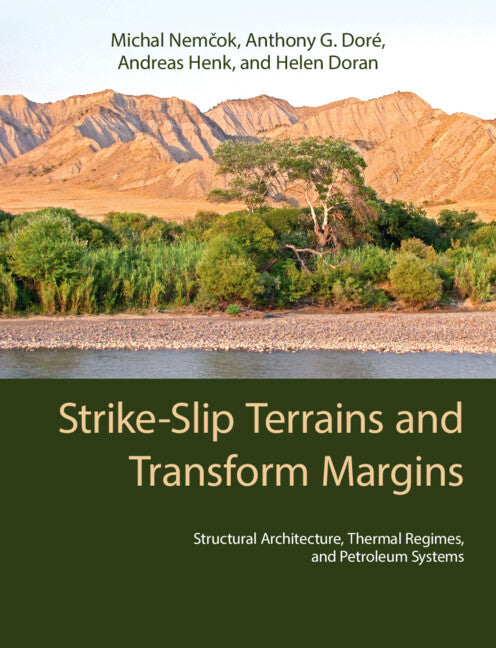
Strike-Slip Terrains and Transform Margins
Structural Architecture, Thermal Regimes and Petroleum Systems
Synthesis of strike-slip and transform settings, aiding petroleum, water and geothermal exploration for advanced students and researchers.
Michal Nemčok (Author), Anthony G. Doré (Author), Andreas Henk (Author), Helen Doran (Author)
9781316513958, Cambridge University Press
Hardback, published 23 January 2025
754 pages
28.8 x 22.4 x 4.5 cm, 2.12 kg
Many of the world's continents are bounded or traversed by vast fault networks that move laterally, like the well-known San Andreas Fault. As well as being major tectonic features of the Earth's surface, these strike-slip regimes are vitally important to the world's natural resources – petroleum, water, and geothermal energy. This book covers all aspects of these regimes; how they initiate; how they develop; and the natural resources associated with them. Numerous global case studies illustrate structural development, thermal and fluid flow implications, and commercial applicability. No other book provides such a comprehensive overview of these settings, and this volume will stand as a critical reference of the state of knowledge of strike-slip terrains and transform margins. It will be invaluable for a broad range of readers, from advanced students of geology and researchers specializing in strike-slip regimes to geoscientists and managers involved in natural resources and energy solutions.
Introduction
1. Basic description of structural architecture in transform margin settings
2. Mechanics of strike-slip faulting and transition to drift phases
3. Determination of continental, proto-oceanic and oceanic crustal boundaries
4. Determination of timing of strike-slip events and continental breakup along transforms
5. Role of lithospheric composition and compositional variations in evolving structural styles
6. Role of pre-existing anisotropy in evolving strike-slip structural styles
7. Role of syn-tectonic deposition and erosion in evolving structural styles
8. Fluid flow systems and magmatism
9. Role of pre-tectonic heat flow in thermal regimes
10. Role of stratigraphic and structural architecture in thermal regimes
11. Role of syn-tectonic deposition and erosion in thermal regimes
12. The role of deformation on thermal regimes of transform margins
13. Role of fluid flow on thermal regime
14. Models of source rock distribution, maturation and expulsion
15. Models of reservoir quality distribution
16. Sealing characteristics
17. Models of hydrocarbon migration
18. Trapping styles
References
Index.
Subject Areas: Geology & the lithosphere [RBG]