Freshly Printed - allow 7 days lead
Couldn't load pickup availability
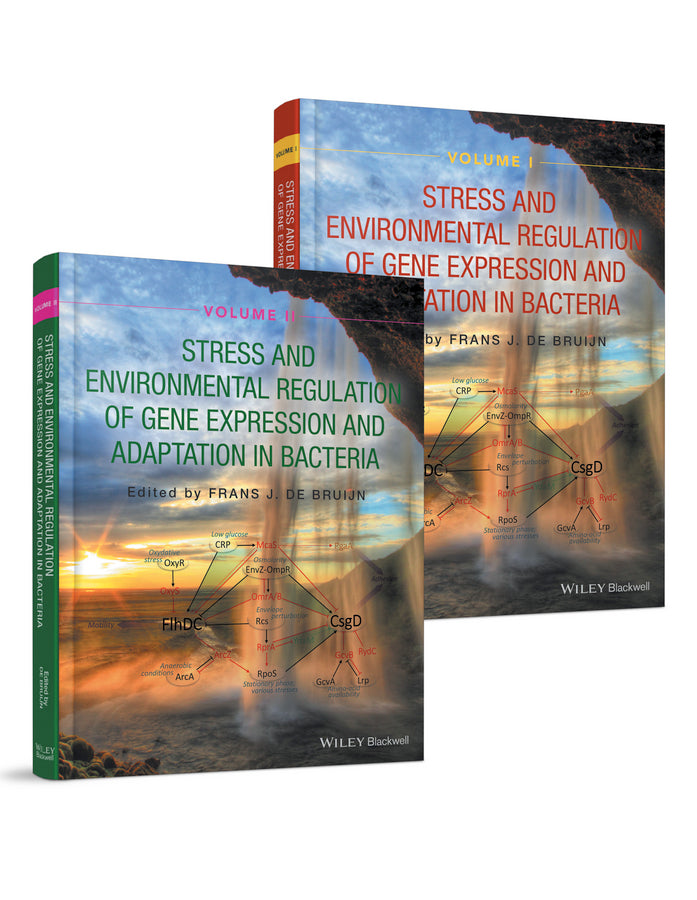
Stress and Environmental Regulation of Gene Expression and Adaptation in Bacteria, 2 Volume Set
Frans J. de Bruijn (Edited by)
9781119004882, Wiley
Hardback, published 13 September 2016
1472 pages
28.5 x 22.4 x 6.4 cm, 4.014 kg
Bacteria in various habitats are subject to continuously changing environmental conditions, such as nutrient deprivation, heat and cold stress, UV radiation, oxidative stress, dessication, acid stress, nitrosative stress, cell envelope stress, heavy metal exposure, osmotic stress, and others. In order to survive, they have to respond to these conditions by adapting their physiology through sometimes drastic changes in gene expression. In addition they may adapt by changing their morphology, forming biofilms, fruiting bodies or spores, filaments, Viable But Not Culturable (VBNC) cells or moving away from stress compounds via chemotaxis. Changes in gene expression constitute the main component of the bacterial response to stress and environmental changes, and involve a myriad of different mechanisms, including (alternative) sigma factors, bi- or tri-component regulatory systems, small non-coding RNA’s, chaperones, CHRIS-Cas systems, DNA repair, toxin-antitoxin systems, the stringent response, efflux pumps, alarmones, and modulation of the cell envelope or membranes, to name a few. Many regulatory elements are conserved in different bacteria; however there are endless variations on the theme and novel elements of gene regulation in bacteria inhabiting particular environments are constantly being discovered. Especially in (pathogenic) bacteria colonizing the human body a plethora of bacterial responses to innate stresses such as pH, reactive nitrogen and oxygen species and antibiotic stress are being described. An attempt is made to not only cover model systems but give a broad overview of the stress-responsive regulatory systems in a variety of bacteria, including medically important bacteria, where elucidation of certain aspects of these systems could lead to treatment strategies of the pathogens. Many of the regulatory systems being uncovered are specific, but there is also considerable “cross-talk” between different circuits. Stress and Environmental Regulation of Gene Expression and Adaptation in Bacteria is a comprehensive two-volume work bringing together both review and original research articles on key topics in stress and environmental control of gene expression in bacteria. Volume One contains key overview chapters, as well as content on one/two/three component regulatory systems and stress responses, sigma factors and stress responses, small non-coding RNAs and stress responses, toxin-antitoxin systems and stress responses, stringent response to stress, responses to UV irradiation, SOS and double stranded systems repair systems and stress, adaptation to both oxidative and osmotic stress, and desiccation tolerance and drought stress.
Covering the full breadth of current stress and environmental control of gene expression studies and expanding it towards future advances in the field, these two volumes are a one-stop reference for (non) medical molecular geneticists interested in gene regulation under stress.
VOLUME 1 Preface, xiii Acknowledgements, xiv List of contributors, xv 1 Introduction, 1 Section 2: Key overview chapters, 3 2.1 Stress-induced changes in transcript stability, 5 2.2 StressChip for monitoring microbial stress response in the environment, 9 2.3 A revolutionary paradigm of bacterial genome regulation, 23 2.4 Role of changes in σ70-driven transcription in adaptation of E. coli to conditions of stress or starvation, 37 2.5 The distribution and spatial organization of RNA polymerase in Escherichia coli: growth rate regulation and stress responses, 48 2.6 The ECF classification: a phylogenetic reflection of the regulatory diversity in the extracytoplasmic function σ factor protein family, 64 2.7 Toxin–antitoxin systems in bacteria and archaea, 97 2.8 Bacterial sRNAs: regulation in stress, 108 2.9 Bacterial stress responses as determinants of antimicrobial resistance, 115 2.10 Transposable elements: a toolkit for stress and environmental adaptation in bacteria, 137 2.11 CRISPR–Cas system: a new paradigm for bacterial stress response through genome rearrangement, 146 2.12 The copper metallome in prokaryotic cells, 161 2.13 Ribonucleases as modulators of bacterial stress response, 174 2.14 Double-strand-break repair, mutagenesis, and stress, 185 2.15 Sigma factor competition in Escherichia coli: kinetic and thermodynamic perspectives, 196 2.16 Iron homeostasis and iron–sulfur cluster assembly in Escherichia coli, 203 2.17 Mechanisms underlying the antimicrobial capacity of metals, 215 2.18 Acyl-homoserine lactone-based quorum sensing in members of the marine bacterial Roseobacter clade: complex cell-to-cell communication controls multiple physiologies, 225 2.19 Native and synthetic gene regulation to nitrogen limitation stress, 234 Section 3: One-, two-, and three-component regulatory systems and stress responses, 247 3.1 Two-component systems that control the expression of aromatic hydrocarbon degradation pathways, 249\ 3.2 Cross-talk of global regulators in Streptomyces, 257 3.3 NO–H-NOX-regulated two-component signaling, 268 3.4 The two-component CheY system in the chemotaxis of Sinorhizobium meliloti, 277 3.5 Stimulus perception by histidine kinases, 282 Section 4: Sigma factors and stress responses, 301 4.1 The extracytoplasmic function sigma factor EcfO protects Bacteroides fragilis against oxidative stress, 303 4.2 Regulation of energy metabolism by the extracytoplasmic function (ECF) σ factors of Arcobacter butzleri, 311 4.3 Extracytoplasmic function sigma factors and stress responses in Corynebacterium pseudotuberculosis, 321 4.4 The complex roles and regulation of stress response σ factors in Streptomyces coelicolor, 328 4.5 Proteolytic activation of extra cytoplasmic function (ECF) σ factors, 344 4.6 The ECF family sigma factor σH in Corynebacterium glutamicum controls the thiol-oxidative stress response, 352 4.7 Posttranslational regulation of antisigma factors of RpoE: a comparison between the Escherichia coli and Pseudomonas aeruginosa systems, 361 Section 5: Small noncoding RNAs and stress responses, 369 5.1 Bacterial small RNAs in mixed regulatory circuits, 371 5.2 Role of small RNAs in Pseudomonas aeruginosa virulence and adaptation, 383 5.3 Physiological effects of posttranscriptional regulation by the small RNA SgrS during metabolic stress in 5.4 Three rpoS-activating small RNAs in pathways contributing to acid resistance of Escherichia coli, 402 5.5 Thermal stress noncoding RNAs in prokaryotes and eukaryotes: a comparative approach, 412 Section 6: Toxin-antitoxin systems and stress responses, 423 6.1 Epigenetics mediated by restriction modification systems, 425 6.2 Toxin–antitoxin systems as regulators of bacterial fitness and virulence, 437 6.3 Mechanisms of stress-activated persister formation in Escherichia coli, 446 6.4 Identification and characterization of type II toxin–antitoxin systems in the opportunistic pathogen 6.5 Transcriptional control of toxin–antitoxin expression: keeping toxins under wraps until the time is right, 463 6.6 Opposite effects of GraT toxin on stress tolerance of Pseudomonas putida, 473 Section 7: Stringent response to stress, 479 7.1 Preferential cellular accumulation of ppGpp or pppGpp in Escherichia coli, 481 7.2 Global Rsh-dependent transcription profile of Brucella suis during stringent response unravels adaptation to nutrient starvation and cross-talk with other stress responses, 489 7.3 The stringent response and antioxidant defences in Pseudomonas aeruginosa, 500 7.4 Molecular basis of the stringent response in Vibrio cholerae, 507 Section 8: Responses to UV irradiation, 517 8.1 UV stress-responsive genes associated with ICE SXT/R391 group, 519 8.2 Altered outer membrane proteins in response to UVC radiation in Vibrio parahaemolyticus and Vibrio alginolyticus, 528 8.3 Ultraviolet-B radiation effects on the community, physiology, and mineralization of magnetotactic bacteria, 532 8.4 Nucleotide excision repair system and gene expression in Mycobacterium smegmatis, 545 Section 9: SOS and double stranded repair systems and stress, 551 9.1 The SOS response modulates bacterial pathogenesis, 553 9.2 RNAP secondary-channel interactors in Escherichia coli: makers and breakers of genome stability, 561 9.3 How a large gene network couples mutagenic DNA break repair to stress in Escherichia coli, 570 9.4 Double-strand DNA break repair in mycobacteria, 577 Section 10: Adaptation to oxidative stress, 587 10.1 Peroxide-sensing transcriptional regulators in bacteria, 58 10.2 Regulation of oxidative stress–related genes implicated in the establishment of opportunistic infections by Bacteroides fragilis, 603 10.3 Investigation into oxidative stress response of Shewanella oneidensis reveals a distinct mechanism, 609 10.4 An omics view on the response to singlet oxygen, 619 10.5 Regulators of oxidative stress response genes in Escherichia coli and their conservation in bacteria, 632 10.6 Hydrogen peroxide resistance in Bifidobacterium animalis subsp. lactis and Bifidobacterium longum, 638 Section 11: Adaptation to osmotic stress, 647 11.1 Interstrain variation in the physiological and transcriptional responses of Pseudomonas syringae to osmotic stress, 649 11.2 Management of osmotic stress by Bacillus subtilis: genetics and physiology, 657 11.3 Hyperosmotic response of Streptococcus mutans: from microscopic physiology to transcriptomic profile, 677 11.4 Defective ribosome maturation or function makes Escherichia coli cells salt-resistant, 687 Section 12: Dessication tolerance and drought stress, 693 12.1 Consequences of elevated salt concentrations on expression profiles in the rhizobium S. meliloti 1021 likely involved in heat and desiccation stress, 695 12.2 Genes involved in the formation of desiccationresistant cysts in Azotobacter vinelandii, 709 12.3 Osmotic and desiccation tolerance in Escherichia coli O157:H7 and Salmonella enterica requires rpoS (σ38), 716 12.4 Desiccation of Salmonella enterica induces cross-tolerance to other stresses, 725 Index, i1 VOLUME 2 Preface, xiii Acknowledgements, xiv List of contributors, xv Section 13: Heat shock responses, 737 13.1 Heat shock response in bacteria with large genomes: lessons from rhizobia, 739 13.2 Small heat shock proteins in bacteria, 747 13.3 Transcriptome analysis of bacterial response to heat shock using next-generation sequencing, 754 13.4 Comparative analyses of bacterial transcriptome reorganisation in response to temperature increase, 757 13.5 Participation of Ser–Thr protein kinases in regulation of heat stress responses in Synechocystis, 766 Section 14: Chaperonins and stress, 781 14.1 GroEL/ES chaperonin: unfolding and refolding reactions, 783 14.2 Functional comparison between the DnaK chaperone systems of Streptococcus intermedius and Escherichia coli, 791 14.3 Coevolution analysis illuminates the evolutionary plasticity of the chaperonin system GroES/L, 796 14.4 ClpL ATPase: a novel chaperone in bacterial stress responses, 812 14.5 Duplicated groEL genes inMyxococcus xanthus DK1622, 820 Section 15: Cold shock responses, 827 15.1 Gene regulation by cold shock proteins via transcription antitermination, 829 15.2 Metagenomic analysis of microbial cold stress proteins in polar lacustrine ecosystems, 837 15.3 Role of two-component systems in cold tolerance of Clostridium botulinum, 845 15.4 Cold shock CspA protein production during periodic temperature cycling in Escherichia coli, 854 15.5 Cold shock response in Escherichia coli: a model system to study posttranscriptional regulation, 859 15.6 New insight into cold shock proteins: RNA-binding proteins involved in stress response and virulence, 873 15.7 Light regulation of cold stress responses in Synechocystis, 881 15.8 Escherichia coli cold shock gene profiles in response to overexpression or deletion of CsdA, RNase R, and Section 16: Adaptation to acid stress, 897 16.1 Acid-adaptive responses of Streptococcus mutans, and mechanisms of integration with oxidative stress, 899 16.2 Acid survival mechanisms in neutralophilic bacteria, 911 16.3 Two-component systems in sensing and adapting to acid stress in Escherichia coli, 927 16.4 Slr1909, a novel two-component response regulator involved in acid tolerance in Synechocystis sp. PCC 6803, 935 16.5 Comparative mass spectrometry–based proteomics to elucidate the acid stress response in Lactobacillus Section 17: Adaptation to nitrosative stress, 953 17.2 Haemoglobins of Mycobacterium tuberculosis and their involvement in management of environmental stress, 967 17.3 What is it about NO that you don’t understand? The role of heme and HcpR in Porphyromonas gingivalis’s response to nitrate (NO3), nitrite (NO2), and nitric oxide (NO), 976 17.4 Di-iron RICs: players in nitrosative-oxidative stress defences, 989 17.5 The Vibrio cholerae stress response: an elaborate system geared toward overcoming host defenses during infection, 997 17.6 Ensemble modeling enables quantitative exploration of bacterial nitric oxide stress networks, 1009 Section 18: Adaptation to cell envelope stress, 1015 18.1 The Cpx inner membrane stress response, 1017 18.2 New insights into stimulus detection and signal propagation by the Cpx-envelope stress system, 1025 18.3 Promiscuous functions of cell envelope stress-sensing systems in Klebsiella pneumoniae and Acinetobacter 18.4 Influence of BrpA and Psr on cell envelope homeostasis and virulence of Streptococcus mutans, 1043 18.5 Modulators of the bacterial two-component systems involved in envelope stress, transport, and virulence, 1055 Section 19: Iron homeostasis, 1065 19.1 Iron homeostasis and environmental responses in cyanobacteria: regulatory networks involving Fur, 1067 19.2 Interplay between O2 and iron in gene expression: environmental sensing by FNR, ArcA, and Fur in bacteria, 1079 19.3 The iron–sulfur cluster biosynthesis regulator IscR contributes to iron homeostasis and resistance to 19.4 Transcriptional analysis of iron-responsive regulatory networks in Caulobacter crescentus, 1103 19.5 Protein–protein interactions regulate the release of iron stored in bacterioferritin, 1109 19.6 Protein dynamics and ion traffic in bacterioferritin function: a molecular dynamics simulation study on Section 20: Metal resistance, 1131 20.1 Nickel toxicity, regulation, and resistance in bacteria, 1133 20.2 Metabolic networks to counter Al toxicity in Pseudomonas fluorescens: a holistic view, 1145 20.3 Genomics of the resistance to metal and oxidative stresses in cyanobacteria, 1154 20.4 Cross-species transcriptional network analysis reveals conservation and variation in response to metal stress in cyanobacteria, 1165 20.5 The extracytoplasmic function sigma factor–mediated response to heavy metal stress in Caulobacter crescentus, 1171 20.6 Metal ion toxicity and oxidative stress in Streptococcus pneumoniae, 1184 Section 21: Quorum sensing, 1195 21.1 Quorum sensing and bacterial social interactions in biofilms: bacterial cooperation and competition, 1197 21.2 Recent advances in bacterial quorum quenching, 1206 21.3 LuxR-type quorum-sensing regulators that are antagonized by cognate pheromones, 1221 21.4 Adaptation to environmental stresses in Streptococcus mutans through the production of its quorum-sensing peptide pheromone, 1232 21.5 Quorum sensing in Bacillus cereus in relation to cysteine metabolism and the oxidative stress response, 1242 Section 22: Chemotaxis and biofilm formation, 1253 22.1 The flagellum as a sensor, 1255 22.2 Flagellar motility and fitness in xanthomonads, 1265 22.3 Understanding Listeriamonocytogenes biofilms: perspectives into mechanisms of adaptation and regulation under stress conditions, 1274 22.4 Biofilm formation and environmental signals in Bordetella, 1279 22.5 Biofilm formation by rhizobacteria in response to water-limiting conditions, 1287 22.6 Stress conditions triggering mucoid-to-nonmucoid morphotype variation in Burkholderia, and effects on 22.7 Effect of environmental conditions present in the fishery industry on the biofilm-forming ability of Staphylococcus aureus, 1304 22.8 Biofilm development and stress response in the cholera bacterium, 1310 22.9 Outer membrane vesicle secretion: from envelope stress to biofilm formation, 1322 Section 23: Viable but nonculturable (VBNC) cells, 1329 23.1 Resuscitation of Vibrios fromthe viable but nonculturable state is induced by quorum-sensing molecules, 1331 23.2 Differential resuscitative effects of pyruvate and its analogs on VBNC (viable but nonculturable) 23.3 Environmental persistence of Shiga toxin–producing E. coli, 1346 23.4 Of a tenacious and versatile relic: the role of inorganic polyphosphate (poly-P) metabolism in the survival, adaptation, and virulence of Campylobacter jejuni, 1354 Index, i1
Frans J. de Bruijn
Dvora Biran and Eliora Z. Ron
Joy D. Van Nostrand, Aifen Zhou and Jizhong Zhou
Akira Ishihama
Umender K. Sharma
Ding Jun Jin, Cedric Cagliero, Jerome Izard, Carmen Mata Martin, and Yan Ning Zhou
Daniela Pinto andThorsten Mascher
Yoshihiro Yamaguchi and Masayori Inouye
Marimuthu Citartan, Carsten A. Raabe, Chee-Hock Hoe, Timofey S. Rozhdestvensky, andThean-Hock Tang
Michael Fruci and Keith Poole
Anna Ullastres, Miriam Merenciano, Lain Guio, and Josefa González
Joseph A. Hakim, Hyunmin Koo, Jan D. van Elsas, Jack T. Trevors, and Asim K. Bej
Christopher Rensing, Hend A. Alwathnani, and Sylvia F. McDevitt
Cátia Bárria, Vánia Pobre, Afonso M. Bravo, and Cecília M. Arraiano
Elizabeth Rogers, Raul Correa, Brittany Barreto, María Angélica Bravo Núñez, P.J. Minnick, Diana Vera Cruz, Jun Xia, P.J. Hastings, and Susan M. Rosenberg
Kuldeepkumar Ramnaresh Gupta and Dipankar Chatterji
Huangen Ding
Joe A. Lemire and Raymond J. Turner
Alison Buchan, April Mitchell,W. Nathan Cude, and Shawn Campagna
J örg Schumacher
Tino Krell
Juan F. Martín, Fernando Santos-Beneit, Alberto Sola-Landa, and Paloma Liras
Dhruv P. Arora, Sandhya Muralidharan, and Elizabeth M. Boon
Martin Haslbeck
Hannah Schramke, Yang Wang, Ralf Heermann, and Kirsten Jung
Ivan C. Ndamukong, Samantha Palethorpe, Michael Betteken, and C. Jeffrey Smith
Irati Martinez-Malaxetxebarria, Rudy Muts, Linda van Dijk, Craig T. Parker, William G. Miller, Steven Huynh,Wim Gaastra, Jos P.M. van Putten, Aurora Fernandez-Astorga, and Marc M.S.M Wösten
Thiago L.P. Castro, Nubia Seyffert, Anne C. Pinto, Artur Silva, Vasco Azevedo, and Luis G.C. Pacheco
Jan Kormanec, Beatrica Sevcikova, Renata Novakova, Dagmar Homerova, Bronislava Rezuchova, and Erik Mingyar
JessicaL. Hastie and Craig D. Ellermeier
Tobias Busche and Jörn Kalinowski
Sundar Pandey, Kyle L. Martins, and Kalai Mathee
Jonathan Jagodnik, DenisThieffry, and Maude Guillier
Hansi Kumari, Deepak Balasubramanian, and Kalai Mathee
Escherichia coli, 393
Gregory R. Richards
Geunu Bak, Kook Han, Daun Kim, Kwang-sun Kim, and Younghoon Lee
Mercedes de la Fuente and José Luis Martínez-Guitarte
Iwona Mruk and Ichizo Kobayashi
Brittany A. Fleming and Matthew A. Mulvey
Stephanie M. Amato and Mark P. Brynildsen
Acinetobacter baumannii, 454
Edita Sûziedéliené, Milda Jurénaité, and Julija Armalyté
Barbara Kℷedzierska and Finbarr Hayes
Rita Hõrak and Hedvig Tamman
K. Potrykus and M. Cashel
Stephan Köhler, Nabil Hanna, Safia Ouahrani-Bettache, Kenneth L. Drake, L. Garry Adams, and Alessandra Occhialini
Gowthami Sampathkumar, Malika Khakimova, Tevy Chan, and Dao Nguyen
Shreya Dasgupta, Bhabatosh Das, Pallabi Basu, and Rupak K. Bhadra
Patricia Armshaw and J. Tony Pembroke
Fethi Ben Abdallah
Yingzhao Wang and Yongxin Pan
Angelina Cordone
Darja ¢§Zgur Bertok
Priya Sivaramakrishnan and Christophe Herman
Elizabeth Rogers, P.J. Hastings, María Angélica Bravo Núñez, and Susan M. Rosenberg
Richa Gupta and Michael S. Glickman
James M. Dubbs and Skorn Mongkolsuk
Felipe Lopes Teixeira, Regina Maria Cavalcanti Pilotto Domingues, and Leandro Araujo Lobo
Jie Yuan, Fen Wan, and Haichun Gao
Bork A. Berghoff and Gabriele Klug
Herb E. Schellhorn, Mohammad Mohiuddin, Sarah M. Hammond, and Steven Botts
Taylor S. Oberg and Jeff R. Broadbent
Gwyn A. Beattie, Chiliang Chen, Lindsey Nielsen, and Brian C. Freeman
Tamara Hoffmann and Erhard Bremer
Lu Wang and Xin Xu
Hyouta Himeno, Takefusa Tarusawa, Shion Ito, and Simon Goto
Jan A.C. Vriezen, Caroline M. Finn, and Klaus Nüsslein
Guadalupe Espín
Zach Pratt, Megan Shiroda, Andrew J. Stasic, Josh Lensmire, and C.W. Kaspar
Shlomo Sela (Saldinger) and Chellaiah Edward Raja
Ana Alexandre and Solange Oliveira
Martin Haslbeck
Kok-Gan Chan
Bei-Wen Ying and Tetsuya Yomo
Anna A. Zorina, Galina V. Novikova, and Dmitry A. Los
Victor V. Marchenkov, Nataliya A. Ryabova, Olga M. Selivanova, and Gennady V. Semisotnov
Toshifumi Tomoyasu and Hideaki Nagamune
Mario A. Fares
Pratick Khara and Indranil Biswas
Yan Wang, Xiao-jing Chen, and Yue-zhong Li
Sangita Phadtare and Konstantin Severinov
Hyunmin Koo, Joseph A. Hakim, and Asim K. Bej
Yâgmur Derman, Elias Dahlsten, and Hannu Korkeala
David Stopar and Tina Ivancic
Anna Maria Giuliodori
Charlotte Michaux and Jean-Christophe Giard
Kirill S. Mironov and Dmitry A. Los
PNPase and relevance to low-temperature RNA metabolism, 890
Sangita Phadtare
Robert G. Quivey Jr., Roberta C. Faustoferri, Brendaliz Santiago, Jonathon Baker, Benjamin Cross, and Jin Xiao
Eugenia Pennacchietti, Fabio Giovannercole, and Daniela De Biase
Yoko Eguchi and Ryutaro Utsumi
Lei Chen, Qiang Ren, Jiangxin Wang, and Weiwen Zhang
plantarum, 944
Tiaan Heunis, Shelly Deane, and Leon M.T. Dicks
17.1 Transcriptional regulation by thiol-based sensors of oxidative and nitrosative stress, 955
Timothy Tapscott, Matthew A. Crawford, and Andr´es Vázquez-Torres
Kanak L. Dikshit
Janina P. Lewis and Benjamin R. Belvin
Lígia S. Nobre and Lí©¥gia M. Saraiva
Karl-Gustav Rueggeberg and Jun Zhu
Jonathan L. Robinson and Mark P. Brynildsen
Randi L. Guest and Tracy L. Raivio
Patrick Hoernschemeyer and Sabine Hunke
baumannii, 1031
Vijaya Bharathi Srinivasan and Govindan Rajamohan
Zezhang T.Wen, Jacob P. Bitoun, Sumei Liao, and Jacqueline Abranches
Rajeev Misra
María Luisa Peleato, María Teresa Bes, and María F. Fillat
Bryan Troxell and Hosni M. Hassan
oxidants in Pseudomonas aeruginosa, 1090
Adisak Romsang, James M. Dubbs, and Skorn Mongkolsuk
José F. da Silva Neto
Huili Yao, YanWang, and Mario Rivera
wild-type and mutant Pseudomonas aeruginosa BfrB, 1118
Huan Rui, Mario Rivera, and Wonpil Im
Lee Macomber and Robert P. Hausinger
Christopher Auger, Nishma D. Appanna, and Vasu D. Appanna
Corinne Cassier-Chauvat and Franck Chauvat
Jiangxin Wang, Gang Wu, Lei Chen, and Weiwen Zhang
Rogério F. Lourenco and Suely L. Gomes
Christopher A. McDevitt, Stephanie L. Begg, and James C. Paton
Yung-Hua Li and Xiao-Lin Tian
Kok-Gan Chan, Wai-Fong Yin, and Kar-Wai Hong
Stephen C. Winans, Ching-Sung Tsai, Gina T. Ryan, Ana Lidia Flores-Mireles, Esther Costa, Kevin Y. Shih, Thomas C.Winans, Youngchang Kim, Robert Jedrzejczak, and Gekleng Chhor
Delphine Dufour, Vincent Leung, and Céline M. Lévesque
Eugénie Huillet and Michel Gohar
Rasika M. Harshey
Marie-Agnès Jacques, Jean-Françis Guimbaud, Martial Briand, Arnaud Indiana, and Armelle Darrasse
Lizziane Kretli Winkelströter, Fernanda Barbosa dos Reis-Teixeira, Gabriela Satti Lameu, and Elaine Cristina Pereira De Martinis
Tomoko Hanawa
Pablo Bogino, Fiorela Nievas, and Walter Giordano
virulence and biofilm formation, 1295
Leonilde M. Moreira, Inês N. Silva, Ana S. Ferreira, and Mário R. Santos
Daniel Vázquez-Sánchez
Anisia J. Silva and Jorge A. Benitez
Thomas Baumgarten and Hermann J. Heipieper
Mesrop Ayrapetyan, Tiffany C. Williams, and James D. Oliver
Salmonella, 1338
Fumio Amano
Philipp Aurass and Antje Flieger
Issmat I. Kassem and Gireesh Rajashekara
Subject Areas: Biology, life sciences [PS]