Freshly Printed - allow 4 days lead
Couldn't load pickup availability
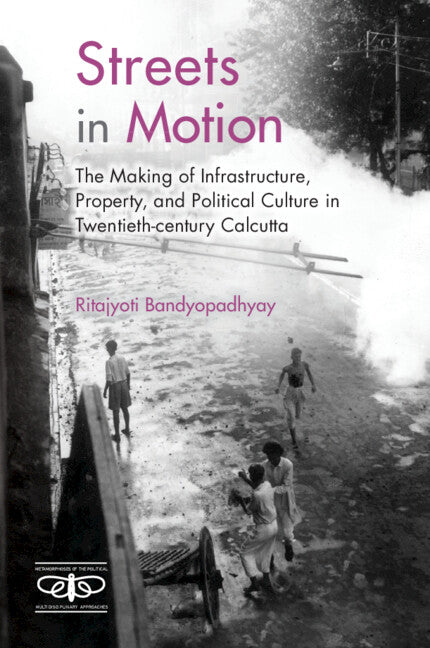
Streets in Motion
The Making of Infrastructure, Property, and Political Culture in Twentieth-century Calcutta
Studies Calcutta's 20th century features through the dialectic of motion and obstruction, analysing how space and polity shaped each other.
Ritajyoti Bandyopadhyay (Author)
9781009100113, Cambridge University Press
Hardback, published 10 November 2022
320 pages
23.6 x 16 x 2.4 cm, 0.52 kg
The book studies the social production of motion in a capitalist urban context. In the city of capital, motion refers to a fetish. The bourgeois order posits motion as a metaphor for energy, positivity, and progress – a norm – and obstruction (motion's dialectical opposite) as delinquency. The book uncovers the social tectonics of spatial mobilization and thus demystifies motion. Who and what set spaces on the move? How did various classes of city dwellers activate, experience, and negotiate it? Streets in Motion develops an approach to urban history by theorizing and historicizing the 'street' as an apparatus of city-making and subject formation. It works at two registers – a local history of Calcutta in colonial and post-colonial periods, and a theorizing of the logistical and political-cultural centrality of the street within this rubric. It is argued that the street is politics in as much as politics is the production of space.
List of Maps, Tables, Appendices, Images
List of Abbreviations
Acknowledgements
Introduction
Chapter 1. The Making of the Modern Street: Engineers, Commoners, Agitators
Chapter 2. The Regime of the Streets: Renewal and Riots, 1910-1926
Chapter 3. City as Territory: Institutionalizing Majoritarianism
Chapter 4. Frontier Urbanization
Chapter 5. Durable Obstructions, Spatializing Motion: The History of Footpath-hawking
Epilogue
Glossary
Bibliography.
Subject Areas: Political economy [KCP], Social & cultural anthropology, ethnography [JHMC], Public buildings: civic, commercial, industrial, etc [AMG]