Freshly Printed - allow 8 days lead
Couldn't load pickup availability
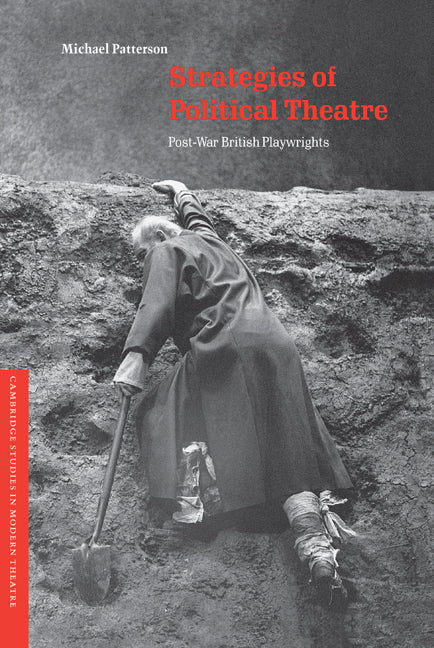
Strategies of Political Theatre
Post-War British Playwrights
Provides theoretical framework for important play-writing in Britain in the second half of the twentieth century.
Michael Patterson (Author)
9780521258555, Cambridge University Press
Hardback, published 22 May 2003
252 pages
23.7 x 16.2 x 2.3 cm, 0.547 kg
'Now that mainstream British theatre seems to have remembered politics, it is useful to recall, with Michael Patterson's help, that political creeds used to inspire stands on the theatrical barricades, if nowhere else.' The Times Literary Supplement
This volume provides a theoretical framework for some of the most important play-writing in Britain in the second half of the twentieth century. Examining representative plays by Arnold Wesker, John Arden, Trevor Griffith, Howard Barker, Howard Brenton, Edward Bond, David Hare, John McGrath and Caryl Churchill, the author analyses their respective strategies for persuading audiences of the need for a radical restructuring of society. The book begins with a discussion of the way that theatre has been used to convey a political message. Each chapter is then devoted to an exploration of the engagement of individual playwrights with left-wing political theatre, including a detailed analysis of one of their major plays. Despite political change since the 1980s, political play-writing continues to be a significant element in contemporary play-writing, but in a very changed form.
Acknowledgements
Brief chronology, 1953–1989
Introduction
Part I. Theory: 1. Strategies of political theatre: a theoretical overview
Part II. Two Model Strategies: 2. The 'reflectionist' strategy: 'kitchen sink' realism in Arnold Wesker's Roots (1959)
3. The 'interventionist' strategy: poetic politics in John Arden's Serjeant Musgrave's Dance (1959)
Part III. The Reflectionist Strain: 4. The dialectics of comedy: Trevor Griffiths's Comedians (1975)
5. Appropriating middle-class comedy: Howard Barker's Stripwell (1975)
6. Staging the future: Howard Brenton's The Churchill Play (1974)
Part IV. The Interventionist Strain: 7. Agit-prop revisited: John McGrath's The Cheviot, the Stag, and the Black, Black Oil (1973)
8. Brecht revisited: David Hare's Fanshen (1975)
9. Rewriting Shakespeare: Edward Bond's Lear (1971)
10. The strategy of play: Caryl Churchill's Cloud Nine (1979)
Conclusion
Notes
Select bibliography
Index.
Subject Areas: Theatre studies [AN]