Freshly Printed - allow 8 days lead
Couldn't load pickup availability
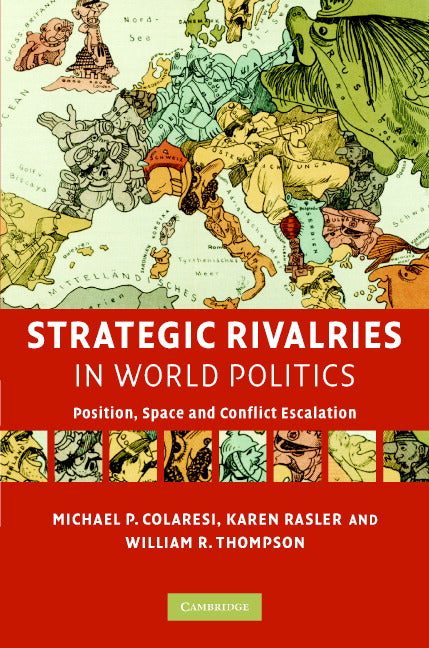
Strategic Rivalries in World Politics
Position, Space and Conflict Escalation
This book examines cases of strategic rivalries and identifies the extent of their effect on international conflict.
Michael P. Colaresi (Author), Karen Rasler (Author), William R. Thompson (Author)
9780521881340, Cambridge University Press
Hardback, published 10 January 2008
330 pages, 18 b/w illus. 54 tables
22.9 x 15.2 x 1.9 cm, 0.61 kg
'This is a book of major importance. It provides new data and new findings that greatly enhance our knowledge of inter-state rivalries, conflict, and war. International Relations scholars and diplomatic historians will find this essential reading.' John A. Vasquez, University of Illinois at Urbana-Champaign
International conflict is neither random nor inexplicable. It is highly structured by antagonisms between a relatively small set of states that regard each other as rivals. Examining the 173 strategic rivalries in operation throughout the nineteenth and twentieth centuries, this book identifies the differences rivalries make in the probability of conflict escalation and analyzes how they interact with serial crises, arms races, alliances and capability advantages. The authors distinguish between rivalries concerning territorial disagreement (space) and rivalries concerning status and influence (position) and show how each leads to markedly different patterns of conflict escalation. They argue that rivals are more likely to engage in international conflict with their antagonists than non-rival pairs of states and conclude with an assessment of whether we can expect democratic peace, economic development and economic interdependence to constrain rivalry-induced conflict.
Part I. About Strategic Rivalries: 1. An introduction to strategic rivalries
2. Defining and identifying strategic rivalries in world politics
3. Describing strategic rivalries
Part II. The Dangers of Strategic Rivalries: Crisis Behavior and Escalation: 4. Protracted conflict and crisis escalation
5. Serial crisis behavior and escalating risks
Part III. Playing to Type: Spatial and Positional Issues in Strategic Rivalries: 6. Contiguity, space and position in the major power subsystem
7. Initiating and escalating positional and spatial rivalries
Part IV. Filling in Some Steps to War: 8. Arms buildups and alliances in the steps-to-war theory
9. Contested territory and conflict escalation
Part V. Strategic Rivalries and Conflict: 10. Inducements, facilitators, and suppressors.
Subject Areas: International relations [JPS], Political science & theory [JPA], Sociology [JHB], General & world history [HBG]