Freshly Printed - allow 7 days lead
Couldn't load pickup availability
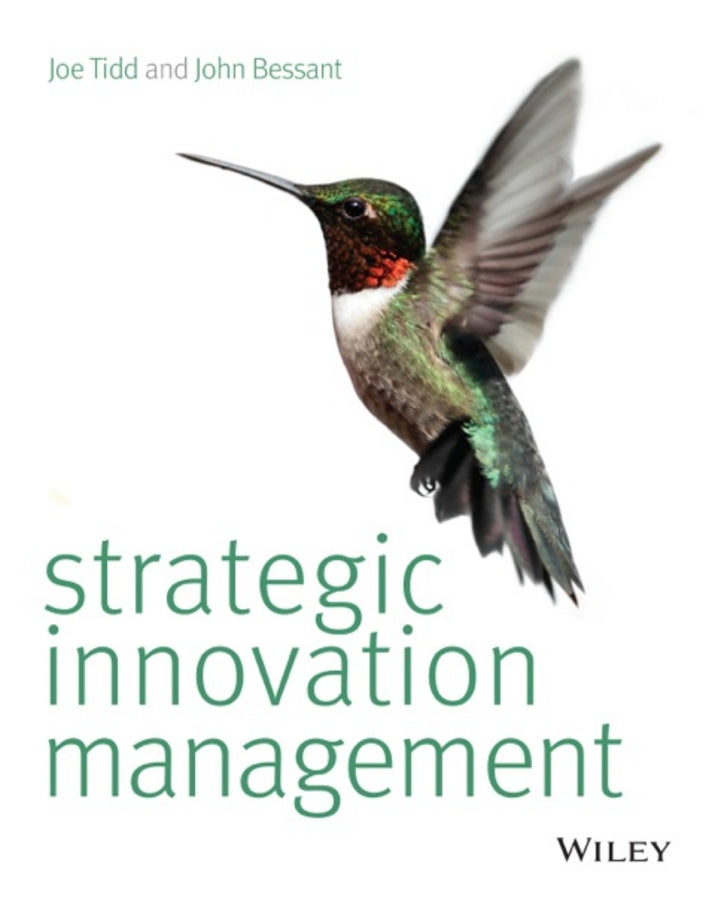
Strategic Innovation Management
Joe Tidd (Author), John R. Bessant (Author)
9781118457238, Wiley
Paperback / softback, published 28 March 2014
448 pages
23.4 x 18.5 x 2 cm, 0.794 kg
Innovative organizations grow twice as fast, both in employment and sales, as those that fail to innovate. The social benefits of innovation are even greater. This first edition of Strategic Innovation Management is an exciting new addition to the established bestselling texts Managing Innovation and Innovation and Entrepreneurship written by Joe Tidd and John Bessant. Aimed at students taking courses in business studies and management, as well as non-specialist courses in other disciplines, this book provides a practical and accessible evidence-based approach to managing innovation in a wide range of contexts, including: manufacturing, services, small to large organizations and the private, public and third sectors. The text has been designed to be fully integrated with the Innovation Portal at https://www.johnbessant.org/the-innovation-portal/, which contains an extensive collection of additional resources for both lecturers and students including teaching resources, case studies, media clips, innovation tools, seminar and assessment activities and over 300 test-bank questions.
About the Authors xi Part I Foundations of Managing Innovation 1 Chapter 1 What Is Innovation – And Why Does It Matter? 3 What Is Innovation? 3 Chapter 2 Innovation Strategy 21 Why Strategy? 21 Chapter 3 Identifying Strategic Capabilities 41 The Resource-Based View 41 Chapter 4 Leadership and Organization of Innovation 61 The Innovative Organization 61 Chapter 5 Innovation as a Process 81 Beyond Spengler 81 Chapter 6 Sources of Innovation 97 Where Do Innovations Come From? 97 Chapter 7 Search Strategies for Innovation 119 Making Sense of the Sources 119 Chapter 8 Forecasting Emerging Opportunities for Innovation 141 Forecasting 141 Chapter 9 Selecting Innovation Projects 159 Why is Selection a Challenge? 159 Chapter 10 Developing New Products and Services 181 The New Product/Service Development Process 181 Chapter 11 Developing Business and Talent through Corporate Venturing 203 Internal Venturing and Entrepreneurship 203 Chapter 12 Commercialization and Diffusion of Innovations 223 Why Adopt Innovations? 223 Chapter 13 Exploiting Knowledge and Intellectual Property 243 Innovation and Knowledge 243 Chapter 14 Business Models and Capturing Value 263 What's a Business Model? 263 Chapter 15 Capture Value: Learning to Manage Innovation 277 The Story So Far . . . 277 Part II The Innovation Frontier 295 Chapter 16 Users as Innovators 297 Users Aren't Passive 297 Chapter 17 Exploiting Open Innovation and Strategic Alliances 311 Open Innovation 311 Chapter 18 Exploiting Discontinuous Innovation 331 Beyond the Steady State 332 Chapter 19 Social Innovation 351 What Is 'Social Innovation'? 352 Chapter 20 Innovation in Developing and Emerging Economies 371 Globalization and Innovation 371 Chapter 21 Sustainability 389 The Challenge of Sustainability-led Innovation 389 Further Resources 404
Preface xiii
Acknowledgements xv
How to Use This Book xvii
Why Does Innovation Matter? 9
To Whom? 10
Innovation Isn't Easy! 10
Can We Manage Innovation? 12
The Case for Strategic Innovation Management 13
What's in an Innovation Strategy? 22
Strategy at Different Levels 33
Dynamic Capability 35
Distinguishing Capabilities from Resources 42
Assessing Capabilities 46
Creating and Capturing Value 53
Beware of Core Rigidities 55Summary 57
Innovation Leadership 62
Collective and Social 65
Context and Climate 72
A Map of the Process 82
Managing the Process 86
Learning to Manage Innovation 90
The Problem of Partial Models 91
Knowledge Push 98
Need Pull. . . 99
Making Processes Better 101
Whose Needs? Working at the Edge 103
Crisis Driven Innovation 105
Towards Mass Customization 107
Users as Innovators 107
Watching Others – and Learning from Them 110Recombinant Innovation 111
Regulation 111
Futures and Forecasting 112
Design-driven Innovation 113
Accidents 114
The Innovation Treasure Hunt 122
Innovation Search Strategies 127
Strategies for Searching 131
Innovation Networks 133
Knowledge Management 134
Learning to Search 135
Customer or Market Surveys 143
Internal: Brainstorming 144
External: Benchmarking 145
Scenario Development 149
Choosing between Projects 162
Success Factors 186
Service Development 188
Tools to Support New Product Development 193
Why Do It? 205
Managing Corporate Ventures 211
Strategic Impact of Ventures 219
Models of Diffusion 227
Factors Influencing Adoption 230
Applying Diffusion to Innovation Strategy 237
Generic and Specific Business Models 267
Why Use Business Models? 268
Building a Business Model 269
Business Model Innovation 273
Making Innovation Happen 278
Learning in Organizations 280
Innovation Auditing 281
Innovation Auditing in Practice 288
Dynamic Capability and Changing Our Routines 291
Lead Users 300
Extreme Users 303
Co-development 304
Democratic Innovation and Crowdsourcing 305
Benefits and Limits of Open Innovation 315
Joint Ventures and Strategic Alliances 323
The Problem – and the Opportunity – in Discontinuous Innovation 333
Innovation Lifecycles: From Discontinuity to Steady State 335
Discontinuous Can Be Disruptive 337
Managing Discontinuous Innovation 343
Dealing with Discontinuity 344
Definitions and Exploration of the Core Idea 355
The Challenge of Social Entrepreneurship 358
Enabling Social Innovation 359
Why Social Innovation? 361
Looking Back 373
Building BRICs: The Rise of New Players on the Innovation Stage 374
Developing Countries 383
We've Seen This Before 391
Sustainability-led Innovation 392
Managing the Innovation Process for Sustainability 399
Responsible Innovation 402
Summary 404
References 405
Index 409
Subject Areas: Business & management [KJ]