Special Order - allow 2+ weeks lead
Couldn't load pickup availability
Strange Multiplicity
Constitutionalism in an Age of Diversity
A profound survey of constitutionalism which develops a post-imperial philosophy to mediate conflicts in a multi-cultural age.
James Tully (Author)
9780521476942, Cambridge University Press
Paperback / softback, published 7 September 1995
272 pages, 1 b/w illus.
21.7 x 13.7 x 1.8 cm, 0.375 kg
"James Tully's questioning of 'our' received view of constitutionalism is long overdue, and the alternatives and corrections he suggests to simple, unified sovereignty notions are worth very serious consideration indeed, both by scholars and by politicians. Now that the fact of constitutional diversity within established states is no longer occluded, no longer can be, and the whole idea of the unitary 'nation-state' is coming under some question, such reconsiderations of the constitutional tradition we have inherited are most necessary. This is an important book, both in what it criticises and in what it proposes. It will stimulate, I am sure, a very useful discussion about a very pressing issue." Institute for Advanced Study, Princeton
In the inaugural set of Seeley Lectures, the distinguished political philosopher James Tully addresses the demands for cultural recognition that constitute the major conflicts of today: supranational associations, nationalism and federalism, linguistic and ethnic minorities, feminism, multiculturalism and aboriginal self government. Neither modern nor post-modern constitutionalism can adjudicate such claims justly. However, by surveying 400 years of constitutional practice, with special attention to the American aboriginal peoples, Tully develops a new philosophy of constitutionalism based on dialogues of conciliation which, he argues, have the capacity to mediate contemporary conflicts and bring peace to the twenty-first century. Strange Multiplicity brings profound historical, critical and philosophical perspectives to our most pressing contemporary conflicts, and provides an authoritative guide to constitutional possibilities in a multicultural age.
Part I. Demands for Constitutional Recognition: 1. The constitutional question raised by the politics of cultural recognition: six examples and three similarities
2. The mutual recognition of cultural diversity: three features of the common ground and three historical movements
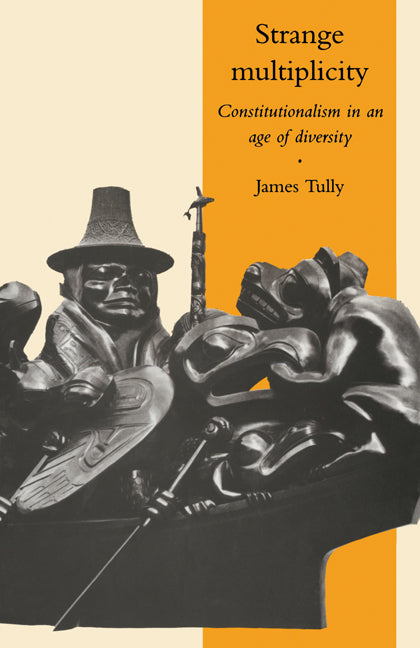
3. The spirit of Haida Gwaii as a symbol of the age of cultural diversity
4. A constitutional dialogue in The spirit of Haida Gwaii
Part II. Diversity and Contemporary Constitutionalism: 5. Anwering the constitutional question: an outline
6. Two languages of contemporary constitutionalism and the three schools of modern constitutionalism
7. The challenge of post-modernism and cultural feminism
8. The challenge of interculturalism
Part III. The Historical Formation of Modern Constitutionalism: The Empire of Uniformity: 9. Constitutions ancient and modern
10. Seven features of modern constitutionalism
11. Example of forging the seven features: Locke and Aboriginal peoples
12. Vattel, Kant and their followers
13.The reform of diversity in Europe and the colonies
14. The American revolution and the guardians of empire today
Part IV. The Historical Formation of Common Constitutionalism: The Rediscovery of Cultural Diversity, Part I: 15. The hidden constitutions of contemporary societies
16. Understanding constitutionalism: Wittgenstein and Hale
17. Examples of the three conventions: the Aboriginal and common-law system and the conventions of mutual recognition and consent
18. The Aboriginal and common law system and the convention of continuity
19.The Aboriginal and common law system and constitutional dialogue
Part V. The Historical Formation of Common Constitutionalism: The Rediscovery of Cultural Diversity. Part II: 20. Diverse federalism and the conventions of mutual recognition, continuity and consent
21. Diverse federalism and continuity: the Québec act and the ancient constitution
22. Diverse federalism, the three conventions and the American revolution
23. The modern attack on diverse federalism: the Durham report and its followers
24. Linguistic minorities and the three conventions: the form of reasoning appropriate to mutual recognition and accommodation
25. Intercultural citizens, gender differences and the three conventions
Part VI. Constitutionalism in an Age of Cultural Diversity: 25. A summary of contemporary constitutionalism
26. Replies to four objections to contemporary constitutionalism
27. Two public goods of contemporary constitutionalism: belonging and critical freedom
Conclusion: the philosophy and practice of contemporary constitutionalism
Notes
Bibliography
Index.
Subject Areas: History of ideas [JFCX]