Special Order - allow 2+ weeks lead
Couldn't load pickup availability
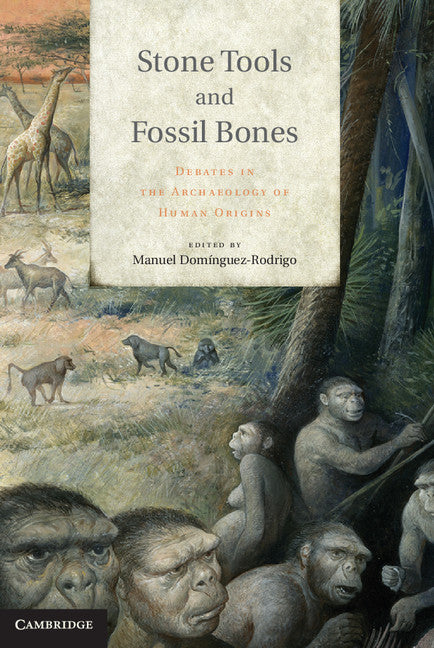
Stone Tools and Fossil Bones
Debates in the Archaeology of Human Origins
International archaeologists examine early Stone Age tools and bones to present the most holistic view to date of the archaeology of human origins.
Manuel Domínguez-Rodrigo (Edited by)
9781107022928, Cambridge University Press
Hardback, published 26 March 2012
376 pages, 25 b/w illus. 1 map 9 tables
23.5 x 16 x 2.2 cm, 0.63 kg
'This volume has a good feel to it - a handsome compact book about the early archaeology of human evolution, all in one … This collection is stimulating in reflecting a strong hand, but also showing a plurality of contributions and opinions.' John Gowlett, Journal of African Archaeology
The stone tools and fossil bones from the earliest archaeological sites in Africa have been used over the past fifty years to create models that interpret how early hominins lived, foraged, behaved and communicated and how early and modern humans evolved. In this book, an international team of archaeologists and primatologists examines early Stone Age tools and bones and uses scientific methods to test alternative hypotheses that explain the archaeological record. By focusing on both lithics and faunal records, this volume presents the most holistic view to date of the archaeology of human origins.
1. Towards a scientific-realistic theory on the origin of human behavior Manuel Domínguez-Rodrigo
Part I. On the Use of Analogy I: The Earliest Meat-Eaters: 2. Conceptual premises in experimental design and their bearing on the use of analogy: a critical example from experiments on cut marks Manuel Domínguez-Rodrigo
3. The use of bone surface modifications to model hominid lifeways during the Oldowan Charles P. Egeland
4. On early hominin meat-eating and carcass acquisition strategies: still relevant after all these years? Karen D. Lupo
5. Meat-foraging by Pleistocene African hominins: tracking behavioral evolution beyond baseline inferences of early access to carcasses Travis Rayne Pickering and Henry T. Bunn
6. Can we use chimpanzee behavior to model early hominin hunting? Travis Rayne Pickering and Manuel Domínguez-Rodrigo
Part II. On the Use of Analogy II: The Earliest Stone Tool Makers: 7. The origins of the Oldowan: why are chimpanzees (pan troglodytes) still good models for the technological evolution in Africa? Susana Carvalho and William McGrew
8. What does Oldowan technology represent in terms of hominin behavior? David R. Braun
9. Testing cognitive skills in early Pleistocene hominins: an analysis of the concepts of hierarchization and predetermination in the lithic assemblages of type section (Peninj, Tanzania) Fernando Diez-Martín, Policarpo Sánchez Yustos, Javier Baena, Manuel Domínguez-Rodrigo and Daniel Rubio
10. The early Acheulean in Africa: past paradigms, current ideas, and future directions Fernando Diez-Martin and Metin I. Eren.
Subject Areas: Evolution [PSAJ], Prehistoric archaeology [HDDA], Ancient history: to c 500 CE [HBLA]