Freshly Printed - allow 10 days lead
Couldn't load pickup availability
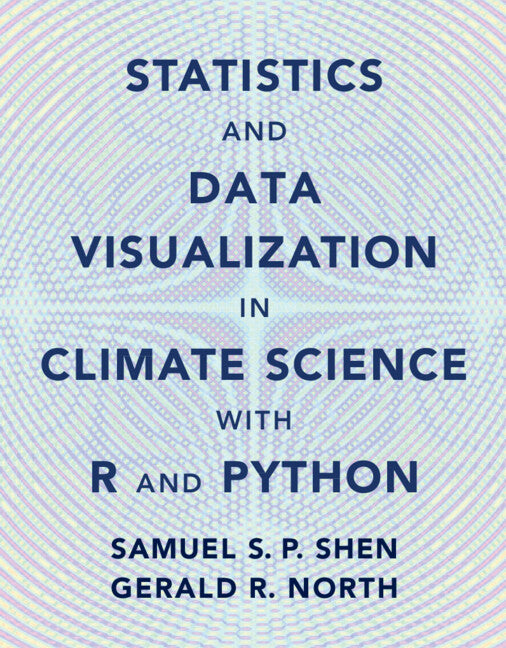
Statistics and Data Visualization in Climate Science with R and Python
Comprehensive overview of essential statistical concepts, useful statistical methods, data visualization, and computing tools for the climate and related sciences.
Samuel S. P. Shen (Author), Gerald R. North (Author)
9781108842570, Cambridge University Press
Hardback, published 30 November 2023
458 pages
26 x 20.7 x 2.5 cm, 1.16 kg
'This book is written by experts in the field, working on the frontiers of climate science. It enables instructors to 'flip the classroom', and highly motivated students to visualize and analyze their own data sets. The book clearly and succinctly summarizes the applicable statistical principles and formalisms and goes on to provide detailed tutorials on how to apply them, starting with very simple tasks and moving on to illustrate more advanced, state-of-the-art techniques. Having this book readily available should reduce the time required for advanced undergraduate and graduate students to achieve sufficient proficiency in research methodology to become productive scientists in their own right.' John M. Wallace, University of Washington
A comprehensive overview of essential statistical concepts, useful statistical methods, data visualization, and modern computing tools for the climate sciences and many others such as geography and environmental engineering. It is an invaluable reference for students and researchers in climatology and its connected fields who wish to learn data science, statistics, R and Python programming. The examples and exercises in the book empower readers to work on real climate data from station observations, remote sensing and simulated results. For example, students can use R or Python code to read and plot the global warming data and the global precipitation data in netCDF, csv, txt, or JSON; and compute and interpret empirical orthogonal functions. The book's computer code and real-world data allow readers to fully utilize the modern computing technology and updated datasets. Online supplementary resources include R code and Python code, data files, figure files, tutorials, slides and sample syllabi.
1. Basics of Climate Data Arrays, Statistics, and Visualization
2. Elementary Probability and Statistics
3. Estimation and Decision Making
4. Regression Models and Methods
5. Matrices for Climate Data
6. Covariance Matrices, EOFs, and PCs
7. Introduction to Time Series
8. Spectral Analysis of Time Series
9. Introduction to Machine Learning
References and Further Reading
Exercises
Index.
Subject Areas: Meteorology & climatology [RBP]