Freshly Printed - allow 8 days lead
Couldn't load pickup availability
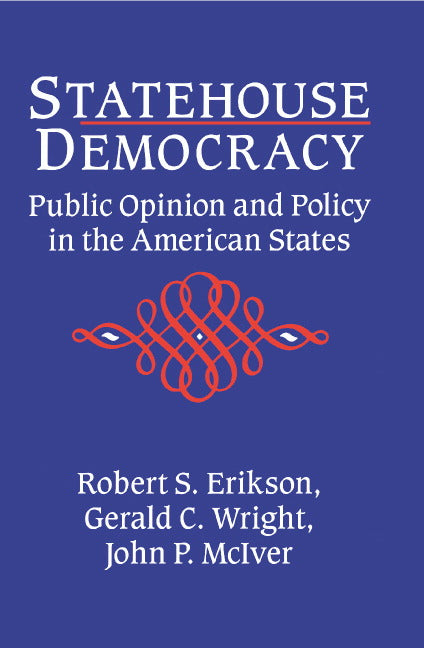
Statehouse Democracy
Public Opinion and Policy in the American States
The authors demonstrate that state policies are highly responsive to public opinion through the analysis of state policies from the 1930s to the present.
Robert S. Erikson (Author), Gerald C. Wright (Author), John P. McIver (Author)
9780521424059, Cambridge University Press
Paperback, published 28 January 1994
284 pages
22.9 x 15.3 x 1.6 cm, 0.567 kg
"… a work that anyone interested in differences across the states should read carefully … this book makes some very significant contributions to our study of state politics. The authors are to be commended for undertaking this project, for the range of data they have assembled, and for contributing to our understanding of state differences … this is one of the better written books to appear lately. The writing is clear, concise and communicates very well. Graphs are used well. It is a model of clarity of presentation and writing."
Jeff Stonecash, American Political Science Review
The importance of public opinion in the determination of public policy is the subject of considerable debate. Whether discussion centres on local, state or national affairs, the influence of the opinions of ordinary citizens is often assumed yet rarely demonstrated. Other factors such as interest group lobbying, party politics and developmental, or environmental, constraints have been thought to have the greater influence over policy decisions. Professors Erikson, Wright and McIver make the argument that state policies are highly responsive to public opinion, and they show how the institutions of state politics work to achieve this high level of responsiveness. They analyse state policies from the 1930s to the present, drawing from, and contributing to, major lines of research on American politics. Their conclusions are applied to central questions of democratic theory and affirm the robust character of the state institution.
Preface
1. Democratic states
2. Measuring state partisanship and ideology
3. Accounting for state differences in opinion
4. Public opinion and policy in the American states
5. State parties and state policy
6. Legislative elections and state policy
7. Political culture and policy representation
8. Partisanship, ideology and state elections
9. State opinion over time
10. Conclusions: democracy in the American states
References
Index.
Subject Areas: Regional government [JPR]