Freshly Printed - allow 6 days lead
Couldn't load pickup availability
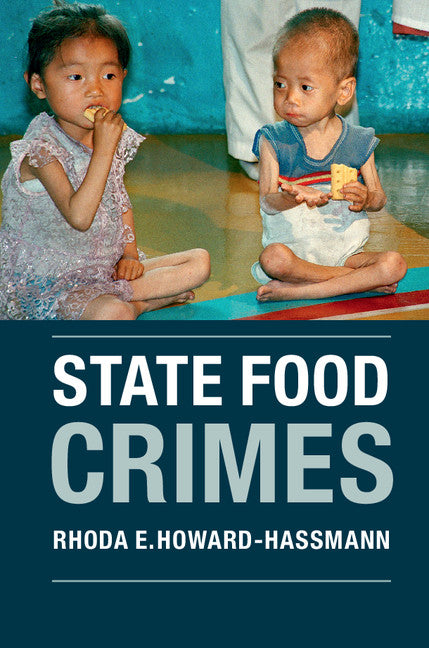
State Food Crimes
Discusses government policies that cause malnutrition or starvation in North Korea, Zimbabwe, Venezuela, and the West Bank and Gaza.
Rhoda E. Howard-Hassmann (Author)
9781107589964, Cambridge University Press
Paperback / softback, published 30 August 2016
284 pages
23.2 x 15.3 x 1.7 cm, 0.4 kg
'The author makes a valuable contribution on the topic by presenting a broader interpretation of what state food crime is, and highlights the centrality of previously understudied aspects relating to food security such as citizenship, mobility and property rights and the right to work for adequate access to food. The volume emphasizes the importance of domestic human rights to ensure food insecurity, but also that an international human rights treaty concerning food could still have an effect in safeguarding citizens from regimes which promote policies that increase the threat of food deprivation.' Ida Rudolfsen, Journal of Peace Research
Some states deny their own citizens one of the most fundamental human rights: the right to food. Rhoda E. Howard-Hassmann, a leading scholar of human rights, discusses state food crimes, demonstrating how governments have introduced policies that cause malnutrition or starvation among their citizens and others for whom they are responsible. The book introduces the right to food and discusses historical cases (communist famines in Ukraine, China and Cambodia, and neglect of starvation by democratic states in Ireland, Germany and Canada). It then moves to a detailed discussion of four contemporary cases: starvation in North Korea, and malnutrition in Zimbabwe, Venezuela, and the West Bank and Gaza. These cases are then used to analyse international human rights law, sanctions and food aid, and civil and political rights as they pertain to the right to food. The book concludes by considering the need for a new international treaty on the right to food.
Part I. Introduction and Background: 1. State food crimes
2. Communist famines
3. Democracies and famines
Part II. Contemporary Case Studies: 4. North Korea
5. Zimbabwe
6. Venezuela
7. The West Bank and Gaza
Part III. Implications for the International Human Right to Food: 8. International law and the right to food
9. Sticks and carrots: sanctions and food aid
10. Interdependent human rights
11. Liberal democracies and the right to food
12. A new international treaty on the right to food
References.
Subject Areas: International relations [JPS]