Freshly Printed - allow 10 days lead
Couldn't load pickup availability
State Crisis in Fragile Democracies
Polarization and Political Regimes in South America
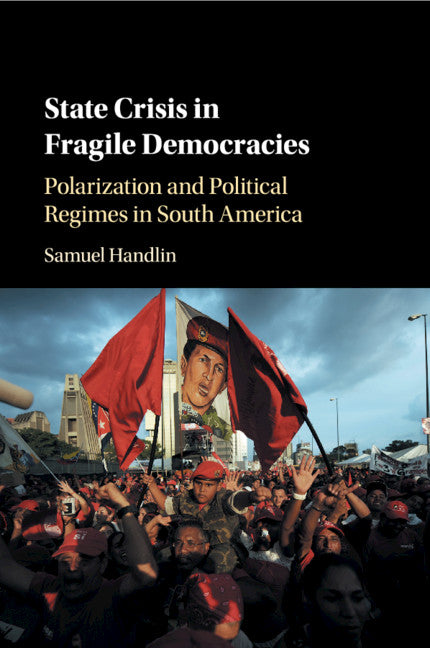
This book develops a new political-institutional explanation of South America's 'two lefts' and the divergent fates of the region's democratic regimes.
Samuel Handlin (Author)
9781108401418, Cambridge University Press
Paperback / softback, published 16 May 2019
336 pages
22.9 x 15.4 x 2 cm, 0.45 kg
'Handlin's use of process tracing is very rigorous … Handlin's book is an excellent example of how scholars can improve transparency in qualitative methods.' Laura Gamboa, Perspectives on Politics
This book offers a novel political-institutional explanation for variation in political polarization, outsider populism, and the fate of democratic regimes across twenty-first-century South America. Drawing upon a wealth of primary evidence and employing process tracing tests to evaluate key causal claims, the book examines how the occurrence - or not - of state crises and the inherited strength of left wing political actors combined to push countries onto distinct party system trajectories characterized by different kinds of left parties and movements, highly variant levels of polarization, and ultimately divergent political regime dynamics. The book challenges extant interpretations of political variation during Latin America's turn to the left, which have centered on economic explanations. It also develops new theoretical propositions for understanding polarization, populism, and democratic erosion in young democracies across the world.
Part I. Puzzles and Theoretical Explanations: 1. State crises, the left, and democracy in contemporary South America
2. Explaining divergent party system trajectories and regime dynamic
Part II. Venezuela and Brazil: 3. Venezuela: development of a highly polarizing party system
4. Brazil: development of a weakly polarizing party system
5. Democratic erosion in Venezuela, representative democracy in Brazil
Part III. Perspectives across South America: 6. Bolivia and Ecuador: high polarization and democratic erosion
7. Chile and Uruguay: low polarization and representative democracy
8. Paraguay and Peru: low polarization and polyarchy
Part IV. Conclusion: 9. Longer-term legacies and comparative perspectives around the world
Appendix A. Operationalization of state crisis and left-wing infrastructure
Appendix B. Operationalization of polarization and regime categories
Bibliography
Index.
Subject Areas: Regional government [JPR], Comparative politics [JPB], Politics & government [JP]