Freshly Printed - allow 10 days lead
Couldn't load pickup availability
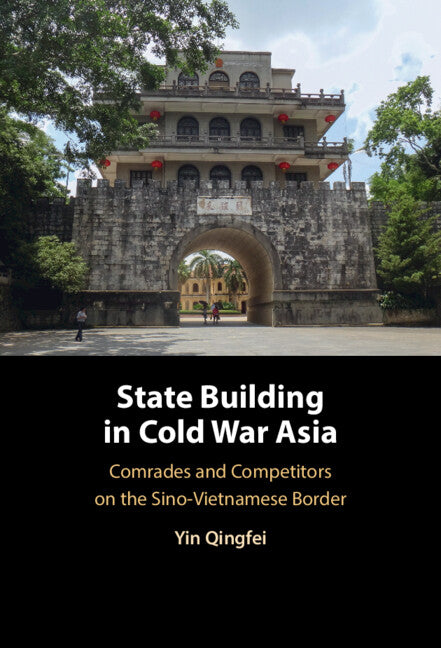
State Building in Cold War Asia
Comrades and Competitors on the Sino-Vietnamese Border
Qingfei Yin presents a new approach to Sino-Vietnamese relations through the lens of borderlands state building during the Cold War.
Qingfei Yin (Author)
9781009426640, Cambridge University Press
Hardback, published 21 November 2024
314 pages
23.4 x 15.8 x 2.2 cm, 0.58 kg
'Qingfei Yin's compelling new study represents a significant departure from … established narratives. … It makes a major contribution to Cold War history and interdisciplinary borderlands scholarship. Beyond significantly enhancing our understanding of Sino-Vietnamese relations, Yin encourages a broader reconsideration of state power, local agency, and the transformative potential of socialist border regions. Her study is significant not only for specialists in Cold War Asia, but also for historians and social scientists broadly interested in comparative state-building, border studies, and state-society relations.' Stefan Messingschlager, Neue Politische Literatur
Departing from conventional studies of border hostility in inter-Asian relations, Yin Qingfei explores how two revolutionary states – China and Vietnam – each pursued policies that echoed the other and collaborated in extending their authority to the borderlands from 1949 to 1975. Making use of central and local archival sources in both Chinese and Vietnamese, she reveals how the people living on the border responded to such unprecedentedly aggressive state building and especially how they appropriated the language of socialist brotherhood to negotiate with authorities. During the continuous Indochina wars, state expansion thus did not unfold on these postcolonial borderlands in a coherent or linear manner. Weaving together international, national, and transnational-local histories, this deeply researched and original study presents a new approach to the highly volatile Sino-Vietnamese relations during the Cold War, centering on the two modernising revolutionary powers' competitive and collaborative state building on the borderlands and local responses to it.
Introduction: internationalism, nationalism, and transnational localism at the Sino-Vietnamese border
1. Asymmetric state building (1949–1954)
2. Joint state building (1954–1957)
3. Negotiated state building (1958–1964)
4. Thwarted state building on the sea (1954–1964)
5. Reversed state building (1965–1975)
Conclusion: Cold War Asia: a borderlands perspective
Bibliography.
Subject Areas: Asian history [HBJF]