Freshly Printed - allow 7 days lead
Couldn't load pickup availability
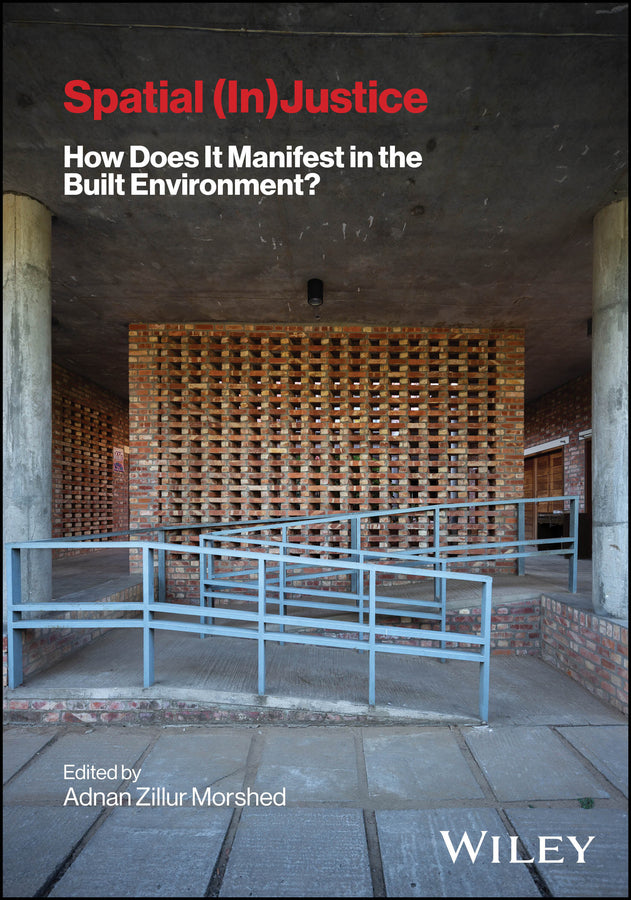
Spatial (In) Justice
How Does It Manifest in the Built Environment?
Adnan Zillur Morshed (Edited by)
9781394294664, Wiley
Paperback / softback, published 17 March 2026
336 pages
25.2 x 17.8 x 2 cm, 0.68 kg
"An essential reference for the design community and beyond, this volume ... responds to a growing urgency within our disciplines to develop the skills and frameworks necessary to pursue spatial justice. It's a call for all of us in education to rethink our curricula, and for practitioners to embrace the methods shared in this well-crafted and important book."
—Places Journal, Spring 2026, (https://placesjournal.org/article/bookshelf-spring-2026)
Explores how spatial justice shapes equitable, empowering, and inclusive experiences In an era increasingly defined by questions of equity and inclusion, Spatial (In) Justice: How Does It Manifest in the Built Environment? offers a vital, global interrogation of how architecture and planning impact the lived experiences of marginalized communities. Edited by Adnan Zillur Morshed, this timely volume brings together contributions from 33 leading thinkers and practitioners—architects, planners, scholars, and academics—who reflect on the ethical and philosophical responsibilities of those who shape space. Rather than offering simplistic answers or prescriptive solutions, this book explores the complex and often contradictory ways justice is interpreted and enacted through space. The essays examine built projects from around the world to ask whether design can foster dignity, hope, and community empowerment—and how design education must evolve to foreground these values. The contributing authors grapple with the mechanisms through which spatial practices can exclude, disempower, or uplift, addressing topics ranging from justice in the city to the politics of community engagement. Throughout the book, the essays advance a critical pedagogy of design—one that scrutinizes how space organizes power and shapes human possibility. Contributors (in alphabetical order): Annmarie Adams
Esra Akcan
Glenn Albrecht
Thomas Barrie
Tom Beaudoin
Bryan Bell
Julio Bermudez
Prem Chandavarkar
Howard Davis
Kim Dovey
Andrew Freear
Tammy Gaber
Megan Gee
Iqbal Habib
Adam Hart
Aseem Inam
Kathleen James-Chakraborty
Mark Jarzombek
Khondaker Hasibul Kabir
Pamela Karimi
Fernando Lara
Yasmeen Lari
Paco Mejias Villatoro
Jason Montgomery
Donghwan Moon
Adnan Zillur Morshed
Dahlia Nduom
Susan Piedmont-Palladino
Sharon Prince
Katie Swenson
Marina Tabassum
Diane Rhyu Taylor
Junjie Xi
Authors Bios (alphabetically) ix Editor Bio xv Acknowledgments xvii Introduction: The Problem of (In)Justice in the Built Environment 1 Part 1 Theorizing Spatial (In)Justice 15 1.1 Working Through Injustice 17 1.2 Human Rights and Everyday Space 25 1.3 Architecture, Power, and Spatial Justice 32 Part 2 Right to Space 41 2.1 Right-to-Truth and Transitional Justice in Urban Space 43 2.2 Two Blocks, Two Cities: Critical Points 55 2.3 Gender and Geometry of Power: Rehearsing Spatial Justice in Tehran 62 Part 3 Urbanity of Justice 71 3.1 From the Bottom- Up: Gillett Square in London 73 3.2 Favelas as Sites of Resistance 83 3.3 Frontstage/Backstage in Las Vegas: A Metaphorical Approach Toward Understanding Spatial Inequality in the Contemporary City 89 3.4 Reclaiming the Public Realm: Designing American Cities for Urban Wellbeing 99 Part 4 Community Engagement as Spatial Justice 109 4.1 Specializing in Public Interest Design to Achieve Spatial Justice 111 4.2 In Conversation with Architect Andrew Freear 121 4.3 From Ideas to Impact: Architecture as a Tool for Equity 132 4.4 Co- Creating Resilient Landscapes in the Rohingya Refugee Response 143 4.5 Justice for the Land of Maya 154 Part 5 Spatializing Justice 163 5.1 Hide and Seek: Indigenous Remains and Canadian Institutional Architecture 165 5.2 The Belgian Friendship Building at Virginia Union University 176 5.3 Spatializing Freedom as Justice 184 Part 6 Symbiocene as Justice 199 6.1 In Conversation with Environmental Philosopher Glenn Albrecht 201 6.2 Transforming the Built Environment Through Ethical Sourcing 209 6.3 In Conversation with Architect Marina Tabassum 217 6.4 The Rivers That Bind Us 229 Part 7 Justice in Sacred Space 239 7.1 Spatial Justice and Spirituality 241 7.2 Designing “Gendered” Worship Spaces is an Accessibility and Justice Issue 248 Part 8 Spatial Justice Literacy 261 8.1 When the State Fails to Rehabilitate Destitute Communities 263 8.2 The Ambiguities of Spatial Justice: Understanding Macro and Micropolitics in Informal Settlements 270 8.3 Flattened Earth Society: How Map Makers Transform Our Reality 281 8.4 Climate Change, Health, and Housing: Design Frameworks for Justice and Repair 290 Index 303
Adnan Zillur Morshed
Mark Jarzombek
Prem Chandavarkar
Kim Dovey
Esra Akcan
Susan Piedmont-Palladino
Pamela Karimi
Howard Davis and Adam Hart
Fernando Luiz Lara
Aseem Inam
Jason Montgomery
Bryan Bell, Emma DeMagistris, Devesh Balakrishnan, and Miraz Reza
Katie Swenson
Diane Rhyu Taylor and Khondaker Hasibul Kabir
Donghwan Moon
Annmarie Adams
Kathleen James-Chakraborty
Adnan Zillur Morshed
Sharon Prince
Iqbal Habib, Rubana Huq, and Shadman Iqbal
Thomas Barrie, Julio Bermudez, and Tom Beaudoin
Tammy Gaber
Yasmeen Lari
Paco Mejias Villatoro and Junjie xi
Megan Gee
Dahlia Nduom
Subject Areas: Architecture [AM]