Special Order - allow 2+ weeks lead
Couldn't load pickup availability
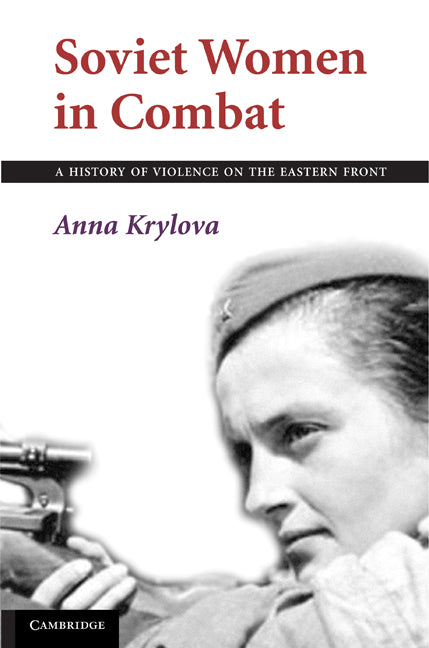
Soviet Women in Combat
A History of Violence on the Eastern Front
Soviet Women in Combat explores the unprecedented historical phenomenon of Soviet women's en masse volunteering for World War II combat.
Anna Krylova (Author)
9781107699403, Cambridge University Press
Paperback / softback, published 30 September 2011
338 pages
23.1 x 15.7 x 1.8 cm, 0.49 kg
'… Anna Krylova has certainly posed provocative, important, questions about gender, the state, Stalinist or otherwise, and modern warfare, which will undoubtedly resonate with contemporary discussions about women and war.' Roger D. Markwick, The Russian Review
Soviet Women in Combat explores the unprecedented historical phenomenon of Soviet young women's en masse volunteering for World War II combat in 1941 and writes it into the twentieth-century history of women, war and violence. The book narrates a story about a cohort of Soviet young women who came to think about themselves as 'women soldiers' in Stalinist Russia in the 1930s and who shared modern combat, its machines and commanding positions with men on the Eastern front between 1941 and 1945. The author asks how a largely patriarchal society with traditional gender values such as Stalinist Russia in the 1930s managed to merge notions of violence and womanhood into a first conceivable and then realizable agenda for the cohort of young female volunteers and for its armed forces. Pursuing the question, Krylova's approach and research reveals a more complex conception of gender identities.
Introduction: the woman veteran as a World War II memoirist
Part I. Before the Front, 1930s: 1. A portrait of a young woman as the citizen soldier: the 'prewar generation' in popular culture, in school, and at the shooting range
Part II. On the Way to the Front, 1941–5: 2. 'And this is exactly who we are - soldiers!': Women volunteers, local authorities, and the Stalinist government in 1941
3. The exceptional mobilization of 1941: the making of a female combat collective by state order
4. New gender landscapes for the army: from grassroots enlistments to the state-run mobilizations of 1942–5
Part III. At the Front, 1941–5: 5. Partners in violence: the woman soldier and the machine in the 1941 trenches
6. 'To be a woman-commander - that was great!: remechanizing and regendering in the Red Army, 1942–5
7. Bonded by combat: women and men sharing violence, authority, and romance in mechanized warfare, 1942–5
Conclusion
Appendix.
Subject Areas: Second World War [HBWQ], 20th century history: c 1900 to c 2000 [HBLW], European history [HBJD]