Freshly Printed - allow 10 days lead
Couldn't load pickup availability
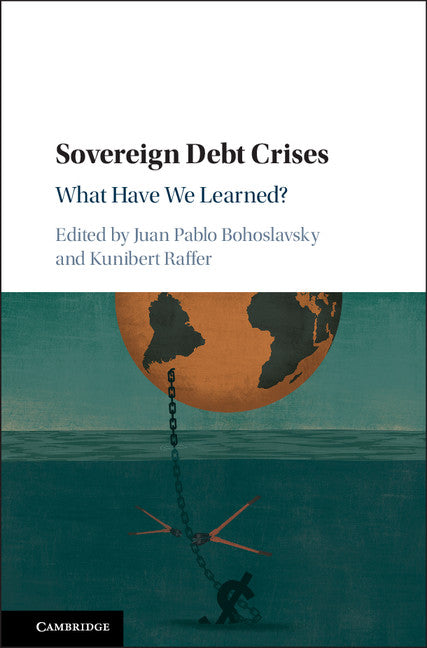
Sovereign Debt Crises
What Have We Learned?
Contributes to a better understanding of the policy, economic, and legal options of countries struggling with debt problems.
Juan Pablo Bohoslavsky (Edited by), Kunibert Raffer (Edited by)
9781316510445, Cambridge University Press
Hardback, published 2 November 2017
304 pages, 23 b/w illus. 17 tables
23.5 x 15.8 x 2 cm, 0.56 kg
'This volume confronts a vital question - why do sovereign debt crises persist, despite the vast intellectual and policy effort invested in fighting them? The book's core contribution is to cast a wide net geographically, with broad country coverage, temporally, by examining developments before and after the acknowledged crisis period, and analytically, by embracing legal, historical, philosophical, and economic perspectives on the debt problem. That the authors are able to distill all this knowledge into pragmatic prescriptions for incorporating human rights and human welfare into debt thinking is an achievement to celebrate.' Anna Gelpern, Georgetown University, Washington, DC
There is an obvious need to learn more about why some countries succeed and others fail when dealing with debt crises. Why do some sovereign debtors overcome economic problems very quickly and at minor human rights costs for their people, while others remain trapped by debts for years struggling with overwhelming debt burdens and exacerbating economic problems and human suffering? This book analyzes fourteen unique or singular country cases of sovereign debt problems that differ characteristically from the 'ordinary' debtor countries, and have not yet received enough or proper attention - some regarded as successful, some as unsuccessful in dealing with debt crises. The aim is to contribute to a better understanding of the policy options available to countries struggling with debt problems, or how to resolve a debt overhang while protecting human rights, the Rule of Law and the debtor's economic recovery.
1. Introduction: we need to learn from our experience Juan Pablo Bohoslavsky and Kunibert Raffer
2. Managing public debt crisis in Argentina: between sovereignty and subordination Alfredo Calcagno
3. Why developing countries should not incur foreign debt: the Brazilian experience Luiz Carlos Bresser-Pereira and Thiago de Moraes Moreira
4. Ecuador's 2008–9 debt restructuring: a special case? Adam Feibelman
5. Greece: an EU-inflicted catastrophe Kunibert Raffer
6. Grenada: a small island developing state needs new ways out of its debt Juergen Kaiser
7. Iceland: a human rights sensitive approach to deal with financial crises Juan Pablo Bohoslavsky
8. Indonesia's 1997–8 economic crisis: a teachable case wasted Manuel F. Montes
9. The Irish sovereign debt crisis post–2009: a lesson on why countries should never enter into unsustainable currency unions Philip Pilkington
10. Short-term capital controls and Malaysia's fast recovery after the East-Asian crisis Marion Pircher
11. Sovereign debt: lessons from the Mexican experience Oscar Ugarteche Galarza and Rodrigo Delgado Méndez
12. Portugal's austerity bailout: lessons of a dangerous experiment José Castro Caldas
13. Don't waste a serious crisis: lessons from South Africa's debt crisis Daniel D. Bradlow
14. Lessons from South Korea: a developmental mindset makes a difference when governing the financial economy Elizabeth Thurbon
15. The Spanish crisis: the trouble of managing debt overhang in an imperfect monetary union José Antonio Alonso
16. Conclusions: what has been learned? Juan Pablo Bohoslavsky and Kunibert Raffer.
Subject Areas: International organisations & institutions [LBBU], International economic & trade law [LBBM], International law [LB], International trade [KCLT], International relations [JPS]