Freshly Printed - allow 7 days lead
Couldn't load pickup availability
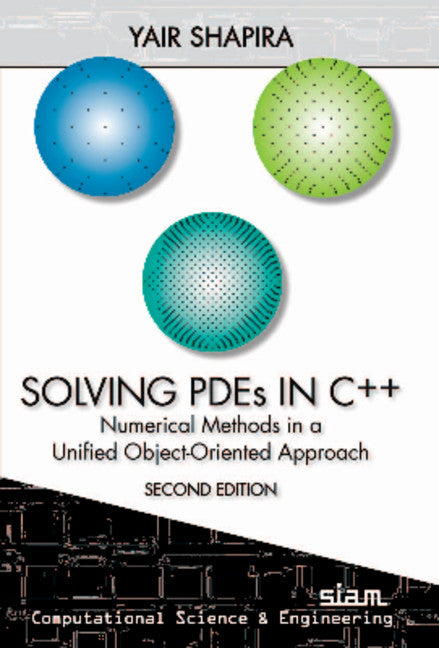
Solving PDEs in C++ – Numerical Methods in a Unified Object–Oriented Approach
Numerical Methods in a Unified Object-Oriented Approach
A comprehensive guide for the numerical solution of PDEs using C++ for students, engineers and researchers. Includes reader-friendly code.
Yair Shapira (Author)
9781611972160
Paperback / softback, published 30 June 2012
808 pages
22.9 x 15.2 x 2 cm, 1.39 kg
This text provides a comprehensive guide for the numerical solution of PDEs using C++ within an object-oriented approach. The high level of abstraction available in C++ is particularly useful in the implementation of complex mathematical objects, such as unstructured meshes, sparse matrices and multigrid hierarchies, often used in numerical modeling. Assuming only an elementary knowledge of calculus and linear algebra, the reader is given a full introduction to programming, PDEs and numerical methods. The learning process is illuminated further by practical examples alongside exercises and solutions that are found at the end of each chapter. This massively expanded second edition contains a wealth of new material, including sections on cryptography, image processing and solution of nonlinear PDEs, accompanied by new reader-friendly code. This book is ideal for students, engineers and researchers who want to use advanced numerical programming methods to solve problems in applied science and engineering.
List of figures
List of tables
Preface
Part I. Elementary Background in Programming: 1. Concise introduction to C
2. Concise introduction to C++
3. Data structures used in the present algorithms
Part II. Object-Oriented Programming: 4. From Wittgenstein–Lacan's theory to the object-oriented implementation of graphs and matrices
5. FFT and other algorithms in numerics and cryptography
6. Object-oriented analysis of nonlinear ordinary differential equations
Part III. Partial Differential Equations and their Discretization: 7. The convection-diffusion equation
8. Some stability analysis
9. About nonlinear conservation laws
10. Application in image processing
Part IV. The Finite Element Discretization Method: 11. About the weak formulation
12. Some background in linear finite elements
13. Unstructured finite-element meshes
14. Adaptive mesh refinement
15. Towards high-order finite elements
Part V. The Numerical Solution of Large Sparse Linear Systems of Algebraic Equations: 16. Sparse matrices and their object-oriented implementation
17. Iterative methods for the numerical solution of large sparse linear systems of algebraic equations
18. Towards parallelism
Part VI. Applications in Two Spatial Dimensions: 19. Diffusion equations
20. The linear elasticity equations
21. The Stokes equations
22. Application in electromagnetic waves
23. Multigrid for nonlinear equations and for the fusion problem in image processing
Part VII. Applications in Three Spatial Dimensions: 24. Polynomials in three independent variables
25. The Helmholtz equation: error estimate
26. Adaptive finite elements in three spatial dimensions
27. Application in nonlinear optics: the nonlinear Helmholtz equation in three spatial dimensions
28. High-order finite elements in three spatial dimensions
29. Application in the nonlinear Maxwell equations
30. Towards inverse problems
31. Application in the Navier–Stokes equations
Appendix. Solutions to selected exercises
Bibliography
Index.
Subject Areas: Miscellaneous items [WZ]