Freshly Printed - allow 7 days lead
Couldn't load pickup availability
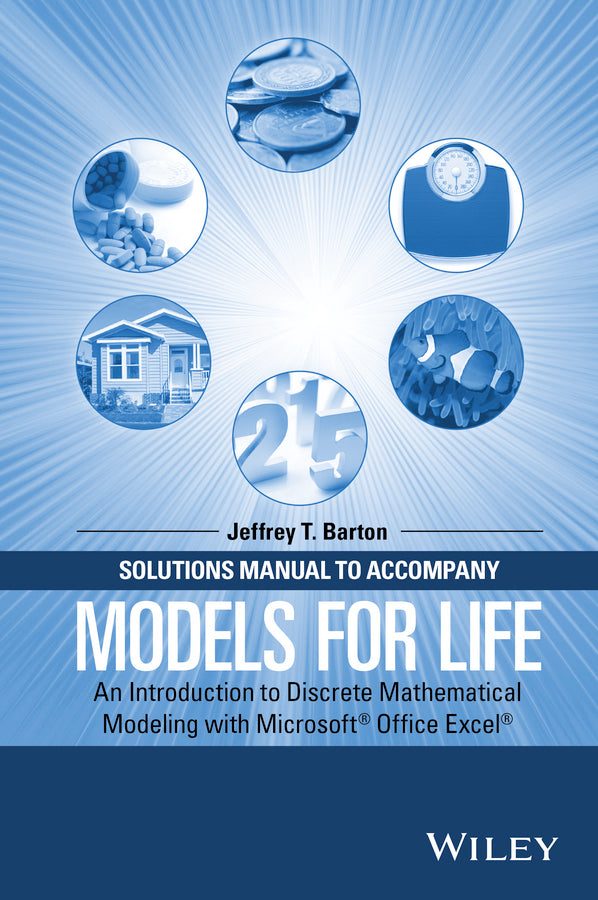
Solutions Manual to Accompany Models for Life
An Introduction to Discrete Mathematical Modeling with Microsoft Office Excel
Jeffrey T. Barton (Author)
9781119040026, Wiley
Paperback / softback, published 19 April 2016
184 pages
22.9 x 14.7 x 1.5 cm, 0.249 kg
A solutions manual to accompany An Introduction to Discrete Mathematical Modeling with Microsoft® Office Excel® With a focus on mathematical models based on real and current data, Models for Life: An Introduction to Discrete Mathematical Modeling with Microsoft® Office Excel® guides readers in the solution of relevant, practical problems by introducing both mathematical and Excel techniques. The book begins with a step-by-step introduction to discrete dynamical systems, which are mathematical models that describe how a quantity changes from one point in time to the next. Readers are taken through the process, language, and notation required for the construction of such models as well as their implementation in Excel. The book examines single-compartment models in contexts such as population growth, personal finance, and body weight and provides an introduction to more advanced, multi-compartment models via applications in many areas, including military combat, infectious disease epidemics, and ranking methods. Models for Life: An Introduction to Discrete Mathematical Modeling with Microsoft® Office Excel® also features:
Preface vii About the Companion Website ix 1 Density Independent Population Models 1 1.1 Exponential Growth, 1 1.2 Exponential Growth with Stocking or Harvesting, 8 1.3 Two Fundamental Excel Techniques, 13 1.4 Explicit Formulas, 18 1.5 Equilibrium Values and Stability, 24 2 Personal Finance 31 2.1 Compound Interest and Savings, 31 2.2 Borrowing for Major Purchases, 43 2.3 Credit Cards, 48 2.4 The Time Value of Money: Present Value, 50 2.5 Car Leases, 54 3 Combat Models 57 3.1 Lanchester Combat Model, 57 3.2 Phase Plane Graphs, 63 3.3 The Lanchester Model with Reinforcements, 64 3.4 Hughes Aimed Fire Salvo Model, 69 3.5 Armstrong Salvo Model with Area Fire, 72 4 The Spread of Infectious Diseases 79 4.1 The S-I-R Model, 79 4.2 S-I-R with Vital Dynamics, 84 4.3 Determining Parameters from Real Data, 88 4.4 S-I-R with Vital Dynamics and Routine Vaccinations, 91 5 Density Dependent Population Models 95 5.1 The Discrete Logistic Model, 95 5.2 Logistic Growth with Allee Effects, 97 5.3 Logistic Growth with Harvesting, 100 5.5 The Ricker Model, 102 6 Blood Alcohol Concentration and Pharmacokinetics 107 6.1 Blood Alcohol Concentration (BAC), 107 6.2 The Widmark Model, 110 6.3 The Wagner Model, 114 6.4 Alcohol Consumption Patterns, 118 6.5 More General Drug Elimination, 122 6.6 The Volume of Distribution, 125 6.7 Common Drugs, 126 7 Ranking Methods 131 7.1 Introduction to Markov Models, 131 7.2 Ranking Sports Teams, 139 7.3 Google PageRank, 147 8 Body Weight and Body Composition 153 8.1 Constant Calorie Expenditure, 153 8.2 Variable Calorie Expenditure, 154 8.3 Health Metrics, 159 8.4 Body Composition, 163 8.5 The Body Composition Model for Body Weight, 166 8.6 Points-based Systems: The Weight Watchers™ Model, 170
Subject Areas: Mathematics [PB]