Freshly Printed - allow 8 days lead
Couldn't load pickup availability
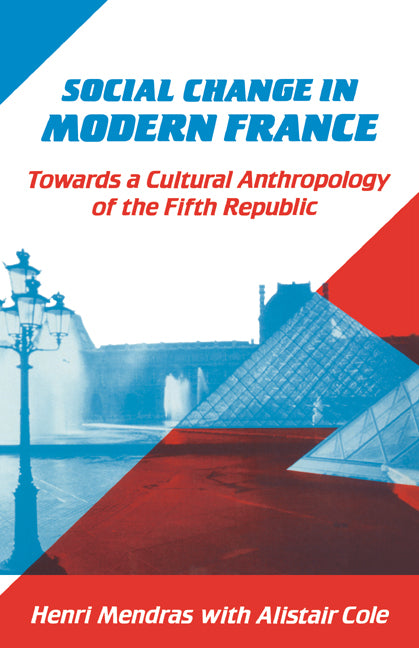
Social Change in Modern France
Towards a Cultural Anthropology of the Fifth Republic
Concerned with the radical transformations that have taken place within French society since the mid-twentieth century.
Henri Mendras (Author), Alistair Cole (Author)
9780521391085, Cambridge University Press
Hardback, published 14 March 1991
264 pages
23.4 x 14.6 x 2.5 cm, 0.48 kg
"He offers a wide-ranging and generally persuasive description and analysis of changes which have taken place in French society since the mid-1960s. His book is well paced and full of provocative insights, like his argument that the French are mistrustful of representative democracy and favor a form of direct democracy through election of national politicians who also hold local office....I was particularly interested by Mendras's appreciation of post-1968 'cultural liberals,' his analyses of the church and its offshoots, and his perceptive comments on the increasing importance of senior citizens. Because Social Change in Modern France requires little specialized background knowledge, it would work well in an undergraduate course on modern French culture in a U.S. college." Donald Reid, Social Science Quarterly
Social Change in Modern France is concerned with the radical transformations which have taken place within French society since the mid-twentieth century. The authors contended that these changes constitute a revolution in French affairs as important as that of 1789. From the late 1950s onwards, the traditional social structures of the Third Republic have been transformed: peasantry and bourgeoisie have disappeared or mutated; the great national institutions of church, army, trade unions and schools have declined or severely weakened, and a late and rapid industrialisation has wrought profound economic changes. Even the French Communist Party has become a virtual irrelevance. All these institutions, so characteristic of French society throughout the Third Republic, have now ceased to be the object of major conflicts and tensions. In their stead local institutions, voluntary associations and the family have acquired a renewed strength and serve as the basic network for social relations and social life.
Preface
Introduction
Part I. The Breaking-Up of Traditional Class Structures: 1. The bourgeois, the workers and the peasants
2. The transformation of the social classes: the triumph of the central constellation
Part II. The De-Mystification of the Great National Institutions: 3. The army and the church
4. Working-class institutions
5. The national education system
6. The new national consensus
7. A village democracy
Part III. The Stages of Life: 8. The strength of kinship
9. Men and women
10. Young and old
Part IV. A New Civilisation: 11. Changing lifestyles
12. The cultural explosion
13. A moral revolution?
Bibliography
Index.
Subject Areas: Sociology & anthropology [JH]