Special Order - allow 2+ weeks lead
Couldn't load pickup availability
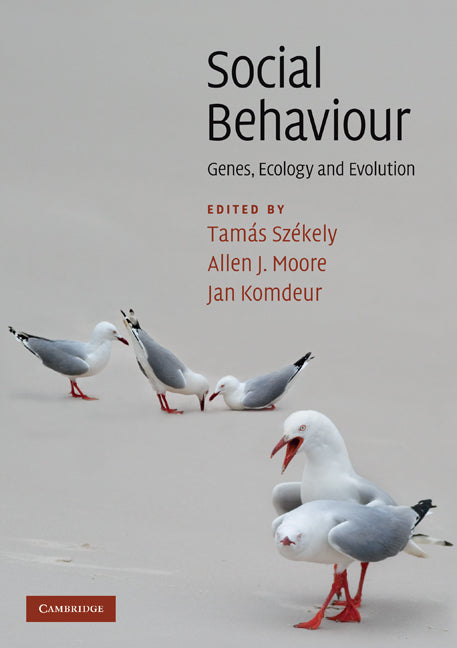
Social Behaviour
Genes, Ecology and Evolution
A comprehensive analysis of the genetic, ecological and phylogenetic aspects of social behaviour, by experts in the field.
Tamás Székely (Edited by), Allen J. Moore (Edited by), Jan Komdeur (Edited by)
9780521709620, Cambridge University Press
Paperback / softback, published 18 November 2010
576 pages, 89 b/w illus. 13 tables
20.5 x 19 x 2.6 cm, 1.22 kg
'… invaluable reading for everyone interested in the evolution of social life …' Mammalia
Humans live in large and extensive societies and spend much of their time interacting socially. Likewise, most other animals also interact socially. Social behaviour is of constant fascination to biologists and psychologists of many disciplines, from behavioural ecology to comparative biology and sociobiology. The two major approaches used to study social behaviour involve either the mechanism of behaviour - where it has come from and how it has evolved, or the function of the behaviour studied. With guest articles from leaders in the field, theoretical foundations along with recent advances are presented to give a truly multidisciplinary overview of social behaviour, for advanced undergraduate and graduate students. Topics include aggression, communication, group living, sexual behaviour and co-operative breeding. With examples ranging from bacteria to social mammals and humans, a variety of research tools are used, including candidate gene approaches, quantitative genetics, neuro-endocrine studies, cost-benefit and phylogenetic analyses and evolutionary game theory.
Introduction Tamás Székely, Allen J. Moore and Jan Komdeur
Part I. Foundations: 1. Nature-nurture interactions Marla B. Sokolowski and Joel D. Levine
2. The quantitative genetics of social behaviour Bronwyn H. Bleakley, Jason B. Wolf and Allen J. Moore
3. Social behaviour and bird-song from a neural and endocrine perspective Elizabeth Adkins-Regan, Timothy J. DeVoogd and Jordan M. Moore
4. Evolutionary game theory John M. McNamara and Franz J. Weissing
5. Recent advances in comparative methods Robert P. Freckleton and Mark Pagel
6. Social evolution theory: a review of methods and approaches Tom Wenseleers, Andy Gardner and Kevin R. Foster
Part II. Themes: 7. Aggression: towards an integration of gene, brain and behaviour Robert Huber and Edward A. Kravitz
8. Social influences on communication signals: from honesty to exploitation Mark E. Hauber and Marlene Zuk
9. Important topics in group living Jens Krause and Graeme Ruxton
10. Sexual behaviour: conflict, cooperation and co-evolution Tomasso Pizzari and Russell Bonduriansky
11. Pair bonds and parental behaviour Lisa McGraw, Tamás Székely and Larry J. Young
12. Adaptations and constraints in the evolution of delayed dispersal: implications for cooperation Jan Komdeur and Jan Ekman
13. Social behaviour in microorganisms Kevin R. Foster
14. Social environments, social tactics and their fitness consequences in complex mammalian societies Marion L. East and Heribert Hofer
15. Social behaviour in humans Ruth Mace
Part III. Implications: 16. Personality and individual social specialisation Denis Réale and Niels J. Dingemanse
17. Molecular and genetic influences on the neural substrate of social cognition in humans Louise Gallagher and David Skuse
18. Population density, social behaviour and sex allocation Suzanne H. Alonzo and Ben C. Sheldon
19. Social behaviour and speciation Gerald S. Wilkinson and Leanna M. Birge
20. Social behaviour in conservation Daniel T. Blumstein
21. Prospects for research in social behaviour: systems biology meets behaviour Allen J. Moore, Tamás Székely and Jan Komdeur
Part IV. Profiles: 22. Undiminished passion Tim Birkhead
23. Social evolution, sexual intrigue and serendipity Andrew Cockburn
24. Mating systems: integrating sexual conflict and ecology Nicholas B. Davies
25. In love with Ropalidia marginata – for 34 years, and still going strong Raghavendra Gadagkar
26. The Huddler's Dilemma: a cold shoulder or a warm inner glow David Haig
27. Multi-component signals in ant communication Bert Hölldobler
28. What's wrong with this picture? Sarah B. Hrdy
29. From behavioural observations, to genes, to evolution Laurent Keller
30. Reputation can make the world go round – or why we are sometimes social Manfred Milinski
31. A haphazard career Ronald Noë
32. In celebration of questions, past, present and future Geoff A. Parker
33. Mating systems and genetic variation Marion Petrie
34. Selections from a life in social selection David C. Queller
35. The de novo evolution of cooperation: an unlikely event Paul B. Rainey
36. Evolutionary genetics and social behaviour Mike Ritchie
37. Genes and social behaviour: from gene to genome to 1000 animal genomes Gene E. Robinson
38. Behavioural ecology, why do I love thee? Let me count the ways Paul W. Sherman
39. Anonymous (and other) social experience and the evolution of cooperation by reciprocity Michael Taborsky
40. Social theory based on natural selection Robert Trivers
41. Look to the ants Edward O. Wilson
42. The handicap principle and social behaviour Amotz Zahavi .
Subject Areas: Animal ecology [PSVS], Animal behaviour [PSVP], Genetics [non-medical PSAK], Evolution [PSAJ], Social, group or collective psychology [JMH]