Special Order - allow 2+ weeks lead
Couldn't load pickup availability
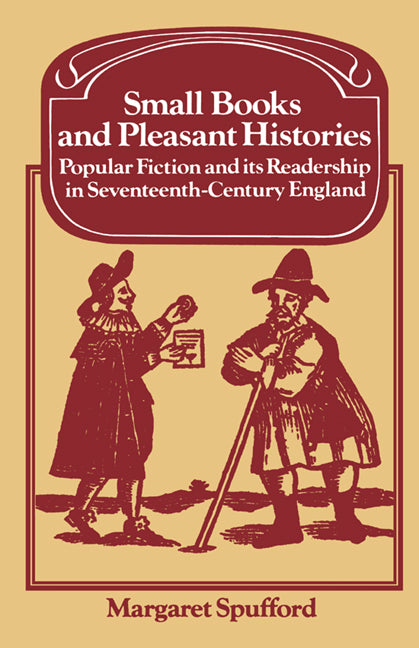
Small Books and Pleasant Histories
Popular Fiction and its Readership in Seventeenth-Century England
Margaret Spufford (Author)
9780521312189, Cambridge University Press
Paperback / softback, published 3 October 1985
300 pages
21.6 x 14 x 2.4 cm, 0.383 kg
'Dr Spufford is already recognized as one of the most distinguished among the younger social historians working on the early modern period. Her second full-length book will not disappoint her readers … a remarkable addition to our understanding of popular literature and religion in seventeenth-century society.' Journal of Ecclesiastical History
Attention has increasingly turned in recent years from the economic and agricultural framework of the life of the English villager in the sixteenth and seventeenth centuries to his or her social and mental world. Margaret Spufford's interest in literacy, and particularly in the ability to read, which laid the villager open to all sorts of external influences other than those coming from the pulpit and the manor house, has led her in this book to examine both the spread of reading ability, and one of the principal forms of cheap print available in the late seventeenth century at a price within the reach of the day labourer. Many historians, notably history of education specialists, had not realized the extent of elementary schooling and the consequent existence of a mass readership and a popular literature created especially for it before the Charity School movement. This book provides them with a radical new emphasis. Dr Spufford's book examines the profits made by these publishers, the scale of their operations, and the way the 'small books' were distributed throughout the country. It also examines their content, and compares the English chapbooks with their French counterparts. By so doing, the author throws light on one of the influences at work on the seventeenth-century villager, and illuminates some of the concepts and imagery that formed the imaginative stock-in-trade of the man behind the plough.
Illustrations
Abbreviations
Acknowledgements
Dedication
Preface
1. The mental world of the peasant reader
2. Elementary education and the acquisition of reading skills
3. Direct and indirect evidence for readership of the chapbooks
4. The fortunes and the volume of stock of the chapbook publishers
5. The distributors: pedlars, hawkers and petty chapmen
6. The content of Samuel Pepys's collection and the bibliothèque bleue
7. Small merry books: courtship, sex and songs
8. Portraits of society: historical and chivalric novels
10. Conclusion
Appendix
Index.
Subject Areas: Early modern history: c 1450/1500 to c 1700 [HBLH], British & Irish history [HBJD1]