Special Order - allow 2+ weeks lead
Couldn't load pickup availability
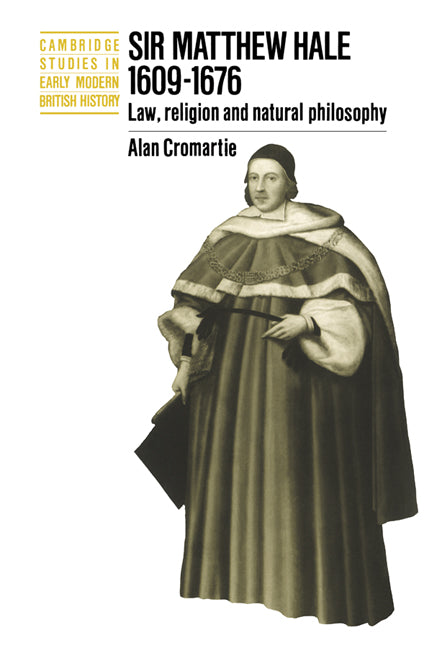
Sir Matthew Hale, 1609–1676
Law, Religion and Natural Philosophy
A survey of the life and work of a great English judge during the Commonwealth and the reign of Charles II.
Alan Cromartie (Author)
9780521450430, Cambridge University Press
Hardback, published 16 March 1995
280 pages
23.6 x 15.7 x 2.5 cm, 0.567 kg
"Alan Cromartie deserves praise and thanks for a book which is well researched, crisply written and full of fascinating insights....certainly essential reading for anyone interested in the history of law and lawyers during the period." Christopher Brooks, The American Journal of Legal History
Sir Matthew Hale (1609–76) was the greatest common lawyer of his age, and the most universally admired. Although he held office under Oliver Cromwell, this barely affected his standing in Restoration times. A study of Hale's life and thought necessarily illuminates the central role of the common law in Stuart politics. This book explains Hale's political ideas, and his subtle understanding of the peculiar character of an 'unwritten' law. It also covers his extensive writings on scientific and religious questions, writings which document a shift from puritan to liberal Protestantism. His acute but equivocal response to the science of Descartes and Boyle reveals a fascinating interplay between his 'latitudinarianism' and the new natural philosophy. The result is a unique case study, and a comprehensive portrait of a seventeenth-century mind.
Introduction: a summary life
Part I. Law: 1. Coke: the appeal to reason
2. Selden: the appeal to contract
3. The rights of the Crown
4. Interregnum
5. Protectorate
6. Restoration: 'the nature of laws'
7. Restoration: constitutional theory
8. Restoration: legal practice
Part II. Religion: 9. Hales's 'puritanism'
10. Hale's 'latitudinarianism'
11. Hale and religious dissent
Part III. Natural Philosophy: 12. Natural motions
13. The Torricellian experiment
14. The soul
Conclusion
Appendix
Bibliography.
Subject Areas: Early modern history: c 1450/1500 to c 1700 [HBLH], British & Irish history [HBJD1]