Special Order - allow 2+ weeks lead
Couldn't load pickup availability
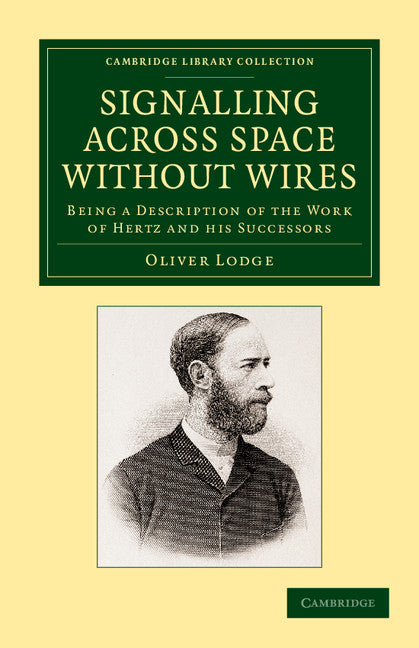
Signalling across Space without Wires
Being a Description of the Work of Hertz and his Successors
Published in 1900, this revised treatise explores the far-reaching effects of Heinrich Hertz's most famous discovery: wireless radio waves.
Oliver Lodge (Author)
9781108052122, Cambridge University Press
Paperback / softback, published 28 March 2013
190 pages, 72 b/w illus.
21.6 x 14 x 1.1 cm, 0.25 kg
The early 1890s saw the development of wireless telegraphy. Although the behaviour of radio waves had been predicted by James Clerk Maxwell, the production of a working coherer occupied some of the greatest practical physicists of the time. A giant in the field was Heinrich Hertz (1857–94), who was among the first to discover that radio waves could travel independently of wires. When Hertz died, his work was continued and soon led to the development of the first wireless radios. This book, published in 1900, is the third edition of Sir Oliver Lodge's popular explanation of Hertz's work. Including the Royal Institution lecture that Lodge (1851–1940) gave in 1894, along with detailed diagrams, it covers the basic principles of radio waves and some of the theory surrounding telegraphic technology. Also included in this reissue is Lodge's 1924 lecture on electrical precipitation, discussing the scintillating possibility of altering atmospheric conditions through the use of electrical charges.
1. Royal Institution lecture on the work of Hertz and some of his successors
2. Application of Hertz waves and coherer signalling to telegraphy
3. Details of other telegraphic developments
4. A history of the coherer principle
5. Communications with respects to coherer phenomena on a large scale
6. Photo-electric researches of Drs. Elster and Geitel
7. Photo-electric researches of Professor Right
Electrical precipitation: a lecture delivered before the Institute of Physics.
Subject Areas: WAP [wireless technology TJKW]