Freshly Printed - allow 7 days lead
Couldn't load pickup availability
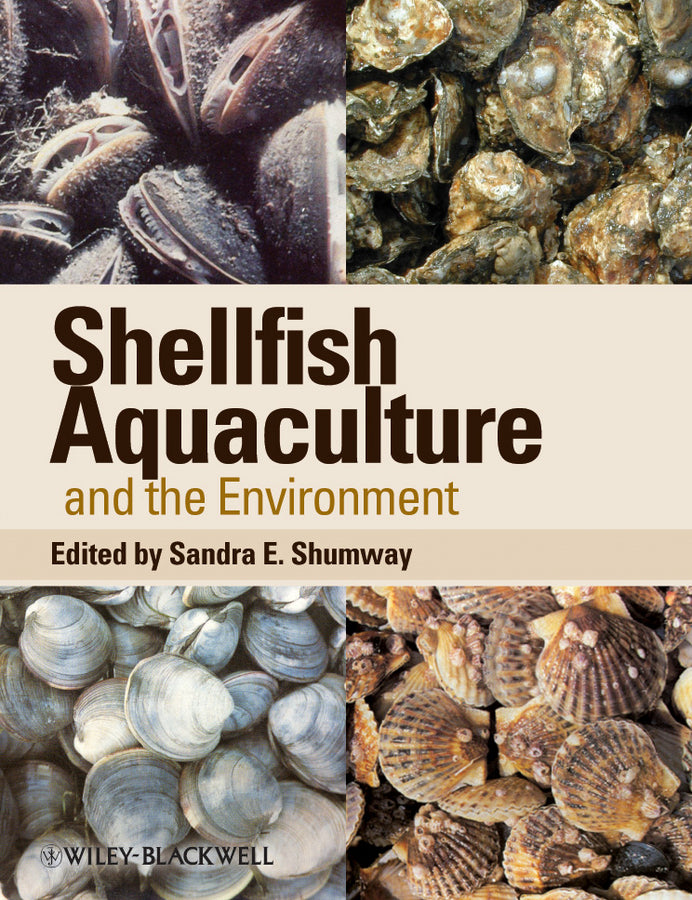
Shellfish Aquaculture and the Environment
Sandra E. Shumway (Edited by), S Shumway (Author)
9780813814131, Wiley
Hardback, published 21 October 2011
526 pages
25.4 x 19.8 x 3.2 cm, 1.424 kg
"While it may be intended for policy makers, and we would all support her in this aim, it will clearly be an essential addition to university libraries, a must-have for shellfish researchers and there could also be good reason for shellfish farmers to think about getting hold of a copy, since it is one way to feel extremely positive about what you do - and supported by real hard science information!." (The Grower, 2011)
Shellfish Aquaculture and the Environment focuses primarily on the issues surrounding environmental sustainability of shellfish aquaculture. The chapters in this book provide readers with the most current data available on topics such as resource enhancement and habitat restoration. Shellfish Aquaculture and the Environment is also an invaluable resource for those looking to develop and implement environmental best management practices. Edited one of the world's leading shellfish researchers and with contributions from around the world, Shellfish Aquaculture and the Environment is the definitive source of information for this increasingly important topic. View the Executive Summary here: http://seagrant.uconn.edu/publications/aquaculture/execsumm.pdf
List of Contributors xi Foreword xiii Preface xv 1 The role of shellfish farms in provision of ecosystem goods and services 3 Introduction 3 Methods of study 6 Ecosystem goods: biomass production 13 Ecosystem services: environmental quality 17 Literature cited 26 2 Shellfish aquaculture and the environment: an industry perspective 33 Introduction 33 Shellfish farmers and harvesters history of water quality protection and stewardship roles 35 BMPs, the shellfish industry, and the role of available research 42 Conclusion 48 Literature cited 48 3 Molluscan shellfish aquaculture and best management practices 51 Introduction 51 Ecosystem change and shellfish aquaculture 53 Classification of impacts 53 BMPs 54 Assurance labeling 64 Pressures to participate in certification programs 65 Perspectives on ecolabeling 67 Aquaculture certification programs 68 Critique of bivalve shellfish ecolabeling efforts in the United States 70 Criticisms of certification programs 73 Towards more meaningful labeling 75 Concluding remarks 77 Literature cited 78 4 Bivalve filter feeding: variability and limits of the aquaculture biofilter 81 Introduction 81 Constraints on maximum feeding activity 82 Shellfi sh feeding in nature 85 Emerging knowledge on ecosystem interactions with the bivalve biofilter 109 Conclusions 111 Literature cited 113 5 Trophic interactions between phytoplankton and bivalve aquaculture 125 The interdependence of bivalves and phytoplankton 125 Bivalve population density: farmed bivalves are naturally gregarious 127 Bivalves as consumers and cultivators of phytoplankton 127 Summary and prospects 130 Acknowledgments 131 Literature cited 131 6 The application of dynamic modeling to prediction of production carrying capacity in shellfish farming 135 Physical oceanographic models 139 Filtration and seston depletion 140 Single-box models 140 Higher-order models 142 Fully spatial models 143 Population-based models 145 Local models 146 Optimization 147 Application to management 148 Modeling environmental impact 149 Sustainability and ecosystem-based management 150 Literature cited 151 7 Bivalve shellfish aquaculture and eutrophication 155 Summary 155 Introduction 156 Most commonly reported: localized changes associated with shellfish aquaculture 158 Interpretations from an ecosystem approach 179 Modeling efforts to assess relationships between bivalve aquaculture and eutrophication 187 Eutrophication of coastal waters from land-based nutrients 192 Ecological and economic benefit of bivalve aquaculture in combating eutrophication 195 Conclusions 200 Literature cited 201 8 Mussel farming as a tool for re-eutrophication of coastal waters: experiences from Sweden 217 Introduction 217 Mussel farming: open landscape feeding in the sea 217 Estimating the environmental value of mussel farming 219 Trading nutrient discharges 222 Agricultural environmental aid program and mussel farming 224 Added ecosystem services through mussel farming 226 The city of lysekil, the first buyer of a nutrient emission quota 226 Swedish mussel farming and its markets 227 Mussel meal instead of fish meal in organic feeds 229 Mussel meal in feeds for organic poultry 230 The use of the mussel remainder as fertilizer and biogas production 232 Risk assessment of mussels for seafood, feed, and fertilizer 233 Conclusions of the Swedish experience 234 Literature cited 235 9 Expanding shellfi sh aquaculture: a review of the ecological services provided by and impacts of native and cultured bivalves in shellfish-dominated ecosystems 239 Introduction 239 Aquaculture-based systems 249 Remaining questions 272 Literature cited 274 10 Bivalves as bioturbators and bioirrigators 297 Bivalves are key species in soft-sediment habitats 297 What are bioturbation and bioirrigation? 298 How do healthy soft-sediment bivalve populations affect their surroundings? 303 Summary 311 Literature cited 312 11 Environmental impacts related to mechanical harvest of cultured shellfish 319 Introduction 319 Literature review 320 Experimental design 329 Conclusions 334 Acknowledgments 335 Literature cited 335 12 Genetics of shellfish on a human-dominated planet 339 Introduction 339 Domestication of shellfish 341 Conservation 347 Conclusions 352 Literature cited 352 13 Shellfish diseases and health management 359 Shellfish health management and infectious disease prevention 359 Interactions of bivalve shellfish and parasites with the natural environment 360 Interactions of hosts and disease agents within the aquaculture environment 367 Solutions: 1. Shellfish aquaculture development and health management 370 Solutions: 2. Implementing health management for shellfi sh aquaculture 377 Summary 385 Literature cited 386 14 Marine invaders and bivalve aquaculture: sources, impacts, and consequences 395 Introduction 395 Introduced shellfish from aquaculture 397 Species moved with aquaculture 406 Introduced species that impact aquaculture 407 Recommendations for minimizing spread and impacts of introductions 412 Future needs 415 Acknowledgments 415 Literature cited 416 15 Balancing economic development and conservation of living marine resources and habitats: the role of resource managers 425 Introduction 425 Regulatory framework for shellfish aquaculture in the United States 429 Environmental best management practices (BMPs) 440 Environmental marketing and other incentive programs 440 Conclusions 442 Literature cited 443 16 Education 447 Skills 447 Aquaculture-related disciplines 449 K-12 education 451 Undergraduate degree programs 452 Graduate degree programs 453 4-H and youth programs 454 Extension programs 455 Technology transfer 457 Conclusion 458 Literature cited 459 17 The implications of global climate change for molluscan aquaculture 461 Introduction 461 Climate change in the oceans and coastal zones 462 The effects of climate change on shellfish aquaculture systems 467 Adapting shellfish farming to climate change impacts 478 Shellfish aquaculture and climate change mitigation 482 Conclusion 484 Acknowledgments 485 Literature cited 485 Index 491
João G. Ferreira, Anthony J.S. Hawkins, and Suzanne B. Bricker
William Dewey, Jonathan P. Davis, and Daniel C. Cheney
John A. Hargreaves
Peter J. Cranford, J. Evan Ward, and Sandra E. Shumway
Gary H. Wikfors
Jon Grant and Ramón Filgueira
JoAnn M. Burkholder and Sandra E. Shumway
Odd Lindahl
Loren D. Coen, Brett R. Dumbauld, and Michael L. Judge
Joanna Norkko and Sandra E. Shumway
Kevin D.E. Stokesbury, Edward P. Baker, Bradley P. Harris, and Robert B. Rheault
Dennis Hedgecock
Ralph A. Elston and Susan E. Ford
Dianna K. Padilla, Michael J. McCann, and Sandra E. Shumway
Tessa L. Getchis and Cori M. Rose
Donald Webster
Edward H. Allison, Marie-Caroline Badjeck, and Kathrin Meinhold
Subject Areas: Agriculture & farming [TV]