Freshly Printed - allow 10 days lead
Couldn't load pickup availability
Shell Money
A Comparative Study
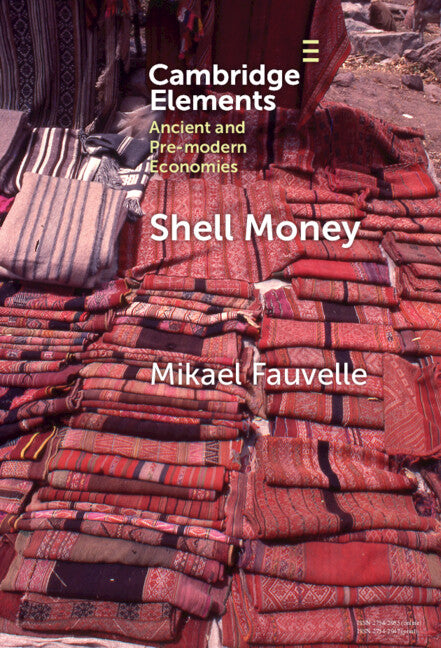
This Element examines the circumstances of how money first emerged through a comparative study of the use of shells.
Mikael Fauvelle (Author)
9781009494434, Cambridge University Press
Hardback, published 21 March 2024
86 pages
23.5 x 16 x 1 cm, 0.276 kg
Where, when, and under what circumstances did money first emerge? This Element examines this question through a comparative study of the use of shells to facilitate trade and exchange in ancient societies around the world. It argues that shell money was a form of social technology that expanded political-economic capacities by enabling long-distance trade across boundaries and between strangers. The Element examines several cases in which shells and shell beads permeated throughout daily life and became central to the economic functioning of the societies that used them. In several of these cases, it argues that shells were used in ways that meet all the standard definitions of modern money. By examining the wide range of uses of shell money in ancient economic systems around the world, this Element explores the diversity of forms that money has taken throughout human history. This title is also available as Open Access on Cambridge Core.
1. What is Money?
2. The Mediterranean, Europe, and the South Pacific
3. North America
4. Cowrie Money in Asia and Africa
5. Conclusions and Future Directions
Acknowledgements
References.
Subject Areas: Archaeology [HD]