Freshly Printed - allow 10 days lead
Couldn't load pickup availability
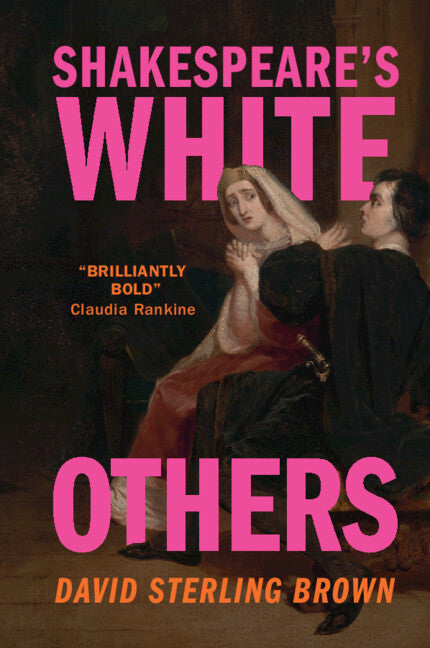
Shakespeare's White Others
Gives readers a sharp new critical understanding of how racial whiteness in Shakespeare begets anti-Blackness and sustains white supremacy.
David Sterling Brown (Author)
9781009384124, Cambridge University Press
Paperback / softback, published 6 March 2025
240 pages
22.9 x 15.2 x 1.3 cm, 0.395 kg
'Anyone with an interest in Shakespeare studies, critical race studies, or the political impact of Shakespearean drama in performance will surely benefit from the analysis on offer … Following in the footsteps of theorists such as W. E. B. Du Bois, Nell Irvin Painter, and Veronica T. Watson, Brown defines whiteness, not as a neutral and inevitable fact of nature, but as an evolving discursive construct with a 2,000-year-old history, deeply rooted in the violence of the transatlantic slave trade, colonial dispossession, and a long legacy of concomitant atrocities … the critical objectives of “Shakespeare's White Others” are inseparable from its emotional and political objectives, and in this respect the work involves an element of vulnerability that one does not typically encounter in Shakespeare criticism or most other forms of academic prose. To Brown's great credit, however, the risk pays off, thanks in large part to an undercurrent of sincerity and personal investment that comes acr
Examining the racially white 'others' whom Shakespeare creates in characters like Richard III, Hamlet and Tamora – figures who are never quite 'white enough' – this bold and compelling work emphasises how such classification perpetuates anti-Blackness and re-affirms white supremacy. David Sterling Brown offers nothing less here than a wholesale deconstruction of whiteness in Shakespeare's plays, arguing that the 'white other' was a racialized category already in formation during the Elizabethan era – and also one to which Shakespeare was himself a crucial contributor. In exploring Shakespeare's determinative role and strategic investment in identity politics (while drawing powerfully on his own life experiences, including adolescence), the author argues that even as Shakespearean theatrical texts functioned as engines of white identity formation, they expose the illusion of white racial solidarity. This essential contribution to Shakespeare studies, critical whiteness studies and critical race studies is an authoritative, urgent dismantling of dramatized racial profiling.
Introduction: Negotiating whiteness
1. Somatic similarity
2. Engendering the fall of white masculinity in Hamlet
3. On the other hand
4. 'Hear me, see me'
Conclusion: Artifactually.
Subject Areas: Literary studies: general [DSB]