Freshly Printed - allow 10 days lead
Couldn't load pickup availability
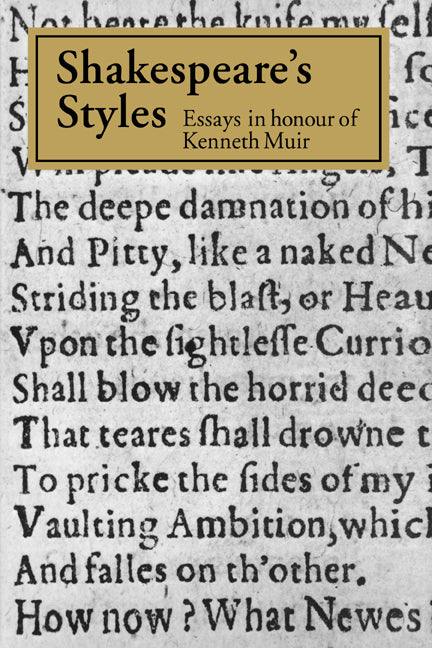
Shakespeare's Styles
Essays in Honour of Kenneth Muir
Shakespeare scholars give an account of particularly important or interesting features of Shakespeare's use of language.
Philip Edwards (Edited by), Inga-Stina Ewbank (Edited by), G. K. Hunter (Edited by)
9780521616942, Cambridge University Press
Paperback / softback, published 16 December 2004
256 pages
23 x 15.5 x 2 cm, 0.4 kg
Although Shakespeare is acknowledged to be one of the greatest masters of language the world has known, there are very few books among the thousands devoted to his work which attempt to deal directly with how he uses language. No single book could deal with the 'infinite variety' of tone, diction, imagery, rhythm, and so on which together make up Shakespeare's different styles. But the editors of this book asked a number of distinguished Shakespearian scholars to give an account of what seemed to him or her some particularly interesting and important feature of Shakespeare's use of language. Using a quotation from Shakespeare as a starting point, some authors have focussed their discussion on individual plays; others have ranged more widely under general headings, such as bombast, rhetoric or paradox. The cumulative effect will enable readers, students and theatre-goers to come to a greater awareness of the richness and subtlety of 'Shakespeare's styles'. The three editors are senior Shakespeare critics and scholars and they have all been close associates of Professor Kenneth Muir. It was to honour the life-long devotion of Kenneth Muir to the study of Shakespeare, and to pay a tribute to the inspiration and help which he has given to those who have worked with him, that his new book was devised.
Preface
1. Rhetoric and insincerity L. C. Knights
2. Some aspects of style in the Henry VI plays Wolfgang Clemen
3. Poem and context in Love's Labour's Lost G. K. Hunter
4. The declaration of love Philip Edwards
5. Juliet's Nurse: the uses of inconsequentiality Stanley Wells
6. Language most shows a man…? Language and speaker in Macbeth Nicholas Brooke
7. Poetic language and dramatic significance in Shakespeare R. A. Foakes
8. Feliciter audax: Antony and Cleopatra, 1,i,1–24 G. R. Hibbard
9. 'My name is Marina': the language of recognition Inga-Stina Ewbank
10. Leontes and the spider: language and speaker in Shakespeare's Last Plays Anne Barton
11. Shakespeare's 'bombast' E. A. J. Honigmann
12. The defence of paradox Geoffrey Bullough
13. 'True, gallant Raleigh': some off-stage conversations in Shakespeare's plays A. C. Sprague
14. Shakespeare's recollections of Marlowe M. C. Bradbrook
15. Shakespeare's Dark Lady: a question of identity S. Schoenbaum
16. Checklist of writings by Kenneth Muir, 1937–1979
Index.
Subject Areas: Literary studies: general [DSB]